


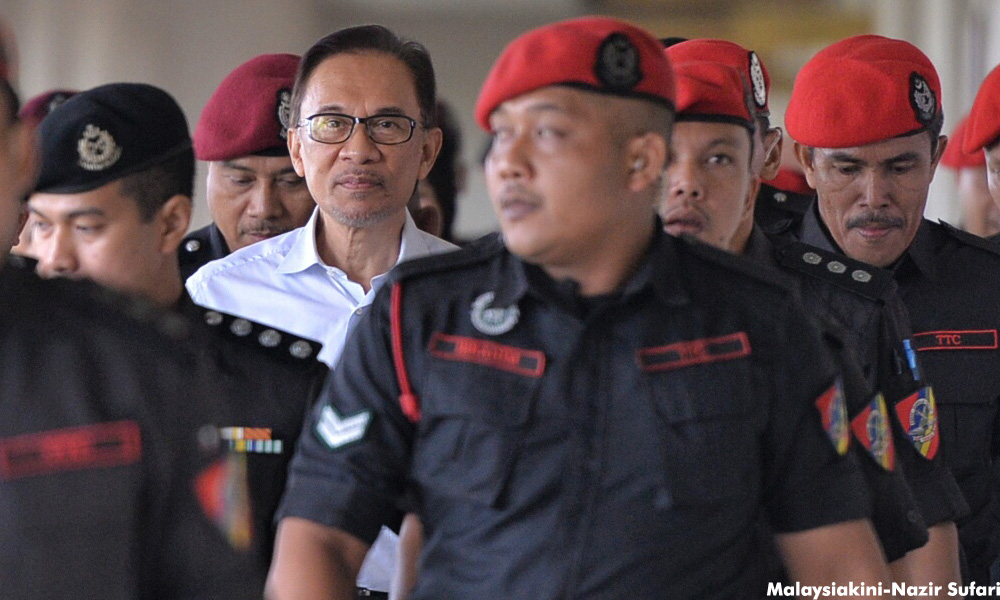

Amnesty: Anwar's continued jailing major blow to M'sia human rights
Amnesty International has called for the "immediate and unconditional release" of jailed former opposition leader Anwar Ibrahim on the second anniversary of his incarceration.
“The ongoing political persecution of Anwar Ibrahim is symbolic of Malaysia’s crackdown on human rights.
"He has unjustifiably spent the past two years behind bars on trumped-up charges intended to silence him and end his political career,” claimed Josef Benedict, Amnesty International’s deputy director for Southeast Asia and the Pacific in a statement today.
Amnesty International has called for the "immediate and unconditional release" of jailed former opposition leader Anwar Ibrahim on the second anniversary of his incarceration.
“The ongoing political persecution of Anwar Ibrahim is symbolic of Malaysia’s crackdown on human rights.
"He has unjustifiably spent the past two years behind bars on trumped-up charges intended to silence him and end his political career,” claimed Josef Benedict, Amnesty International’s deputy director for Southeast Asia and the Pacific in a statement today.
On Feb 10, 2015, Anwar failed at the Federal Court to challenge an earlier Court of Appeal's overturning of his acquittal of his second sodomy charge on March 7, 2014 and was sentenced to five years' jail.
Anwar was initially acquitted on Jan 9, 2012 after the High Court found reasonable doubt to the prosecution’s case.
The PKR de facto leader maintains the charge was politically motivated.
"At the last election, the ruling coalition lost the popular vote but managed to cling on to power," said Benedict.
"Anwar Ibrahim’s five-year imprisonment makes it impossible for him to contest the next general election, due to take place by 2018.
"Anwar Ibrahim’s conviction was a major blow to human rights as the Malaysian government escalated its attacks on civil society," he added.
He cited the clampdown on dissent on civil society pointing to the use of "draconian, colonial-era laws" on Bersih chief Maria Chin Abdullah and cartoonist Zunar.
"This has included the harassment, intimidation, arrest and prosecution of activists who have called for Anwar Ibrahim’s release."
“The longer Anwar Ibrahim and other prisoners of conscience remain behind bars, the clearer it becomes that the government has no interest in upholding its international human rights obligations and commitments and instead wishes to use its power to silence anyone it disagrees with,” he said.
'Jailing arbitrary, said UN'
The International Federation for Human Rights (FIDH) and its member organisation Suaram also joined condemnation of Anwar's continued imprisonment and urged his release.
“Anwar’s imprisonment is the result of a long-standing politically motivated persecution that must end today.
"The only way this ugly stain can be wiped from Malaysia’s human rights record is by immediately releasing Anwar,” said FIDH president Dimitris Christopoulos in a separate joint statement.
The groups noted the UN working group on arbitrary detention (UNWGAD) in an opinion issued on Sept 1, 2015, deemed Anwar’s detention arbitrary.
"The UNWGAD had called for Anwar’s immediate release and for his political rights to be reinstated," said FIDH and Suaram.
“The Malaysian government’s ongoing refusal to implement the UN’s ruling that found Anwar’s detention to be arbitrary is deplorable.
"It’s time for the government to stop ignoring findings from UN human rights mechanisms and immediately release Anwar,” said Suaram executive director Sevan Doraisamy.
The two rights groups said in the meantime, the government should guarantee Anwar his prisoner rights "including the rights to receive adequate medical care in accordance with relevant international standards".
'Halt death penalties'
On another matter Amnesty International congratulated Malaysia on the commutation in Malaysia of the death sentence imposed on Nigerian national Osariakhi Ernest Obayangbon, who was convicted of murder in 2000.
He had been diagnosed as having schizophrenia before his appeal in 2007.
“The organisation encourages the Malaysian government to build on this positive development and immediately establish a moratorium on all executions.
“Further the authorities should commute all other existing death sentences and swiftly reform the country’s death penalty laws as critical steps towards full abolition of this punishment in the country,” said Amnesty.
Amnesty said Obyangbon’s case highlighted “many flaws” associated with the use of the death penalty in Malaysia and in the region.
“These include the use of the mandatory death penalty and use on people with mental disabilities, the wide scope of offences for which this punishment can be imposed - in contravention of international law - and lack of transparency on its use.”
The international rights organisation also urged Malaysia to do more to intervene in cases of Malaysian nationals who are facing the death sentence abroad.
In particular, they cited the cases of S Prabagaran and K Datchinamurthy facing imminent execution in Singapore for drug-related offences, “which do not meet the threshold of the most serious crimes” to warrant the use of the death penalty.
“It is imperative that the Malaysian authorities call for the commutation of their death sentences and support their families.”


Are you sure you want to delete this comment?
This action cannot be undone.