




'Families face financial meltdown when fighting cancer'
When Anne was first diagnosed with Chronic Myeloid Leukaemia (CML), a form of blood cancer, the first thing that went through her mind was her family.
The mother of three girls was concerned about how they would take the news and that of her aging parents.
“I wasn’t worried about my sickness but (I was worried for) my children.
“When I found out this medication is so expensive, it is another big blow (to me), I almost wanted to give up,” the housewife said.
The medication for her condition costs up to a whopping RM110,000 per year, excluding treatment. She has to continue taking the medication for life. The family’s household annual income is only RM72,000.
She declined to be identified because she did not want to worry her family members, who do not know about the financial burden.
Based on previous data on incidences of cancer in Malaysia, it is estimated that about 42,000 Malaysians will be diagnosed with cancer this year, out of which, some 39,000 patients will eventually lose their battle against the disease.
But even if they make it, the cost of fighting cancer can cripple survivors...
When Anne was first diagnosed with Chronic Myeloid Leukaemia (CML), a form of blood cancer, the first thing that went through her mind was her family.
The mother of three girls was concerned about how they would take the news and that of her aging parents.
“I wasn’t worried about my sickness but (I was worried for) my children.
“When I found out this medication is so expensive, it is another big blow (to me), I almost wanted to give up,” the housewife said.
The medication for her condition costs up to a whopping RM110,000 per year, excluding treatment. She has to continue taking the medication for life. The family’s household annual income is only RM72,000.
She declined to be identified because she did not want to worry her family members, who do not know about the financial burden.
Based on previous data on incidences of cancer in Malaysia, it is estimated that about 42,000 Malaysians will be diagnosed with cancer this year, out of which, some 39,000 patients will eventually lose their battle against the disease.
But even if they make it, the cost of fighting cancer can cripple survivors.
The Asean Costs in Oncology Study conducted between 2012-2014 concluded that more than half of patients suffer from financial difficulties a year after diagnosis.
The cost of cancer treatment varies from one type of cancer to the next but Dr Nirmala Bhoo-Pathy, a Universiti Malaya cancer epidemiologist, estimates treatment for breast cancer can cost up to RM395,000 for those seeking private care.
Breast cancer is among the most common type of cancer diagnosed in Malaysia.
Those treated at public hospitals would see a dramatic reduction in costs (up to 70 percent less), but this too, could run into the tens of thousands of ringgit.
Financial meltdown
Due to these high costs, at least one in two Malaysians diagnosed with cancer suffer from "financial meltdown" a year after being diagnosed, a Sydney-based George Institute for Global Health study said.
This means medical costs can exceed a third of the household income, the institute said.
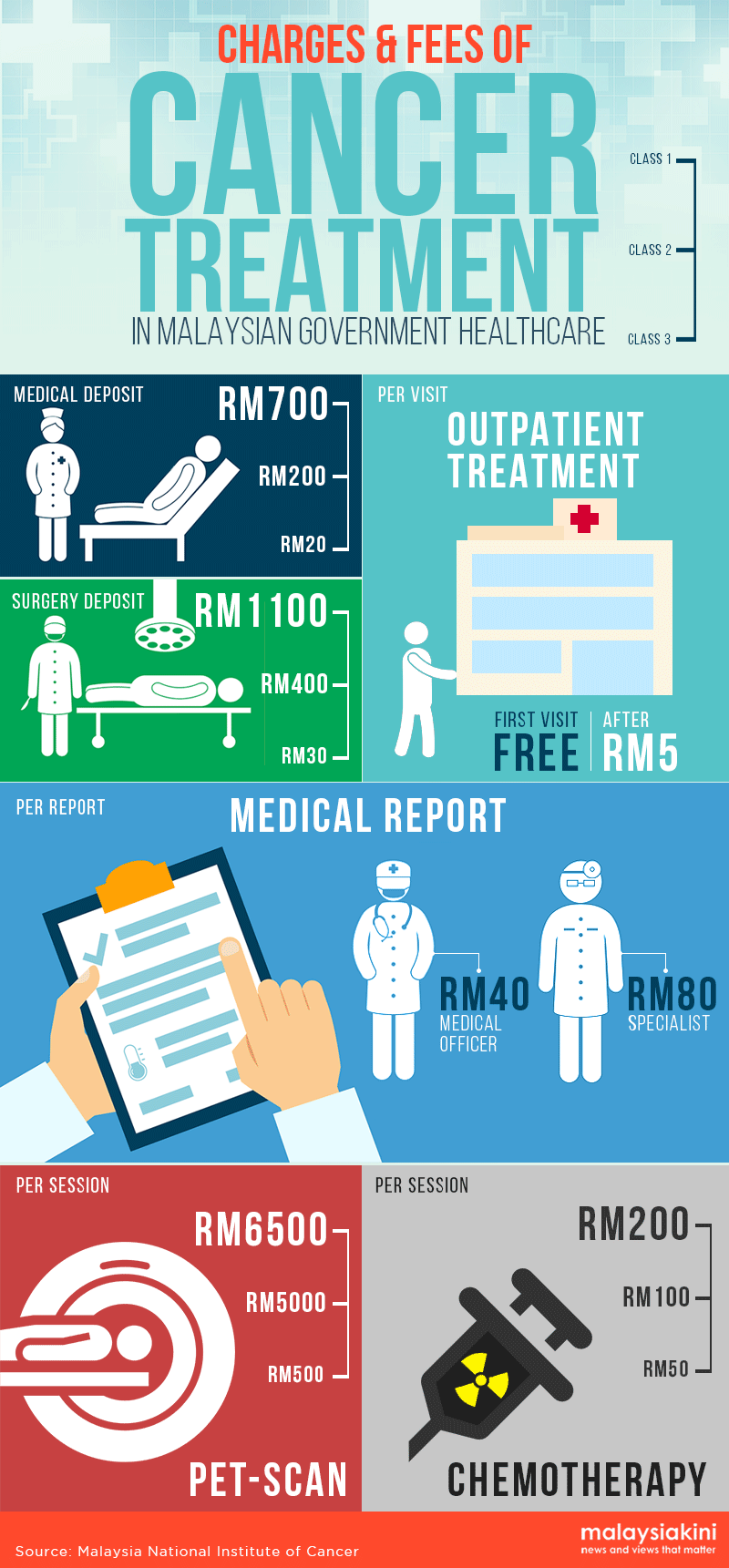 Furthermore, five percent of cancer patients and their families in Southeast Asia can be rendered destitute, a study between March 2012 and September 2013 by Nirmala concluded.
"The scope of cancer care and drugs offered free through the public health services is limited in Malaysia.
"The current system of funding for cancer healthcare needs to be reviewed. The government must increase financial risk protection especially for the poor," she said in her study.
Financial shocks for the poor can create short-term food insecurities and in the long term, it can result in vagrancy, permanent malnutrition, and people leaving school to earn a living, a report by the Malaysian International Islamic University said.
The report added that more than a fifth of the Malaysian public are unable to raise RM10,000 within a short period - a fraction of the cost of treatment for some types of cancer.
Dr Lim Teck Onn, who specialises in the field, believes there is a gap in the policy on cancer in Malaysia.
"There is financial framework for other health conditions, why is there no similar financial support for cancer?
"As a (relatively) developed country, overall under-spending and low funding for cancer healthcare translate into inadequate access to care.
"It is an urgent issue that we need to address immediately," said the one-time World Health Organisation consultant for China.
Expect cost to rise
According to Health director-general Dr Noor Hisham Abdullah, the ministry spent RM240 million on cancer therapy, 10 percent of its total drug budget.
He said cancer patients have access to all medicines listed in a formulary at no charge, but patients are charged RM1 to RM5 for outpatient treatment and ward charges for inpatient treatment.
The ministry also has cooperation with the pharmaceutical industry through Patient Access Schemes and Patient Assisted Programmes.
“These are among measures taken in making these medicines more affordable for MOH (Ministry of Health), thus enabling a greater number of patients to receive these treatments,” he said in a statement in December.
“There is hardly any other country in the world where patients, including those requiring treatment for cancers, can get such access to such services,” he said.
However, he notes not all cancer treatment medications are listed in the formulary and are only available on a “case-to-case” basis.
If the application for the non-formulary medications is unsuccessful, the patient will need to purchase them from private pharmacies out of their own pocket.
“In the absence of government control, manufacturers, distributors and retailers set medicine prices... Malaysia has become a high price island for pharmaceutical prices,” a report by The United Nation’s Intergovernmental Group of Experts (IGE) on Competition Law and Policy said.
The report also said the health minister has not used his power to control the price of medicines in the private sector, which is allowed under the Private Healthcare and Services Act 1998.
“The lack of coherent government policy to regulate medicines prices allowed excessive profits and reduced medicine affordability,” it said.
In the next instalment of this two-part series on the financial costs of cancer, Malaysiakini explores the choice patients have to make between public and private healthcare.


Are you sure you want to delete this comment?
This action cannot be undone.