


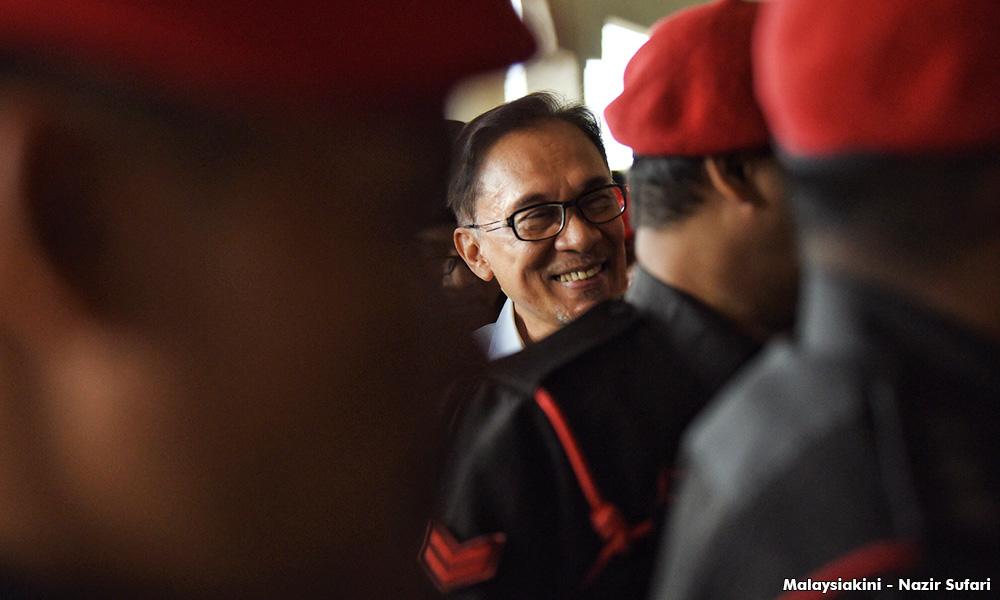

Ruling on physical contact with relatives in prison set for March 7
The issue of whether prisoners can be allowed physical contact with family members will be decided by the Kuala Lumpur High Court on March 7.
Justice Nik Hasmat Nik Mohamad fixed the date after hearing submissions from lawyers representing jailed opposition politician Anwar Ibrahim and the government lawyers representing the prison authority today.
Lawyer N Surendran for Anwar told the court that the politician is only allowed to meet his family members once in three weeks and the matter of being allowed physical contact was at the discretion of the Prisons Department.
The issue of whether prisoners can be allowed physical contact with family members will be decided by the Kuala Lumpur High Court on March 7.
Justice Nik Hasmat Nik Mohamad fixed the date after hearing submissions from lawyers representing jailed opposition politician Anwar Ibrahim and the government lawyers representing the prison authority today.
Lawyer N Surendran for Anwar told the court that the politician is only allowed to meet his family members once in three weeks and the matter of being allowed physical contact was at the discretion of the Prisons Department.
"The family members are only allowed to meet him through a transparent glass with conversation done through the phones there," said the lawyer.
"What if a person is serving a life sentence and during that time the person is not allowed any physical contact with the family?" he asked.
Anwar, 69, his wife Dr Wan Azizah Wan Ismail, their children and grand-children named the Sungai Buloh Prison director, the commissioner general of Prisons and Home Ministry as respondents.
They are seeking a certiorari to quash the decision of the Prisons Department in a letter dated March 14 last year, in not allowing physical contact, and a mandamus order to compel the prison authorities to allow physical contact.
Surendran said the Prisons Act was silent regarding physical contact and claimed that not allowing such contact with prisoners was unconstitutional as it violated Article 5 regarding Liberty of a Person, and Article 8 regarding equality.
The lawyer further cited English and Indian case laws which are more liberal in their interpretation, recognising such wide range of rights to include socialising with family members.
He added that in UK, while a prisoner cannot move freely, they are allowed certain rights.
“We are challenging the constitutionality of Prison Rules in not allowing physical contact. Denying physical contact is more than necessary ro achieve the aims of judicial punishment,” said Surendran.
He added that Anwar's family members were only allowed physical contact in the final five minutes of some of their prison visits, as the prison authorities gave it arbitrarily.
“The five-minute physical contact is insufficient,” he added.
Surendran emphasised that the denial of physical contact and the prison rules which provide for such denial are subject to judicial review as the court certainly has the right to challenge the constitutionality of prison rules.
Seven times Anwar allowed physical contact
Meanwhile, senior federal counsel Shamsul Bolhassan, who was representing the respondents, told the court that prisoners should not be given special privileges as they are inmates and should be subject to discipline.
“There is no breach of Article 5 or 8. They can make an application and it will be considered,” he said.
The senior federal counsel further cited Regulation 3 (1) (a) where discipline and order shall be maintained at prison. He further said the court can intervene in a decision if it found that the authority did not properly exercise its discretion.
Shamsul added in Anwar's case, the prison authorities had allowed physical contact on seven occasions with his family members last year.
This, Shamsul said did not include the number of times Anwar's family members were allowed to meet him and have physical contact with him during court proceedings.
Surendran in his reply said they are not seeking privileges or treatment of Anwar, as he is not asking for special privileges but a fundamental right to be allowed physical contact.
Justice Nik Hasmat recognised the gravity of the decision which she would make in this case affects other inmates as well.
She also allowed Anwar to speak before adjourning the case, where the politician said he is not seeking this matter for himself but also 6,000 inmates.
Anwar said he appreciated how difficult it could be but felt time should be given to allow inmates to have physical contact as this was for their welfare.
He further cited an example in Indonesia where prisoners are allowed physical contact except for those who are found guilty of terrorism and hardcore criminals.
“All prisoners have the right for a contact visit,” he said.


Are you sure you want to delete this comment?
This action cannot be undone.