




Tear down trade barriers, Pak Lah tells Muslim nations
Prime Minister Abdullah Ahmad Badawi today urged Muslim nations to tear down tariff barriers and move towards forming an Islamic common market.
Speaking to economic and finance ministers from the world's biggest Muslim bloc, the Organisation of the Islamic Conference (OIC), Abdullah said there was an urgent need to foster the economic development of the Muslim world.
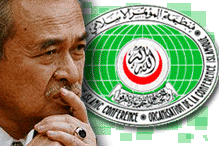 "We should actively promote and integrate markets and reduce tariffs as well as non-tariff barriers," he said.
"This can be done by promoting FTAs (free-trade agreements) among member countries while working towards an Islamic common market."
Abdullah lamented the absence of strong economic links among the 57-member
"In the past, trade was a strong bond for Muslim communities ... Today, this bond has become very weak," he said in an opening address to a two-day meeting of the Islamic Development Bank (IDB), the lending arm of the OIC.
"We do not trade with each other as much as we used to do during the peak of our civilisation."
The premier said intra-OIC trade was only 12 percent of the total trade of OIC countries. Combined, they only represented 7.0 percent of global trade despite the fact they possess 60 percent of the world's natural resources.
Highlighting their wealth, he said that 10 of the 11 members of the powerful Organisation of Petroleum Exporting Countries (Opec) are OIC members, with the exception being Venezuela.
As the current chair of the OIC, Malaysia has been pushing for closer economic integration in the grouping and for member nations to develop trade links and bolster their Islamic finance sectors.
It announced earlier this week that in the first step of the process, 14 OIC members had agreed to join a preferential trading system and that the others were expected to sign up once it is in place, probably by year's end.
Under the system, countries will reduce tariffs on 7.0 percent of product lines in a gradual three-stage process, while there will also be fast-track mechanisms, officials said.
US$10 billion bond issue
Abdullah said that apart from raising money from financial markets to help economic development, the IDB could look at indigenous sources of funding in member countries.
"This is important as the financing needs are large and cannot be satisfied through conventional means," he said.
"For infrastructure financing alone, it is estimated that the IDB members will require about US$741 billion over the next 10 years."
The premier suggested that the IDB establish an OIC infrastructure bond fund to which the central banks of OIC countries could contribute, with the proceeds to be used for major projects in member nations.
Second finance minister Nor Mohamed Yakcop later gave more details on the plan, saying Malaysia would push for a US$10 billion bond issue to be used to fund infrastructure projects in OIC countries.
"A sum of US$10 billion will be a decent amount to look forward to. I am sure the infrastructure bond will receive a good response," he told reporters.
"The priority should be for infrastructure projects since the economic spin-offs are huge," he said.
Nor Mohamed also insisted that the proposed common market was a long-term plan and was not going to become a trade block.
"It is a long-term objective and ... will not be exclusive of other groups," he said.


Are you sure you want to delete this comment?
This action cannot be undone.