


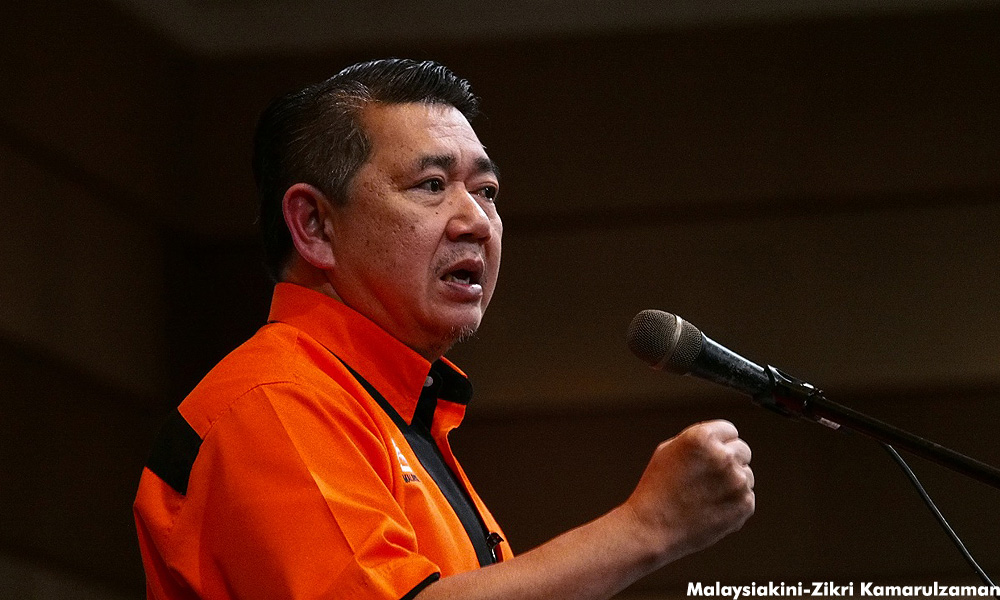

Amanah proposes impeachment law to check PM, cabinet
Parti Amanah Negara has proposed the introduction of impeachment law in Malaysia to check the powers of the prime minister and his cabinet.
Amanah deputy president Salahuddin Ayub said such procedures were proven effective, and cited the US and South Korea as good examples.
"The provision allowing executive power to be challenged is feared by presidents embroiled in corruption and criminal scandals as well as administrative wrongdoing," he said in a statement today.
Salahuddin suggested that the Federal Constitution or the Dewan Rakyat standing orders be amended to allow for impeachment procedures.
He called on legal experts, judges and academicians to provide feedback on how the practice can be introduced in Malaysia.
Parti Amanah Negara has proposed the introduction of impeachment law in Malaysia to check the powers of the prime minister and his cabinet.
Amanah deputy president Salahuddin Ayub said such procedures were proven effective, and cited the US and South Korea as good examples.
"The provision allowing executive power to be challenged is feared by presidents embroiled in corruption and criminal scandals as well as administrative wrongdoing," he said in a statement today.
Salahuddin suggested that the Federal Constitution or the Dewan Rakyat standing orders be amended to allow for impeachment procedures.
He called on legal experts, judges and academicians to provide feedback on how the practice can be introduced in Malaysia.
Impeachment procedures are common in countries practising the presidential system.
In Malaysia, a prime minister can be removed through a vote of no-confidence, which requires two-thirds majority.
Malaysia's vote of no-confidence differs from the US' impeachment procedures in that it only seeks to remove the prime minister while the US system allows the legislature to conduct a trial and convict the president of a crime.
In the US, the House of Representatives can commence impeachment proceedings with a simple majority vote.
The matter will then be brought to the Senate, which will conduct a trial where witnesses can be called and cross-examinations held.
The Senate will require two-thirds majority to convict a president of a crime and complete the impeachment process.
The courts also cannot overturn the decision.


