




Panel: Be realistic about changes in PAS
While the young Turks in PAS may have gained the upper hand during the recent polls, the party will remain close to its core values. Therefore, any expectation of an immediate "liberalised" PAS is unrealistic, according to political observers.
While the young Turks in PAS may have gained the upper hand during the recent polls, the party will remain close to its core values. Therefore, any expectation of an immediate "liberalised" PAS is unrealistic, according to political observers.
Three panelists came to this conclusion at a talk organised by the Youth section of the Selangor Chinese Assembly Hall last night. Themed 'Interpret PAS' New Face', it was moderated by social commentator Chong Teck Peng.
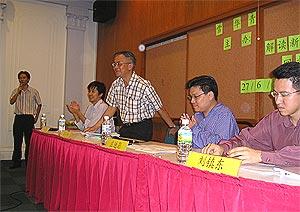 About 50 people, mainly university students, attended the talk which was organised to analyse the prospects for PAS after its recent polls.
They were political analyst Liew Chin Tong who has an interest in PAS; Parti Keadilan Rakyat information bureau chief Tian Chua; and Hu Pang Chaw, a member of the international investment and special relationships committee of the PAS-led Kelantan government.
Liew said Nasharuddin Mat Isa was rumoured to have won the deputy president's post by only 11 votes, indicating a serious rift between the ulama and professionals in the party.
Although PAS has said it will implement a two-tier strategy for its Islamic state policy - targeting Malay-dominated states - this will not see core values being dropped, he said.
"We cannot expect PAS to change immediately. The best it can do is to converge to a parliamentarian party which believes in constitutionalism, like the conservative Christian Democrats (in Germany)," he said.
Chua meanwhile argued that non-Muslims should welcome the changes in PAS instead of viewing this transition in leadership as merely cosmetic in nature.
"Otherwise PAS might return to its old ways and continue to be a sidelined as a conservative opposition party," he noted.
Rise and fall of PAS
Tracing the party's history, Liew pointed out that PAS was a left-leaning, pan-Islamist opposition party in the 1950s and 1960s that could only survive in rural states like Kelantan and Terengganu.
The sacking of then deputy premier Anwar Ibrahim in 1998 saw PAS membership shoot up from 400,000 to 800,000. At the same time, the change in profile of the party membership began to influence the alteration of PAS' position.
After its commendable showing in the 1999 general election, PAS suddenly become the largest opposition party and a threat to Umno.
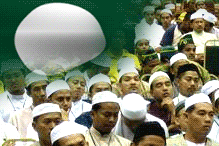 Since then, however, other voices have emerged within the party to suggest that PAS should adopt a more general agenda in order to soften its Islamist image, and thereby attract more young voters and non-Muslims.
Liew said the contradiction between old leadership and young Turks is best demonstrated in the two internal documents drawn up in 2003 on the party's concept of the Islamic state.
The first, entitled 'PAS Memorandum to Malaysians', was prepared by a committee comprising the late party president Fadzil Noor, Nasharuddin, Dr Syed Azman Syed Ahmad Nawawi, Kamaruddin Jaafar, Dr Mohd Hatta Ramli and Dr Zuklifli Ahmad.
The second was drafted by deputy mursyidul am and information chief Haron Din and was entitled 'The Islamic State Document'.
The first document, which was not made public, did not refer to the term 'Islamic state', but stressed a modern Islamic way of ruling a multi-ethnic country.
The second, which was presented to the public as the party's official document, clearly stated that the Islamic state would implement Islamic law and systems.
Changes will take time
 Chua said he sees the changes in the PAS leadership as a move to regain influence under current limitations and as an attempt to open up new possibilities.
He agreed with Nasharuddin's recent remarks that the election was a contest between generations, not between the ulama or non-ulama factions in the party. The majority of the young leaders belong to the post-Mahathir (Mohamad) generation whose positions were reinforced during the Anwar episode.
Chua said PAS' concept of the Islamic state was inspired by the Iranian Revolution in the 1980s, when it aspired to become a mass Islamic movement.
The use of conservative ideology was also a way of sustaining its influence in rural areas when Mahathir came to power in 1982 and improved the economic status of Malays as well as strengthened Umno's domination.
Since the 1999 general election, PAS has been torn between its conservative and liberal wings as it tried to formulate a concerted strategy to improve its electoral standing.
After being thumped in 2004, however, the young Turks have won the opportunity to rejuvenate PAS - again targeted at regaining its political standing.
Hu said the new leadership will not be able to change PAS overnight because it will be guided by the party constitution which focuses on Islamic values. However, he claimed that PAS policies in Kelantan have never discriminated against non-Muslims in the state.
Seven of the 11 appointed exco members have a professional background, which enables the state government to focus on Kelantan's economic development. A Singaporean economist has been appointed as advisor, to attract more investments from China.
Hu pointed out that the largest Buddhist monument in the country is located in Kelantan, while the state governnment has donated 1,100 ha of land to a private Chinese secondary school.
"PAS also wants to launch a Mandarin version of Harakahdaily. Umno has done nothing like this...PAS is more democratic and open-minded than Umno," he said.
Hu added that public perceptions of PAS have been affected by unfair treatment of the party by the mainstream media, calling for credit to be given to the party for trying to be more receptive to change.


