



Ex-UN commissioner: Unlike South Africa, M’sia judiciary not free
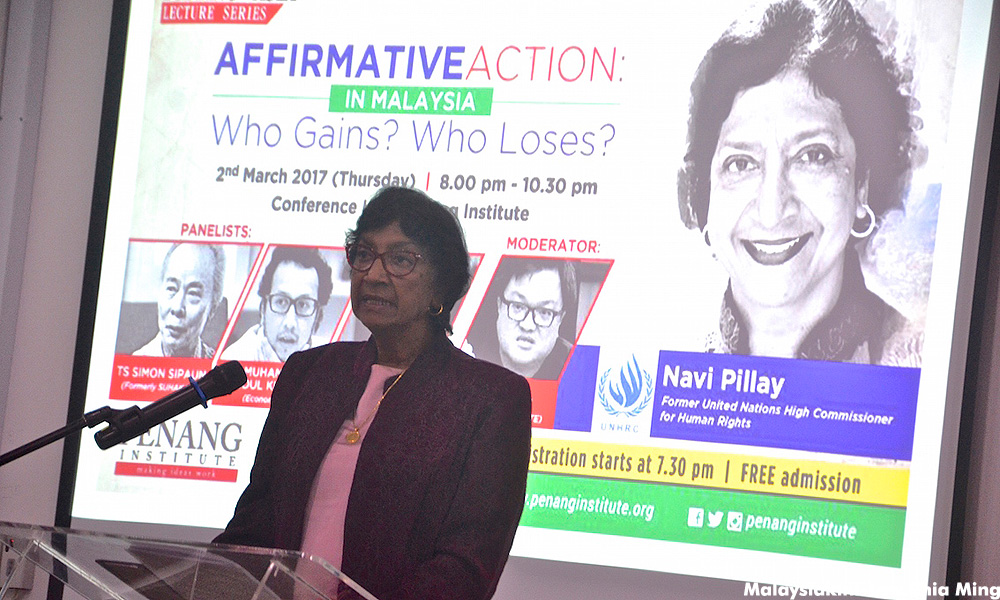
The key difference between Malaysia and South Africa is that the former does not have an independent judiciary which could resolve issues of racial discrimination in the country, said former United Nations Human Rights Commissioner Navi Pillay.
“Your judicious decisions are circumscribed by Parliament, I never heard of such a thing,” she said, to loud cheers from the 80-odd crowd at a forum organised by Penang Institute last night.
“Our (South African) constitutional courts, every one of them, the high court, and the appeal court, are very firm; they are there to ensure the rule of law prevails,” she said...
The key difference between Malaysia and South Africa is that the former does not have an independent judiciary which could resolve issues of racial discrimination in the country, said former United Nations Human Rights Commissioner Navi Pillay.
“Your judicious decisions are circumscribed by Parliament, I never heard of such a thing,” she said, to loud cheers from the 80-odd crowd at a forum organised by Penang Institute last night.
“Our (South African) constitutional courts, every one of them, the high court, and the appeal court, are very firm; they are there to ensure the rule of law prevails,” she said.
Pillay said in South Africa, where she serves as a judge, there have been instances where the Constitutional Court had annulled the decisions of the government because they were unconstitutional.
She said the country’s Parliament exercises an oversight over the executive as that is the responsibility of parliamentarians according to the constitution.
Recently, the Constitutional Court ordered President Jacob Zuma to revoke an application he had filed to withdraw South Africa from the International Criminal Court.
“The court said that the president should have consulted Parliament first, and to look at the laws implemented to allow that,” Pillay said.
“That’s the value of an independent judiciary, because it can render justice to all complaints (on racial discrimination in Malaysia) that I am hearing today,” she said.
'UN convention not ratified'
Pillay was speaking at the event 'Affirmative Action: Who Gains? Who Loses?', moderated by Penang Institute research fellow Wong Chin Huat.
During her speech, she reminded that Malaysia has yet to ratify the UN international convention on the elimination of racial discrimination (ICERD), which has been signed by 88 states.
Former Suhakam commissioner Simon Sipaun, economist Muhammed Abdul Khalid, Institute for Democracy and Economic Affairs chief executive Wan Saiful Wan Jan also spoke at the three-hour event.
Chief Minister Lim Guan Eng gave the opening speech, saying, “We are sick of egregious corruption or crony capitalism disguised as affirmative action.
“We want affirmative action to work, not to be abused. We want it to empower, not control citizens.
“We need a new lens that is free from our communal bias; we need the language of human rights to articulate and frame issues related to affirmative action, to break free from a communal paradigm,” he said.
Taking his turn, Wan Saiful said affirmative action is “morally wrong”, no matter what data is presented to justify it.
He said such policies are still wrong although it is claimed to be right according to the constitution.
“Even if you present the strongest of data, discrimination is wrong, and morally, it must be rejected,” said Wan Saiful.
He explained, saying the discriminatory policy is like “legalising robbery”, giving an example.
“We have a poor and rich person, and to resolve the inequality, the poor one can rob the rich, as long as there is enough to equalise the two,” he said.
Wan Saiful said even if affirmative action works, it is still discrimination.
“Discrimination is discrimination; we must not accept excuses to accept discrimination.”
He noticed the nation is divided now more than ever, and he cannot see a future where policies are decided based on needs and not race.
“Any one politician who wants to change the narrative will lose,” he said.
'Affirmative action still needed'
Muhammed begged to differ, reiterating that affirmative action policies are not morally wrong as long as there are poor and disadvantaged people in society.
He pointed out that the children of the Orang Asli in Gua Musang, Kelantan, who are deprived of land, cannot be equal with children from other states.
“It is morally wrong not to acknowledge this, it is morally wrong when the middle class take advantage of the situation,” said the author of the popular book ‘Colours of Inequality’.
He has conducted a study to see how many rich children get scholarships from JPA and MARA, admitting, “The numbers are quite sizeable.”
“Why should the Malay middle class deserve a place in MRSM? That is morally wrong,” said Muhammed, who coauthored the inaugural UN development programme’s Malaysia human development report.
Despite incidents of discrimination, Muhammed said the government needs to make affirmative action policies stronger in order to make them better as “we are a caring society”.
He said there will be times when policies are made based on race, gender, age, and not on income or needs.
“For example, we would surely want to take in more non-Malays into the public sector as the group that is lacking there are the non-Malays,” said Muhammed, who was head of economics at the Securities Commission and senior analyst at ISIS Malaysia.
“What about other minorities? The migrants or the indigenous groups? There are still disadvantaged groups who need help.”
‘Policy created by majority’
Sipaun meanwhile said the affirmative action policy was created by the majority race, the Malays, who control political power, parliament, “everything and anything associated with the government”.
He said the country's affirmative action policy has made a big difference in the lives of many Malays, especially the “well-connected Malay elite”.
The New Economic Policy (NEP) was introduced in 1971 after the May 13, 1969 racial riots, and was supposed to promote unity and harmony.
It was planned to end in 1990, but the objectives remain elusive until today, open ended and there is no time frame for its end, said Sipaun.
The former Sabah state secretary said the policy has come to be known as the 'Never Ending Policy'.
“Because it is based on race and religion, and not needs-based, it is not conducive for Malaysia and has become a dividing instead of a unifying factor,” said the director of Center to Combat Corruption and Cronyism.
“Since it benefits only the majority and (those of a) particular race and religion, yet involving public funds, it is also known as ‘robbing Peter to pay Paul’.”


Report this comment
Are you sure you want to delete this comment?
This action cannot be undone.