
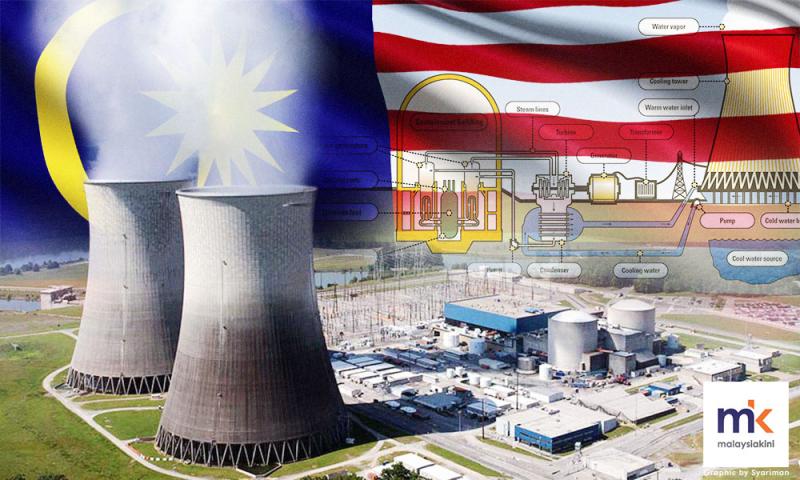
The Pakatan Harapan coalition has opposed the government’s plans to set up a nuclear power infrastructure in Malaysia, saying that it is too risky and costly.

In addition, it said, the government has a poor track record when it comes to mega-projects, such as the Sultan Mizan Zainal Abidin Stadium that collapsed in 2009 and again in 2013.

“We are concerned that such tragedy would repeat itself if there are mistakes or negligence during construction and operation, in addition to the risk of graft,” PKR’s Kuantan MP Fuziah Salleh, Amanah central committee member Dr Dzulkefly Ahmad and DAP’s Klang MP Charles Santiago said in a joint statement today.

They were responding to thge announcement by Minister in the Prime Minister’s Department, Nancy Shukri, on Tuesday that a International Atomic Energy Agency (IAEA) report had concluded that Malaysia has the knowledge base to make an informed decision about introducing nuclear power in the country.

The report on the Integrated Nuclear Infrastructure Review (INIR) Mission Phase 1 is the first of a three-part assessment by the IAEA to determine whether a country has the necessary infrastructure to develop a nuclear power programme.

Its findings are to be tabled in the cabinet next week, and Malaysia has a 30-day period to respond to the IAEA’s recommendations.

However, the Harapan leaders said, the government should instead intensify the research and application of green and renewable energy sources, instead of pursuing nuclear power.

These include solar energy, since Malaysia receives plenty of sunlight year-round, they said, as well as wave energy that was once experimented by local universities.

Malaysia also has other options such as biomass, which would reduce problems in solid waste disposal, or to connect the hydroelectric power generated at Bakun Dam in Sarawak with Peninsular Malaysia, via an undersea cable, they said.

Germany adopting wind power instead

Quoting the then energy, green technology and water minister Peter Chin from the Hansard, they said an analysis had found that the undersea power cable would be a cheaper means to supply electricity, in the long run, than coal or gas-fired power plants, which means it would certainly be cheaper than nuclear power.

“The statement by the minister in the Prime Minister’s Department (Nancy) is disappointing to the people. It invites debate that must be informed by the latest scientific knowledge together with horrifying nuclear tragedies of the past.

“The supply of electricity from the Bakun hydroelectric project in Sarawak to Peninsular Malaysia via undersea cable is vital in ensuring an electricity supply that is sufficient, reliable and at reasonable cost to consumers in Peninsular Malaysia,” they added.

In contrast, they pointed that Malaysia’s move towards nuclear power seemed regressive, at a time when several countries, including Germany, have shifted away from nuclear power and are adopting wind power instead, following the March 2011 Fukushima Daiichi nuclear disaster.

Although Malaysia is not in an earthquake-prone region, Harapan claimed that this has changed following the earthquakes at Mount Kinabalu.

As for cost, Harapan quoted a US-based non-profit group Union of Concerned Scientists report that the cost of building and maintaining a nuclear power generator is very high - between US$2 billion and US$4 billion, and in some cases exceeding US$9 billion.

The cost per unit of electricity is also higher, if compared with other sources.

“Pakatan Harapan is concerned that such high costs would ultimately be borne by the rakyat when the prices of various goods increase as a result of a domino effect, whereas the people are already saddled with increasing costs of living,” the Harapan leaders added.