
How can EC lawfully take Selangor out of Malaya?
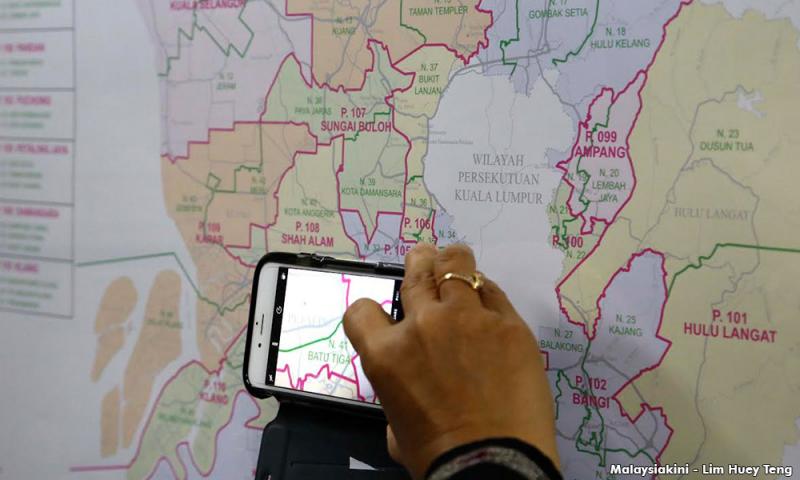
COMMENT The Election Commission’s (EC) move to proceed with its redelineation exercise in the “States of Malaya” by blatantly taking out Selangor where it faces an embarrassing suit is not only unconventional, but unconstitutional.
It is unconstitutional because the States of Malaya are always in one entity in constituency redelineation. Never in our constitutional history any of the states of Malaya was treated as equal to the states of Sabah, Sarawak and once, Singapore.
Before the formation of Malaysia, redelineation was designed to be a single process which would allocate federal constituencies to the state proportionally and then delimit each state proportionally into federal and state constituencies.
With Malaysia coming into existence, Article 113(6) was added to the Federal Constitution and it read,
There shall be separate reviews under Clause (2) for the States of Malaya, for each of the Borneo States and for the State of Singapore, and for the purposes of this Part the expression “unit of review” shall mean, for federal constituencies, the area under review and, for State constituencies, the State.
Today it reads,
There shall be separate reviews under Clause (2) for the States of Malaya and for each of the States of Sabah and Sarawak, and for the purposes of this Part the expression “unit of review” shall mean, for federal constituencies, the area under review and, for State constituencies, the State and the expression “States of Malaya” shall include the Federal Territories of Kuala Lumpur, Labuan and Putrajaya.
The creation of separate units of review corresponded with the disproportional allocation of federal seats between Malaya, Sabah, Sarawak and Singapore. This is related to the “approximately equal” apportionment demanded by sub-section 2(c) of the Thirteenth Schedule.
Today, such “approximately equal” apportionment applies on constituencies within the same state. Before the 1973 constitutional amendment, it was meant to apply on constituencies within the entire unit of review. For Sabah and Sarawak, “unit of review” and “state” are the same thing. For Malaya, “unit of review” means one single system while “state” means 11 systems...
COMMENT The Election Commission’s (EC) move to proceed with its redelineation exercise in the “States of Malaya” by blatantly taking out Selangor where it faces an embarrassing suit is not only unconventional, but unconstitutional.
It is unconstitutional because the States of Malaya are always in one entity in constituency redelineation. Never in our constitutional history any of the states of Malaya was treated as equal to the states of Sabah, Sarawak and once, Singapore.
Before the formation of Malaysia, redelineation was designed to be a single process which would allocate federal constituencies to the state proportionally and then delimit each state proportionally into federal and state constituencies.
With Malaysia coming into existence, Article 113(6) was added to the Federal Constitution and it read,
There shall be separate reviews under Clause (2) for the States of Malaya, for each of the Borneo States and for the State of Singapore, and for the purposes of this Part the expression “unit of review” shall mean, for federal constituencies, the area under review and, for State constituencies, the State.
Today it reads,
There shall be separate reviews under Clause (2) for the States of Malaya and for each of the States of Sabah and Sarawak, and for the purposes of this Part the expression “unit of review” shall mean, for federal constituencies, the area under review and, for State constituencies, the State and the expression “States of Malaya” shall include the Federal Territories of Kuala Lumpur, Labuan and Putrajaya.
The creation of separate units of review corresponded with the disproportional allocation of federal seats between Malaya, Sabah, Sarawak and Singapore. This is related to the “approximately equal” apportionment demanded by sub-section 2(c) of the Thirteenth Schedule.
Today, such “approximately equal” apportionment applies on constituencies within the same state. Before the 1973 constitutional amendment, it was meant to apply on constituencies within the entire unit of review. For Sabah and Sarawak, “unit of review” and “state” are the same thing. For Malaya, “unit of review” means one single system while “state” means 11 systems.
Intended as single unit
That the 1973 constitutional amendment retained “the states of Malaya” and not replaced it with “each of the Malayan states” means that Malaya was intended to be kept as a single unit, more than just as a collective for apportionment.
In other words, “the states of Malaya” are considered to be not only distinctly different from Sabah and Sarawak, but also homogenous enough amongst themselves that redelineation should be done collectively.
Nothing has changed since 1973. For every delineation exercise carried out in the states of Malaya since then, 1974, 1984, 1994, 2003 and even 2016 until its first display, all states of Malaya (including the Federal Territories of Kuala Lumpur, Labuan and Putrajaya) were considered together for redelineation proposal.
Can the EC choose to not redelineate any state? Yes, the Thirteenth Schedule provides for such option in sub-section 4(a) on the need for the EC to publish its notice:
(a) the effect of their proposed recommendations, and (except in a case where they propose to recommend that no alteration be made in respect of the constituency) that a copy of their recommendations is open to inspection at a specified place within the constituency;
But “[recommending] no alteration” is not exclusion from its recommendation. In the current redelineation exercise for the States of Malaya, the EC has recommended in its first proposal no alteration for the state of Perlis, which is then excluded from changes in its second proposal.
This is completely different from Selangor which the EC has recommended drastic and controversial changes. As Article 113(2)(i) of the Federal Constitution stipulates that,
… the Election Commission shall, from time to time, as they deem necessary, review the division of the Federation and the States into constituencies and recommend such changes therein as they may think necessary in order to comply with the provisions contained in the Thirteenth Schedule;…
that the EC has made those recommendations in Selangor means that the EC acknowledges there are instances of constitutional non-compliance in the current boundaries. How can the EC act now as if these instances of constitutional non-compliance suddenly just do not exist?
Power to rush through
The EC, and the Attorney-General’s (AG) Chambers which has to have advised the EC on the matter, have offered no constitutional grounds, in the notice of its second proposal or elsewhere, why Selangor is excluded. These two bodies act as if they are above the Federal Constitution.
While the justification is missing, the motive for the exclusion of Selangor is crystal clear. It is to avoid the ongoing judicial review on the EC’s redelineation proposal for Selangor from slowing down the process and obstructing the use of new boundaries in the upcoming general elections.
This produces another ground of unconstitutionality.
A review under Article 113(2)(i) “shall be completed within a period of not more than two years from the date of its commencement”, stipulates paragraph (iii) of the same clause.
The two-year limit, from the publication of its first notice to the submission of its report to the prime minister, applies on the entire unit of review.
It serves not only to ensure the electoral rolls used will not grow too outdated, but also to give sufficient time to achieve the best outcome for the entire unit of review.
If some parts of a unit of review can be excluded exactly because the flaws are exposed and proper remedies are required, the two-year limit is virtually non-existent.
The EC is then given the power to rush through redelineation for any part that is not effectively challenged, without having applied whatever lessons of improvement from those parts effectively challenged.
Implications on future
What happens if Selangor eventually wins its case and has the first notice quashed? What happens if the EC fails to submit its recommendations to the prime minister before the Sept 14, 2018 deadline even if it eventually gets to resume the exercise?
In either case, if the EC is to restart the redelineation exercise for Selangor, it must use the latest electoral rolls, which cannot be those gazetted on May 13, 2016 (to be read together with those dated Sept 6, 2016) as currently used by other states of Malaya.
How can then a unit of review have its constituencies redelineated using different “current electoral rolls” (as stipulated by Section 3 of the Thirteenth Schedule)?
Further, Article 113(2)(ii) stipulates that
“There shall be an interval of not less than eight years between the date of completion of one review, and the date of commencement of the next review, under this Clause”.
If different parts of a unit of review have their redelineation completed at different dates, these different parts will qualify for future reviews on different dates too. This effectively breaks up the unit of review not only for the present exercise, but also for the future cycles.
If the EC’s “excluding Selangor” proposal can be allowed to proceed, two provisions in the constitution will be materially jeopardised: first, “the States of Malaya” as a unit of review [Article 113(6)]; and, second, the two-year limit within which a review must be completed [Article 113(2)(iii)].
What mandate and from where the EC has got to jeopardise them? Who gives it the power to effectively amend the federal constitution, which is the prerogative of the Parliament?
These are questions that all Malaysians especially parliamentarians must demand from, not only the EC and its chairman Mohd Hashim Abdullah, but also from AG Mohamed Apandi Ali and his federal counsels who advise the EC and will be defending it when this move is challenged in court.
WONG CHIN HUAT is a research fellow with Penang Institute, the state government think-tank on public policy.


Are you sure you want to delete this comment?
This action cannot be undone.