



Challenges of a part-time sign language interpreter
SPECIAL REPORT Unlike the birthday parties I have attended, one that I went to recently was an annually-held birthday party for people with hearing disabilities.
This gathering was quiet. Not even a whispering sound was heard, just some footfalls and snapping. More than 20 people were squeezed into a 500sq-ft unit, for the NGO that organised the party lacked the funds to rent a bigger space.
The gathering started with Agnes Peter, the co-founder of RC Deaf Missions Malaysia, giving her speech, followed by the dinner session.
This group does not gather too often, given that the deaf are scattered all around, with a handful working with the NGO, doing either handicraft selling at a kiosk or working as administrative assistants in the office.
Some just finished their work and arrived at the party, excitedly meeting with one another, while there were some who came with their family members.
Everyone received a cupcake, with a sign language symbol atop, during dinner time. Pizzas and fried chicken were served at the corridor. Lots of selfies and welfies were taken.
Barely able to communicate with them, I could only throw an awkward smile, with some formal head noddings.
There were a few sign language interpreters present. And the only times when they stepped in was I able to have some more basic understanding of the world of the deaf.
“The deaf community usually flocks into where they want to be with the people who understand them. For many deaf, they do not ask a new friend where his or her hometown is, but would rather associate with those they know from their school days,” Agnes said.
Deaf persons are indeed friendly and some of them did talk, though with some speech disfluency. There are four levels of hearing loss, which is defined by the quietest sound a person is able to hear, and it’s measured in decibels (dB).
Mild and moderate hearing loss
Those who can hear the quietest sounds, at 69dB frequency and above, are considered to suffer mild and moderate hearing loss, which can be enhanced with the help of hearing aids.
While some who have greater hearing loss, at 70dB and above, which is considered severe, usually require lip reading and sign language to communicate with the outside world....
SPECIAL REPORT Unlike the birthday parties I have attended, one that I went to recently was an annually-held birthday party for people with hearing disabilities.
This gathering was quiet. Not even a whispering sound was heard, just some footfalls and snapping. More than 20 people were squeezed into a 500sq-ft unit, for the NGO that organised the party lacked the funds to rent a bigger space.
The gathering started with Agnes Peter, the co-founder of RC Deaf Missions Malaysia, giving her speech, followed by the dinner session.
This group does not gather too often, given that the deaf are scattered all around, with a handful working with the NGO, doing either handicraft selling at a kiosk or working as administrative assistants in the office.
Some just finished their work and arrived at the party, excitedly meeting with one another, while there were some who came with their family members.
Everyone received a cupcake, with a sign language symbol atop, during dinner time. Pizzas and fried chicken were served at the corridor. Lots of selfies and welfies were taken.
Barely able to communicate with them, I could only throw an awkward smile, with some formal head noddings.
There were a few sign language interpreters present. And the only times when they stepped in was I able to have some more basic understanding of the world of the deaf.
“The deaf community usually flocks into where they want to be with the people who understand them. For many deaf, they do not ask a new friend where his or her hometown is, but would rather associate with those they know from their school days,” Agnes said.
Deaf persons are indeed friendly and some of them did talk, though with some speech disfluency. There are four levels of hearing loss, which is defined by the quietest sound a person is able to hear, and it’s measured in decibels (dB).
Mild and moderate hearing loss
Those who can hear the quietest sounds, at 69dB frequency and above, are considered to suffer mild and moderate hearing loss, which can be enhanced with the help of hearing aids.
While some who have greater hearing loss, at 70dB and above, which is considered severe, usually require lip reading and sign language to communicate with the outside world.
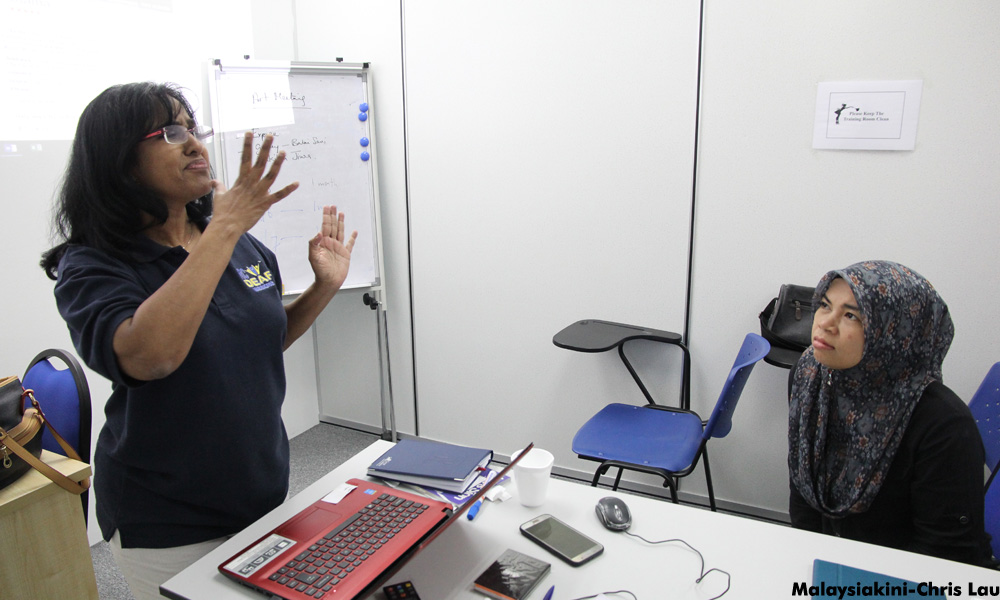
Agnes herself is not a full time social worker, but she has spent many of her weekends teaching the sign language course at different levels, stretching from the most basic level to diploma level.
She also gives free interpreting service to her deaf friends during some of the weekdays, interpreting for deaf individuals in their job interviews and offering employers some suggestions on ways they can contribute to inclusiveness for the deaf in their work environments.
RC Deaf Missions was founded in 2006 by Agnes and her brother Mario Peter, and both of them have a natural passion to work with the deaf community.
More than a decade after the founding of the group, RC Deaf Missions is trying to expand its operations. It took them a decade to open an office.
Being a part-time sign language interpreter is both challenging and time consuming for Agnes.
Once, on a late night, she received an urgent text message from a deaf friend whose home was burgled. It was a shock to Agnes and Mario when they arrived at the apartment, and the deaf friend needed their help to lodge a police report on the burglary.
“We went with her to the police station, and I interpreted for her as her report was taken by the officer. I stayed for the next part, which was the photo taking by the police at her home,” she said. “It was 1am when we reached home.”
The 52-year-old’s selfless contributions have helped her to gain trust among the deaf. As a sign language interpreter who had been on the field for years, Agnes expressed her concerns on the lack of sign language interpreters in the country.
In Malaysia, it is not easy to get a job as a sign language interpreter. The salary is also low, at RM1,200 or less, according to Malaysia Federation of the Deaf.
Crucial need for the interpreters
However, there is a crucial need for interpreters for the deaf and the federation says mechanisms should be put in place in the country to provide for more sign language interpreters.
It has never been easy to be a part-time interpreter when one has a daily job to take care of.
“In Asian countries, there are two things we are trying to educate the people on: if you are doing voluntary work, then why are you asking for money? If this is charity work, why should we pay?” Agnes asked.
“We have to pay the interpreters as they spend their time and have transport costs as well. Some part-timers might even need to take leave from their workplace in order to help.”
There are four areas in which the deaf really require the help of a sign language interpreter - medical, law, education and religion. Medical is the most vital part as the lack of interpreter would probably see the deaf being unable to explain exactly the symptoms of their sickness or ailments.
“Sometimes, the hearing-impaired persons who visit clinics are barely able to be aware of the nurse’s calling,” Agnes added.
Clauses 30 (1), (2) and (3) of the Persons with Disabilities Act 2008 state that such people should be given access to information, communication and technology through the channel that can reach them, but Agnes said local private and governmental hospitals do not have sign language interpreter services for the deaf.
The deaf also need sign language interpreters in the higher learning institutions but this service hardly exists in the country. Hence, students who are deaf have to put on extra efforts in order to catch up in their classes.
In terms of law, the deaf also have to deal with the law on matters of properties, marriage, divorce, etc. And in religious matters as well, when the deaf are present. Fortunately, some churches and mosques in the country do provide volunteer service to help the deaf.
“I have done a lot of interpreting for free because the deaf mostly cannot afford the cost. The deaf themselves are not earning enough to pay,” said Anita Wong, a part time sign language interpreter.
There was a time when a corporate company was giving some talks to deaf persons, but they did not hire an interpreter. The deaf persons asked Wong for help.
“Many corporate companies or institutions are not aware of the need for sign language interpreters, and they expect the deaf themselves to pay for the service,” she said. “These people don’t have enough earning for themselves, so how to pay to hire sign language interpreters?”
Wong said many deaf people who were studying in local colleges and universities were not getting interpreters in their institutions and they have to sit down and copy whatever is put on the whiteboard.
Life has never been easy for the deaf people in Malaysia.
“I met a deaf student who was trying to enrol into a college but the administration told him to defer a semester so as to first learn to lip read on his own, since the institution does not keen to provide any sign language interpreter,” Wong said.
“It is extremely difficult for a deaf person to learn lip reading, as they grow up without knowing or learning the other languages, be it English or Malay. And it’s almost impossible to lip read during long sessions of lectures.”
Yesterday: Part 1 - We face a massive shortage of sign language interpreters
CHRIS LAU is a former intern with Malaysiakini.


Are you sure you want to delete this comment?
This action cannot be undone.