



For Dr M, what goes around comes around
COMMENT | In politics you get all types. The thing is the specimens can mutate in ways that can turn out to make them interesting.
Hence politics as a spectator sport in Malaysia demands that watchers must be prepared to observe all types.
This would be difficult in most cases. Imagine having to monitor Ibrahim Ali for more than a bit.
But wait a minute. Even the former MP for Pasir Mas in Kelantan can turn out to have redeeming aspects.
He recently and accurately observed that his weakness for the game of political hopscotch, which had saddled him with comparisons to a dubious type of amphibian, is now viewed in softer light.
It took fellow Kelantanese, the new DAP enlistee Zaid Ibrahim, who has gone dizzyingly round the political party bloc in his career, to best the resident grandmaster of party-hoppers at the game.
Suffice, pace people like Ibrahim and Zaid, it could be said not so much in charity as relief, that only bores are insufferable in Malaysian politics.
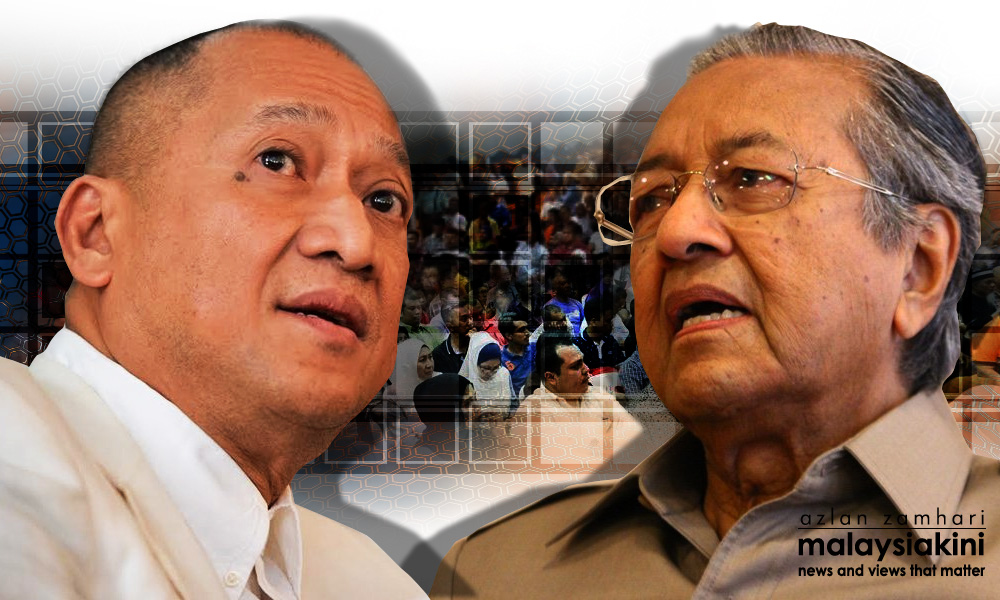
This is all prologue to the point that in Mohamad Nazri Aziz, the Culture and Tourism Minister embroiled in the saga of cancelled debates with Dr Mahathir Mohamad, Umno has a political octopus whose tentacles and ink-squirts can ensnare the public and adversaries in the outer defences.
For the past few weeks, he has led the country and Dr M in an unmerry go-round concerning his willingness to debate the former prime minister on the great issues of this and past days.
Depending on your perspective, the police have had a critical role in this saga of now-cancelled debates.
Nazri makes the police or affects to make them - again depending on one’s perspective - look like the bad guys in this ongoing charade of risque debates that the minister deftly keys up to a pitch of public expectation and excitement before the cops step in to call the thing off.
Thus far Nazri has been able to pull off his beguiling entrapment of opponent and keyed-up public because of his stature as a maverick in all the administrations - first Mahathir, then Abdullah Ahmad Badawi, and now Najib Abdul Razak - of which he has been a loyal and compliant member, but one who resists easy pigeonholing.
The fascinating thing about Nazri's resistance to easy categorisation is that he has been able to survive...
COMMENT | In politics you get all types. The thing is the specimens can mutate in ways that can turn out to make them interesting.
Hence politics as a spectator sport in Malaysia demands that watchers must be prepared to observe all types.
This would be difficult in most cases. Imagine having to monitor Ibrahim Ali for more than a bit.
But wait a minute. Even the former MP for Pasir Mas in Kelantan can turn out to have redeeming aspects.
He recently and accurately observed that his weakness for the game of political hopscotch, which had saddled him with comparisons to a dubious type of amphibian, is now viewed in softer light.
It took fellow Kelantanese, the new DAP enlistee Zaid Ibrahim, who has gone dizzyingly round the political party bloc in his career, to best the resident grandmaster of party-hoppers at the game.
Suffice, pace people like Ibrahim and Zaid, it could be said not so much in charity as relief, that only bores are insufferable in Malaysian politics.
This is all prologue to the point that in Mohamad Nazri Aziz, the Culture and Tourism Minister embroiled in the saga of cancelled debates with Dr Mahathir Mohamad, Umno has a political octopus whose tentacles and ink-squirts can ensnare the public and adversaries in the outer defences.
For the past few weeks, he has led the country and Dr M in a unmerry go-round concerning his willingness to debate the former prime minister on the great issues of this and past days.
Depending on your perspective, the police have had a critical role in this saga of now-cancelled debates.
Nazri makes the police or affects to make them - again depending on one’s perspective - look like the bad guys in this ongoing charade of risque debates that the minister deftly keys up to a pitch of public expectation and excitement before the cops step in to call the thing off.
Thus far Nazri has been able to pull off his beguiling entrapment of opponent and keyed-up public because of his stature as a maverick in all the administrations - first Mahathir, then Abdullah Ahmad Badawi, and now Najib Abdul Razak - of which he has been a loyal and compliant member, but one who resists easy pigeonholing.
The fascinating thing about Nazri's resistance to easy categorisation is that he has been able to survive.
A square-peg-in-a-round-hole
In the current saga, he has been helped not only by his status as a square-peg-in-a-round-hole, but also by Mahathir’s past and present of using any device to secure justification of his conduct.
It was Mahathir who told an American academic who interviewed him for a book on pivotal Asian leaders that he was not in favour of the use of the now-jettisoned Internal Security Act (ISA) against the 100-odd social and political activists in the police crackdown of October 1987, called ‘Operation Lalang’, a blot on his 22-year tenure (1981-2003) as PM.
Mahathir claimed the police had insisted on the preventive detentions to safeguard peace and order during a period of racial and linguistic tensions.
That argument could only fly if in the wording of the provisions of the ISA, it is not stated clearly that a detention order has to be signed by the home minister, which Mahathir was at that time.
The order to detain must be approved by the home minister. If done sans ministerial diktat, then it is a police state.
Mahathir went to the extent of saying, in an attempt at retrospective justification, that the then deputy home minister, the late Megat Junid Megat Ayob, signed the orders. He made it seem that Megat did so of his own volition.
Of course, Megat was not around to gainsay this interpretation of events, but a son of his swiftly retorted that his father would not have acted on his own.
In other words, he was Mahathir’s surrogate, as those familiar with the career of Megat, who died of cancer in 2009, would readily aver.
It was a tawdry attempt by Mahathir to exculpate himself, with a view to preserving a legacy free from repressive blemishes on his prime ministerial record.
Mahathir’s version of Operation Lalang, which was backed by Hanif Omar, the inspector-general of police during that time, created the impression that police enjoy latitude in these detentive exercises.
They don’t, but today it is Nazri’s turn to profit on the impression that the police do have latitude.
Who has helped engender this impression?
TERENCE NETTO has been a journalist for more than four decades. A sobering discovery has been that those who protest the loudest tend to replicate the faults they revile in others.
The views expressed here are those of the author/contributor and do not necessarily represent the views of Malaysiakini.


