




MCA taken to task for dereliction of duty
MCA Youth chief Ong Tee Keat ( photo:second from right ) was cornered during a talk show during which the party was accused of "running away' from politics and infiltrating Chinese guilds and organisations to dilute their independence.
MCA Youth chief Ong Tee Keat ( photo:second from right ) was cornered during a talk show during which the party was accused of "running away' from politics and infiltrating Chinese guilds and organisations to dilute their independence.
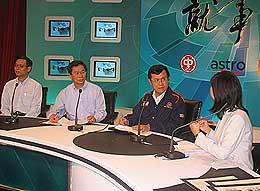 Selangor and Federal Territory Hainan Association honorary secretary Wong Liang Yew levelled the charge during the talk show recorded last Thursday by Astro at the Selangor Chinese Assembly Hall (SCAH), which co-organised the event.
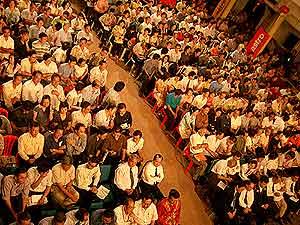
The first talk show recorded outside the studio of the satellite television service provider, it covered two subjects - Chinese politics and education issues - to be aired separately. The event, held in conjunction with the 22nd Chinese Cultural Festival, attracted about 1,000 people.
Wong kicked off the discussion on politics by stating that political infiltration of Chinese associations and guilds by Barisan Nasional component parties is a reality that cannot be denied.
He pointed out that this has been happening since the 1970s when MCA launched its economic self-help programme to establish deposit-taking co-operative societies and holding companies.
New Era College registrar Mok Soon Chong then suggested that such infiltration is a regressive step through which Chinese political parties 'de-politicise themselves' and revert to performing the functions of social organisations and guilds.
Ong defended the move saying: "Since many Chinese leaders simultaneously hold posts in both political parties and Chinese associations, they cannot be accused of political infiltration unless they harbour such intentions."
Wong disagreed, referring to the 'fast-track establishment' of the Kuala Lumpur Chinese Assembly Hall, set up by a pro-MCA faction that broke away from the SCAH leadership.
"(This was done) within one or two months...if there no political interest is involved, how can a society be registered so quickly?" he asked, to thunderous applause.
Umno influence
 Wong claimed that the dominance of Umno had reduced the role of Chinese-based political parties, thereby causing them to 'flee from political duties'.
"They cannot lead Chinese society in the struggle for a common political goal. They are only fighting for government or party posts," he alleged.
Mok agreed, saying that "this phenomenon (depoliticisation)... is also partly their failure to establish a proper relationship with Chinese organisations".
"They should be using their voice to negotiate with their big brother (Umno)not follow their big brother's orders to suppress Chinese organisations," he said.
Ong disputed these views, arguing MCA's limitation has been that its failure to explain itself properly.
"We do not explain to gain sympathy...(we use) a strategy to let the public understand certain information through proper activities," he said.
He also described MCA's 'Life Long Learning' movement as an initiative to advance the competitiveness of Chinese.
Inherent phobia
In the discussion of education issues, DAP researcher Liew Chin Tong and social commentator Josh Hong said the Chinese education movement should leave behind ethnic-based nationalist sentiments and incorporate principles of human rights and democracy in its struggle.
However, United Chinese School Teachers Association of Malaysia (Jiao Zong) executive secretary Yow Lee Fung disagreed that the strategies of Dong Jiao Zong (DJZ) are outdated.
(DJZ is the collective name of the United Chine se School Committees Association of Malaysia and United Chinese School Teachers Association of Malaysia.)
"As long as ethnic politics exists and there is inequality in civil rights in Malaysia, the struggle of the DJZ to uphold mother-tongue education will not be outdated. However, adjustments and improvements may be needed," she noted.
 Liew agreed that the DJZ objectives are not outdated, but said its strategy should be reviewed to move away from one that is " too technical, passive and depoliticised".
Hong also said DJZ is not politicised enough and that "our society has a phobia of the term 'politicise' even when politics influences daily life".
He cited the example of teachers in other countries, who organise public demonstration to protest education reforms by the government.
They have shown that educationists should not be afraid of politics but should present their case to the public, he said.
"The state has replaced nationalism with developmentalism since the 1990s...this has not only boosted the social advancement of the Chinese but also reduced their resentment over unequal policies," he added.
"If DJZ can replace the nationalist sentiment with (notions of) democracy and human rights, it could reach a wider section of the public."


