




EIU: M'sia's low cost of living due to the weak ringgit
Malaysia's low cost of living, relative to other Asean countries, is due to the weakening ringgit and stable inflation levels, the Economist Intelligence Unit (EIU) said.
According to EIU analyst Jon Copestake, the ringgit has weakened significantly against the US dollar over the past five years.
"Other currencies in the region may have remained stable or strengthened," said Copestake, EIU's chief retail and consumer goods analyst, and lead analyst for data and research.
In terms of inflation, Copestake told Malaysiakini, inflation levels have been held in check over the past five years, averaging below four percent...
Malaysia's low cost of living, relative to other Asean countries, is due to the weakening ringgit and stable inflation levels, the Economist Intelligence Unit (EIU) said.
According to EIU analyst Jon Copestake, the ringgit has weakened significantly against the US dollar over the past five years.
 "Other currencies in the region may have remained stable or strengthened," said Copestake, who is EIU's chief retail and consumer goods analyst, and lead analyst for data and research.
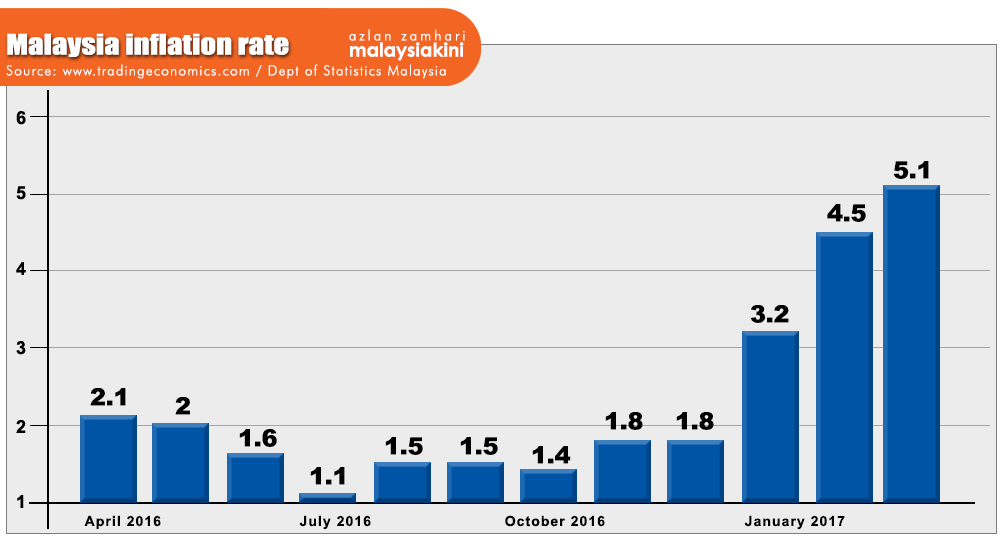
In terms of inflation, Copestake told Malaysiakini, inflation levels have been held in check over the past five years, averaging below four percent.
"There has been no significant hike in prices, with inflation generally tracking in the low, single figures.
"Other countries may have seen localised inflation pushing prices up by five percent or more over the same period.
"In some cases, annual inflation may have moved into double digits elsewhere, while the annual price movement in Kuala Lumpur has generally averaged below four percent," Copestake added.
The weakened ringgit, combined with low inflation, had pushed down the relative cost of living in Kuala Lumpur compared to regional peers.
Five years ago, Kuala Lumpur was more expensive to live in, compared with Phnom Penh, Hanoi, Ho Chi Minh, Bandar Seri Begawan and Manila, he added.
The EIU, a sister company of The Economist magazine, recently published its Worldwide Cost of Living 2017 report which involved a study of 133 cities.
Najib takes credit
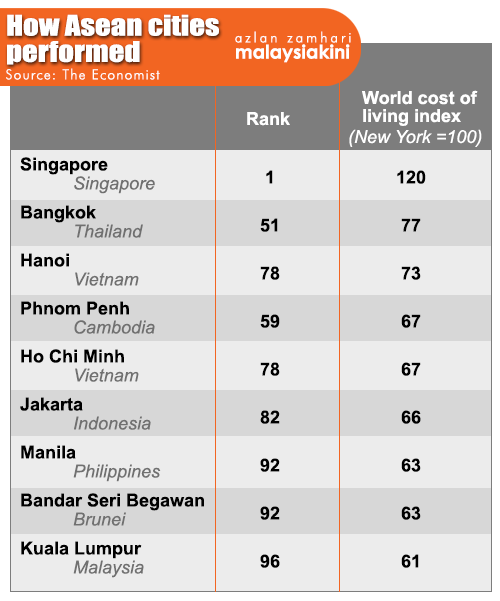
According to the report, Kuala Lumpur was ranked 96th, the lowest among all Asean cities involved in the survey (lower in rank means lower cost of living).
Following this, Prime Minister Najib Abdul Razak cited the report as validation of his administration's policies - price controls, the Bantuan Rakyat 1Malaysia (BR1M) cash handouts and removal of middlemen, among others - to reduce the cost of living.
Najib said that despite this "acknowledgement" by the EIU, his administration would do more to reduce the cost of living.
Copestake also said that the best value for money in Kuala Lumpur comes in terms of day-to-day shopping categories.
"It is relatively cheap for groceries, household items such as soaps and cleaners, as well as tobacco and clothing.
"Utility and domestic help prices in Kuala Lumpur are also relatively low in absolute terms.
"Conversely Kuala Lumpur is more expensive for items like alcohol and transports, notably cars and car maintenance costs," he said.
The EIU Worldwide Cost of Living survey, conducted on a bi-annual basis for more than 30 years, compares more than 400 individual prices across 160 products and services.
Among others, the survey helps human resources and finance managers to calculate cost-of-living allowances and build compensation packages for expatriates and business travellers.
All cities in this survey are compared with New York as the base city. Real product prices from the 133 cities are then converted to US dollars as the central currency, using prevailing exchange rates, and are weighted in order to achieve comparative indices.
Kuala Lumpur scored 61 on the index, meaning that cost of living in the city averages 61 percent of that in New York.
Singapore held the top rank in the world, with prices 20 percent more than those found in New York.
Kuala Lumpur's closest competitor in Asean is Brunei capital Bandar Seri Begawan, with a score of 63 and a ranking of 92.
Reporting by Koh Jun Lin.


