
Labour issues a priority for Harapan manifesto authors
Top Pakatan Harapan policy makers believed that labour reforms must be the coalition's top priority should they form the federal government, particularly on minimum wage and foreign labour.
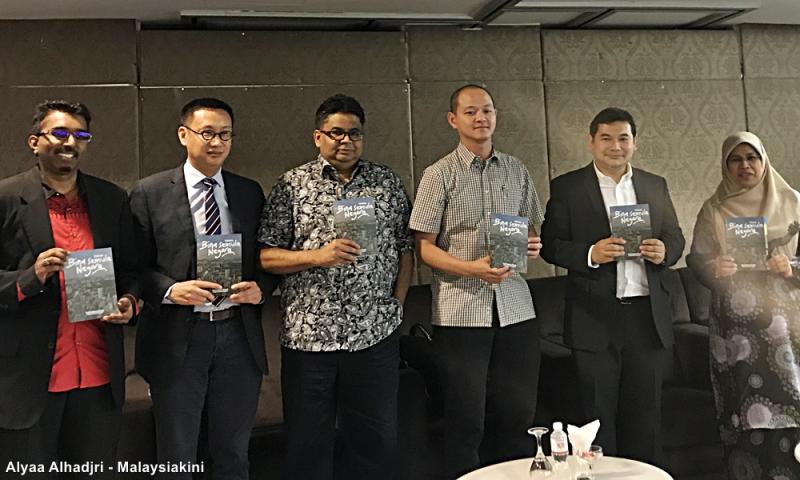
Speaking at the launch of PKR vice-president Rafizi Ramli's policy manual today, the Harapan leaders in attendance lauded the author's effort and said many ideas warrant serious consideration.
Among others, Rafizi's manual had proposed a target for reducing dependency on foreign labourers by 80 percent by the year 2035.
Top Pakatan Harapan policy makers believed that labour reforms must be the coalition's top priority should they form the federal government, particularly on minimum wage and foreign labour.
Speaking at the launch of PKR vice-president Rafizi Ramli's policy manual today, the Harapan leaders in attendance lauded the author's effort and said many ideas warrant serious consideration.
Among others, Rafizi's manual had proposed a target for reducing dependency on foreign labourers by 80 percent by the year 2035.
Rafizi said this could be done by identifying sectors and sub-sectors which are currently hiring foreigners despite being prohibited from doing so under the law.
The food service industry, for example, is only allowed to hire cooks or cleaners, but in practice this was not the case, he said.
Speaking a forum after the book launch, Parti Amanah Negara research director Dzulkefly Ahmad said labour reforms was definitely an area which the Harapan manifesto and policy committee would look into.
Another speaker Serdang MP Ong King Ming said presently, Putrajaya appeared to be wavering on labour issues, citing the stillborn employment insurance scheme as an example.
He said that while workers and the opposition supported the scheme, meant to provide financial aid to people who are retrenched, Putrajaya appeared to be swayed by employers who were against it.
"Both (employers and workers) were never consulted together (at the same time)," said Ong.
Meanwhile, Rafizi, who authored the Invoke Center for Policy Initiatives (I-CPI) Guide to Rebuilding our Nation, said he hoped that his manual, currently in its first volume, also covered the abolishing of GST and a return of fuel subsidies.
"Why do we start we social market reforms? Because this is about low hanging fruits.
"Its easy and involves many people and the effect is big. That's why we have to start with labour market reforms and subsidy reforms," he said, adding that there are some 35 percent of voters who remains fence-sitters and may be swayed by ideas that addresses their concerns.
Rafizi said I-CPI will solicit public feedback on the policies outlined in his book and will communicate with all political parties to seek their endorsement.
"I will publish which parties agrees to what (policy) and which parties does not agree. The public can then evaluate for themselves.
"Maybe its a BN component party but they agree. Or maybe they are a Harapan party but they disagree. Let them be answerable to the public," he stressed, adding that it was a part of an attempt to democratise the policy making process in Malaysia.


Are you sure you want to delete this comment?
This action cannot be undone.