
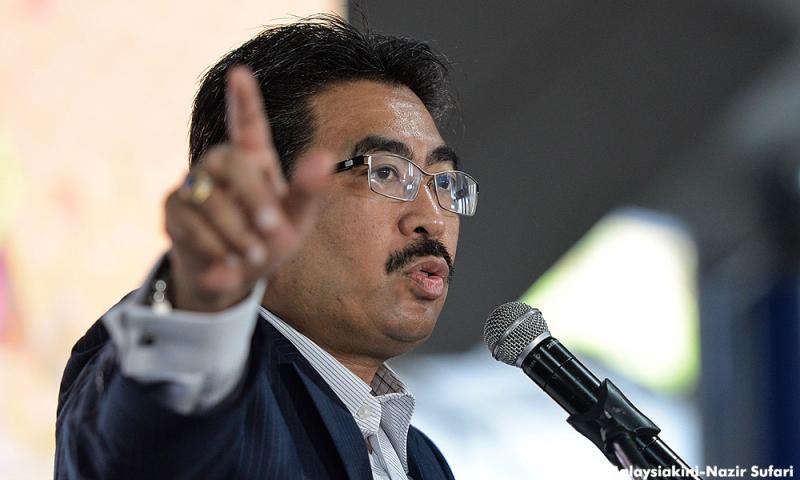
We won't let Proton become another Perwaja, Johari tells Dr M
While the government no longer holds any direct interest in Proton Holdings Bhd, Finance Minister II Johari Abdul Ghani has said it does not wish to see the company suffer the same fate as Perwaja Steel.
The failed iron ore processing project Perwaja came under former premier Dr Mahathir Mohamad’s administration.
In an interview with Malay-daily Utusan Malaysia’s Sunday edition Mingguan, Johari pointed out that Perwaja had eventually ceased operations despite various forms of assistance given.
While the government no longer holds any direct interest in Proton Holdings Bhd, Finance Minister II Johari Abdul Ghani has said it does not wish to see the company suffer the same fate as Perwaja Steel.
The failed iron ore processing project Perwaja came under former premier Dr Mahathir Mohamad’s administration.
In an interview with Malay-daily Utusan Malaysia’s Sunday edition Mingguan, Johari pointed out that Perwaja had eventually ceased operations despite various forms of assistance given.
“Many of their workers were retrenched when the factory stopped its operations.
“Don’t tell me we are going to do the same thing with Proton? I would like to stress that we don’t want Proton’s fate to be like Perwaja's,” Johari was quoted by Mingguan Malaysia as saying.
He said this when asked for comments on critics of DRB-Hicom’s recent sale of a 49.9 percent stake in Proton Holdings Bhd to China firm Geely Automobile Holdings Ltd.
“I understand that Dr Mahathir is very disappointed. But I would like to inform him, Geely is a strategic partner that will hopefully further develop Proton,” said the Titiwangsa MP.
It was reported that Geely will also acquire a 51 percent stake in British sports car brand Group Lotus Plc, which is a fully-owned subsidiary of Proton Holdings. The balance would be acquired by Etika Automobile Sdn Bhd.
70k jobs at stake
Johari reiterated that the deal was a private venture, but the government maintains an interest to ensure sustainability of strategic industries, including Proton, estimated to employ 10,000 direct staff and 60,000 others through its network.
“If Proton is closed down, this means these 70,000 people will lose their jobs.
“If one worker has four dependents in their family, they will also be affected,” he said.
This is the second consecutive day Johari has responded to Mahathir's criticisms, after yesterday saying the former premier's brainchild is “sick” and needs medicine.
Following the announcement of the sale last week, Mahathir, who founded Proton in 1983, lamented that “his child” is now lost and wondered if it could mark further sales of national assets to settle the country’s debts.
Both Perwaja and Proton were considered as cornerstones of Mahathir’s industrialisation drive for Malaysia, which saw involvement of state-owned companies in industries such as steel, cement and automotive manufacturing.
Perwaja was founded in 1982 through a joint-venture between then state-owned Heavy Industries Corporation of Malaysia Bhd (Hicom) and Japan’s Nippon Steel Corp to set up a steel plant in Terengganu.
Nippon Steel subsequently pulled out of the project in 1987 and Mahathir had at the time appointed tycoon Eric Chia to save the company.
The scandal-ridden project eventually saw Chia being charged with criminal breach of trust in 2004, and the government reportedly taking-over some RM9.9 billion in accumulated losses after the company was privatised in 1996.
Gearing for growth
According to Bernama, the sale is a move to secure growth, and the Proton-Geely tie-up promises to upend Proton from its slowing sales, to ramping up production to 500,000 cars over the next three years, more than five times its current production.
According to analysts, in an industry where volume, per unit cost, research and development, platform sharings are all essential to profitability, it has proved impossible for Proton to achieve this in the small Malaysian domestic market.
While the 500,000 production number constitutes a big jump in manufacturing from Proton's current output of roughly 100,000 cars per year, the cross-border partnership-for-growth model that Proton has entered into, is a well-tested concept.
Proton's new foreign partner, Geely, in 2009 did what was then thought to be foolhardy, buying Sweden's ailing Volvo from Ford and turned it around in quick fashion within just two years.
Volvo, under Geely, went from an auto basket case bleeding US$653 million in pre- tax losses in 2009 to making record profits of US$1.25 billion on the back of a revenue of US$20.2 billion in 2016, proving that partnerships with seemingly strange bedfellows can pay off handsomely.
Geely has six factories in China and four abroad.
Chairman Li Shufu has said that the company plans for 15 factories, worldwide, with two-thirds of its cars being sold outside China.
Geely also owns The London Taxi Company which produces the iconic black cabs of London.
In the first four months of this year, 365,000 cars were sold globally by the Geely group, which is on track to selling one million cars, worldwide, by end 2017.


Are you sure you want to delete this comment?
This action cannot be undone.