



From student activism to politics
INTERVIEW | In January 2001, the protest against the closure of SJK (C) Damansara took place when Chang Lih Kang entered University Putra Malaysia (UPM) as a first-year student. At that time, he did not know anything about student movements, but he knew that he had to come forward.
Chang learned from the newspapers that a "Save Our School Movement" (SOS) was being held. He then participated in the demonstration and walked from Pudu to SJK (C) Damansara with other protesters to protest against the closure of the school by the government.
Chang was arrested by the police for participating in his first ever social movement. Looking back, he says, he felt angry, rather than afraid.
"The atmosphere was relatively conservative and tense at the time because everyone was afraid of the Police Act 1967. It was considered an illegal rally when three individuals came together, so the organiser asked us to walk together in pairs, but we were still arrested.
"The police used intimidation when questioning us by saying that we would be kicked out of university. I felt very irrational and I was very angry, but I could not do anything because I did not know anyone at that time," said Chang.
Chang only started learning about student movements when some student activists contacted him over his arrest. He was not charged by police at the end, but his student activism began then.
Chang later founded the Student Progressive Front at UPM with his university friends so that they could have a platform to discuss various societal issues on campus, such as urban poverty.
Two years later, Tan Kar Hing began his studies at UPM. Coincidentally, the first campus activity he joined was organised by the Student Progressive Front, where he met Chang Lih Kang.
Tan still remembers that the activity was held in conjunction with campus orientation week, and that they were taken to visit illegal houses in Jinjang and study Kuala Selangor's rivers, mangrove forests and fireflies....
INTERVIEW | In January 2001, the protest against the closure of SJK (C) Damansara took place when Chang Lih Kang entered University Putra Malaysia (UPM) as a first-year student. At that time, he did not know anything about student movements, but he knew that he had to come forward.
Chang learned from the newspapers that a "Save Our School Movement" (SOS) was being held. He then participated in the demonstration and walked from Pudu to SJK (C) Damansara with other protesters to protest against the closure of the school by the government.
Chang was arrested by the police for participating in his first ever social movement. Looking back, he says, he felt angry, rather than afraid.
"The atmosphere was relatively conservative and tense at the time because everyone was afraid of the Police Act 1967. It was considered an illegal rally when three individuals came together, so the organiser asked us to walk together in pairs, but we were still arrested.
"The police used intimidation when questioning us by saying that we would be kicked out of university. I felt very irrational and I was very angry, but I could not do anything because I did not know anyone at that time," said Chang.
Chang only started learning about student movements when some student activists contacted him over his arrest. He was not charged by police at the end, but his student activism began then.
Chang later founded the Student Progressive Front at UPM with his university friends so that they could have a platform to discuss various societal issues on campus, such as urban poverty.
Two years later, Tan Kar Hing began his studies at UPM. Coincidentally, the first campus activity he joined was organised by the Student Progressive Front, where he met Chang Lih Kang.
Tan still remembers that the activity was held in conjunction with campus orientation week, and that they were taken to visit illegal houses in Jinjang and study Kuala Selangor's rivers, mangrove forests and fireflies.
Soon, the campus election neared and the seniors asked Tan to help out.
"My student activism started from here, the campus election was the most shocking experience for me because I saw many election frauds, the student candidates and their families being intimidated, their hostels being raided at midnight and so on.
"I saw the need for change in the whole system. I also started to pay close attention to social issues such as the SJK (C) Damansara incident. To be frank, I was seldom concerned about politics and social issues before this," Tan said.
Turning to politics for institutional reform
Tan was Chang's junior and both of them started out in student movements at UPM. They continued their involvement with social movements after graduating and then turned to politics and joined PKR.
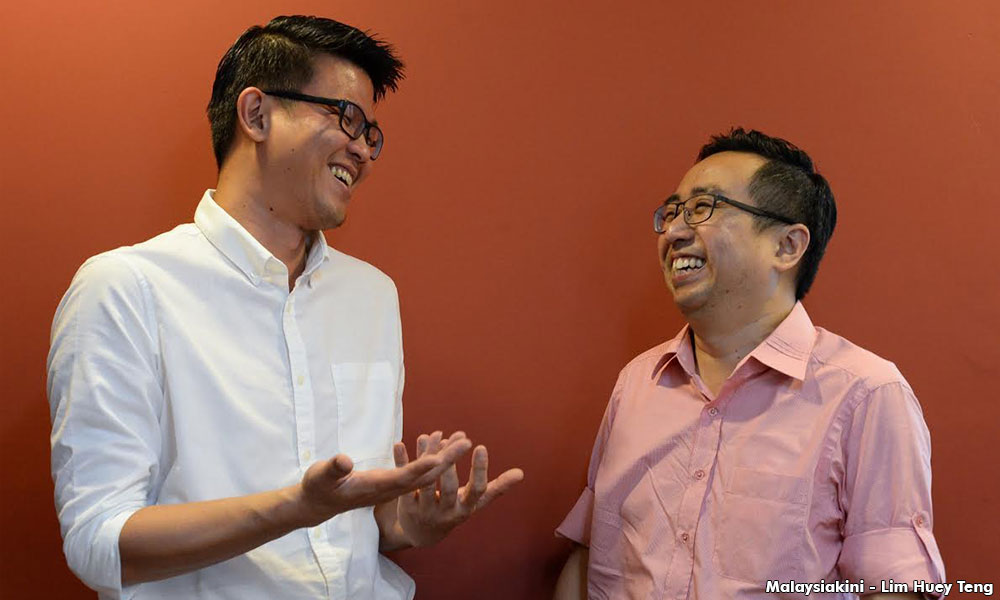
Tan and Chang were eventually elected as state assemblypersons of Simpang Pulai and Teja respectively. They were both acquitted, along with four others, on Wednesday of obstructing a Kuala Lumpur City Hall (DBKL) officer from carrying out his duties in March 2015, during the #KitaLawan rally.
After their acquittal, both of them shared, in an interview with Malaysiakini, their stories of how they turned to politics from student activism.
Chang said he joined Suaram after graduating from UPM and mainly handled detention without trial and police violence cases while Tan worked in the private sector as a sales and marketing person.
However, Tan also joined social movements while working and both of them formed a platform in Serdang with their friends so that they could provide services for the local community, such as free tuition, youth camps, study trips and so on.
A few years later, they started discussing politics with their comrades. Chang said that at first, they did not aim to join politics directly. Instead, they just discussed whether they could push reforms forward through a political platform.
"We hoped to remain in social activism but were also aware that non-governmental organisations (NGO) could usually only focus on a single issue. If we wanted comprehensive institutional reforms, we needed to enter politics.
"These are not decisions we made alone. We discussed it together and we also discussed which party to join. Our discussion lasted for about two years. We felt that if students who join campus elections also avoid political elections after they graduate, who else would get involved? So we decided to enter politics," said Chang.
After working in Suaram for three years, Chang resigned and went back to his hometown of Ipoh, where he served as political secretary to the then-PKR vice-president Lee Boon Chye.
He joined PKR and won the Teja state legislative assembly seat in the 2008 general election as the party’s candidate.
Tan helped out in Chang's election campaign and still remembers that they set two goals at the time: to abolish the Internal Security Act 1960 and replace the current government. The former has been achieved but not the latter.
After the 2008 general election, Tan resigned from the private sector and worked for Lee Boon Chye. He then went to Chenderiang constituency to work with the local commmunity in preparation for the 2013 general election, but ended up contesting the Simpang Pulai seat due to party arrangements.
Checks and balances
Chang and Tan and their university friends decided to enter politics together so that they could monitor each other and not forget their original goal.
Tan said that they even demanded that Chang declare his assets internally within their group when he was elected as Teja assemblyperson.
According to them, around 20 of their friends are now active in politics.
Chang and Tan have begun to appreciate the differences between the world of NGOs and politics. After they became state assemblypersons, they realised they were unable to address some issues as thoroughly as they had hoped, as they had too many responsibilities to fulfil.
However, they remained focused on two issues, which they have championed since their student movement days - the right to assemble, and to implement local elections.
Chang said that six villages under the Gopeng parliamentary constituency have held village chief elections. Two of the villages are in Chang's state constituency, three in Tan's state constituency, and one in another state constituency.
"Although Barisan National has appointed its village chiefs, we still run our local elections so that villagers can choose their own village chiefs.
"We are also concerned about the right to assemble. We have been arrested by the police many times, because we joined rallies. We think that rallies should allowed to be held without applying for police permission,” said Chang.
Memorable moments
Throughout their varied and evolving careers, the most memorable moment for Chang and Tan has been when they were in student and social movements.
Tan said that an unforgettable experience for him was the last campus election he took part in at UPM. At that time, he was helping his junior to contest in the election. They ended up boycotting the election because the school adopted an electronic voting system.
"We were charged with seven offences by UPM, and we were a bit worried because the campus's atmosphere was very tense at the time.
"There were Light Strike Force (LSF) teams standing by inside the campus on the day of our hearing. It was unforgettable because it was the first time we faced such a high degree of pressure.
"At the end we were acquitted, just like in this #KitaLawan case. A few months later, when I graduated, I received a letter from the university saying that the charges against me had been officially dropped. It was definitely a victory for the students," Tan recalled.
As for Chang, his most unforgettable experience was in Suaram when he joined the protest against the Ampang Jaya Municipal Council’s (MPAJ) action to demolish the illegal squatters of a Malay village, Kampung Berembang.
"We lined up against a wall when they started to dismantle the village. I was standing next to a Malay teenage girl, and when the policeman took me away, I remembered she scolded the police 'makan babi' (eat pork).
"The policeman was Malay, and in fact 'makan babi' should have been an insult directed at me but because I was standing with them... Of course using the words 'makan babi' is racist, but I think this kind of deep-rooted racial discourse can be broken through by standing together with others," Chang said.
Another time was when Chang first handled a death in custody case. He was responsible for recording the statement of the deceased's mother, but ended up shedding tears together with her.
"She had been crying when talking of her sadness, and I too shed tears while recording her statement. At one point I had to stop and excuse myself to wipe away my tears before I could continue. This was an episode that I could not forget," said Chang.
Remember your original goal
Prior to the #KitaLawan case, Chang and Tan had taken part in numerous rallies and were arrested seven and six times respectively. However, the #KitaLawan case was the first time either of them had been charged in court.
Chang had not expected to be acquitted because previously the magistrate had ruled that the prosecution had made out a prima facie case and ordered them to enter their defence on the charge.
Tan expressed relief at the acquittal because the case had been on trial for two years.
Some supporters had been worried that the pair would lose their state seats and be banned from contesting in future if they were convicted. However, looking back, both of them had no regrets or worries with regards to the situation.
“We wanted to fight for institutional reform when we joined politics, therefore we were not afraid of being charged or losing our seats. It is certainly good to be acquitted, but there will still be the next case and even if we were found guilty in this case, does it mean that I will not join a rally next time? No, I will still attend rallies because the most important thing is to not forget the original goal, that is for institutional reform, rather than to change ourselves to become more conservative.” - Chang Lih Kang
“Our initial aims were to abolish the ISA and to champion regime change. Once we have established these points, the 'party' is just a tool for us to reach our goals. If we do not use this tool today, we can use another tool. So being an elected representative is just one path forward. At the end, if you lose a tool, you can find another way to do the same thing because this is not an option but a responsibility.” - Tan Kar Hing


