


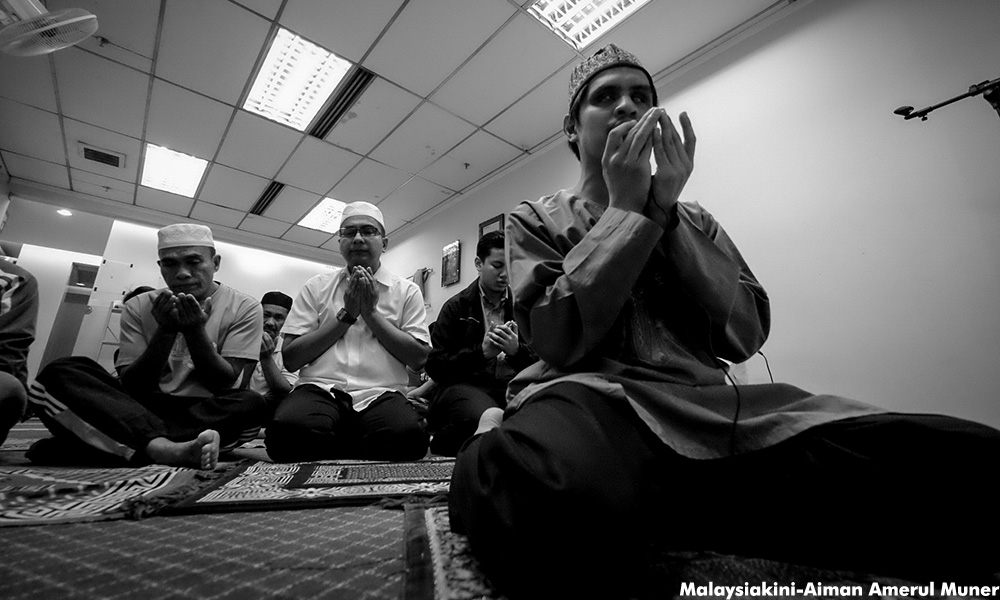

Meet Firdaus Hairi, the blind al-hafiz imam
MALAYSIANS KINI | He may lead his life in darkness, but 29-year-old Muhamad Firdaus Hairi suddenly found himself in the spotlight after a photo of him and his son went viral on social media.
Every morning at around 8am, Muhamad Firdaus leaves his house with his baby boy and walks to the Sentul Timur LRT station.
His routine commute to the baby-sitter’s before going to work has however earned him viral fame as “the blind man cradling his baby”.
One morning, a stranger captured a photo of Muhamad Firdaus sitting at the LRT station with his son strapped to his front in a baby sling carrier.
The image was uploaded on Facebook sometime in January, and has, to date, been shared by over 10,000 people.
Many of them noted how commuting with a baby is no easy feat, and expressed awe at Muhamad Firdaus' resilience in overcoming his challenges.
Since then, Muhamad Firdaus has also been featured in a Facebook series titled “Ordinary Muslims doing Extraordinary Things”, which highlights his talent in memorising the Al-Quran and earning the title of al-hafiz.
Born in Port Klang, Muhamad Firdaus holds a diploma in Al-Quran and Dakwah from the Darul Quran institute in Kuala Kubu Baru.
In an interview with Malaysiakini at a health centre in Kuala Lumpur where he used to work as a blind masseuse, Muhamad Firdaus shared the ups and downs of his daily life. His wife Noor Hidayah Ibrahim is also blind, while their one-year-old baby Muhammad Razin Hamizan was born with normal vision.
Here is Muhamad Firdaus’ story in his own words:...
MALAYSIANS KINI | He may lead his life in darkness, but 29-year-old Muhamad Firdaus Hairi suddenly found himself in the spotlight after a photo of him and his son went viral on social media.
Every morning at around 8am, Muhamad Firdaus leaves his house with his baby boy and walks to the Sentul Timur LRT station.
His routine commute to the baby-sitter’s before going to work has however earned him viral fame as “the blind man cradling his baby”.
One morning, a stranger captured a photo of Muhamad Firdaus sitting at the LRT station with his son strapped to his front in a baby sling carrier.
The image was uploaded on Facebook sometime in January, and has, to date, been shared by over 10,000 people.
Many of them noted how commuting with a baby is no easy feat, and expressed awe at Muhamad Firdaus' resilience in overcoming his challenges.
Since then, Muhamad Firdaus has also been featured in a Facebook series titled “Ordinary Muslims doing Extraordinary Things”, which highlights his talent in memorising the Al-Quran and earning the title of Al-Hafiz.
Born in Port Klang, Muhamad Firdaus holds a diploma in Al-Quran and Dakwah from the Darul Quran institute in Kuala Kubu Baru.
In an interview with Malaysiakini at a health centre in Kuala Lumpur where he used to work as a blind masseuse, Muhamad Firdaus shared the ups and downs of his daily life. His wife Noor Hidayah Ibrahim is also blind, while their one-year-old baby Muhammad Razin Hamizan was born with normal vision.
Here is Muhamad Firdaus’ story in his own words:
I WAS BORN A PREMATURE BABY. I also had jaundice so I was placed in an incubator but the light was too strong and my eyes were not properly shut.
The hospital staff forgot to shut my eyes properly, which damaged my nerves. That, however, was not the end of my life.
I GREW UP AS A NORMAL CHILD. But my family was puzzled after I turned two but had yet to start walking. It was only when they observed me closely that they realised I could not see.
My parents continued to think positively. They believed that they should take steps to ensure that I, as their son, could be given the same opportunities as any other children.
MY DAD PLAYED A BIG ROLE. He would ask my mum to guide me to take steps on the dewy grass.
Sometimes, these old folks’ advice is useful. With their guidance, I succeeded in receiving an education.
WHAT DIFFERENTIATES THE BLIND FROM THE SEEING IS ONLY VISION. Our other senses remain the same as normal people’s.
When I first got married, there were those who asked us how a person with disabilities gets married. I told them, the way you got married was how we got married as well.
BUT OUR BIGGEST CHALLENGE WAS WHEN I ACCOMPANIED MY WIFE FOR HER MONTHLY PREGNANCY CHECK-UP. For one, no one knew our reason for being at the clinic, and no one bothered to ask.
Secondly, the clinic used a number display system instead of calling our names or number.
My wife had to figure out how to use her smartphone to ’zoom in’ and see the number on the display. Her struggle was to that extent, just to be able to see.
I LEARNT TO TAKE CARE OF MY OWN CHILD. When he was born, people continued to talk. They said, ‘I can’t just let my wife take care of the baby’.
So I felt challenged. By the fourth day, I had already learnt how to carry my son. The first time I held him, in my heart I felt so grateful to Allah SWT.
THERE ARE STILL PEOPLE WHO QUESTION THE ELIGIBILITY OF A BLIND PERSON TO LEAD PRAYERS AT THE MOSQUE. Throughout this month of Ramadan, I have been selected to be an imam at Surau An-Nur in Kuala Lumpur.
Some people have questioned whether our prayers are acceptable, because as blind people we cannot see the praying mat, and some of them even left the prayer congregation.
Typically people will only leave the congregation because of a significant mistake (by the imam). But here, there was no excuse for them to do so.
IGNORANT ATTITUDES WON’T STOP ME FROM SERVING THE PEOPLE. The knowledge that I have has so far allowed me to answer all their questions.
I pity my friends who do not have this knowledge, and so it becomes my duty to share the answers with the public.
THE ANSWER IS SIMPLE. According to the Shafie school of thought, the only thing blind people are not allowed to do is slaughter animals, for fear that we will miss the jugular vein.
But to be an imam, or even to prepare final burial rites, is not an issue.
I HAVE ALSO SUCCEEDED IN MEMORISING THE AL-QURAN. Since 2014 I have worked as an analyser for the braille version of the Al-Quran, to ensure that there are no mistakes.
There was one time when I disagreed with the Home Ministry, because they refused to consult the blind community before exporting a set of braille Al-Quran overseas.
The braille Al-Quran which has now been approved by the ministry is produced by the Association of Blind Muslims in Malaysia (PERTIS).
NOT ALL BLIND PEOPLE ARE LIVING ON THE GOODWILL OF OTHERS. I hope people will stop discriminating against people with disabilities.
I also hope that our mosques and suraus will open its doors to welcome and accept us, just like any other people.
The attitude of a certain segment of society, which treats people with disabilities as outcasts, will only cast themselves in a negative light.
SOMETIMES WE CAN’T EVEN PUT OUR BRAILLE AL-QURAN ON THE RACKS AT THE MOSQUE. Each blind person should have four sets of Al-Quran, each with six volumes.
The mosque authorities say it takes up too much space and no one will read it. We put it there, so we will be the ones reading it.
WHAT WE NEED NOW IS TO CREATE TEACHERS. There are at least 20 of us who graduated from Darul Quran.
So there is no issue about not having enough teachers for the blind to learn to read the Al-Quran.
All we need to do is to get accreditation from the religious authorities and funds to pay the teachers.
We can even set up classes in housing areas, for example the DBKL flats.
WE KNOW THERE ARE PEOPLE WITH DISABILITIES WHO ARE JOBLESS. We don’t deny that they make a living by begging. But because of them, we, the ones who are working, become victims.
This is a big problem. Even when I go to the supermarket or wet market, there will be people who give me money because they think I’m selling tissues. Others will offer to pay for my purchases.
MALAYSIANS KINI is a series on Malaysians you should know.
Previously featured:
War has no victors, says last surviving WWII vet
The one-man Malay literature archive
The last of generations of storytellers


Are you sure you want to delete this comment?
This action cannot be undone.