


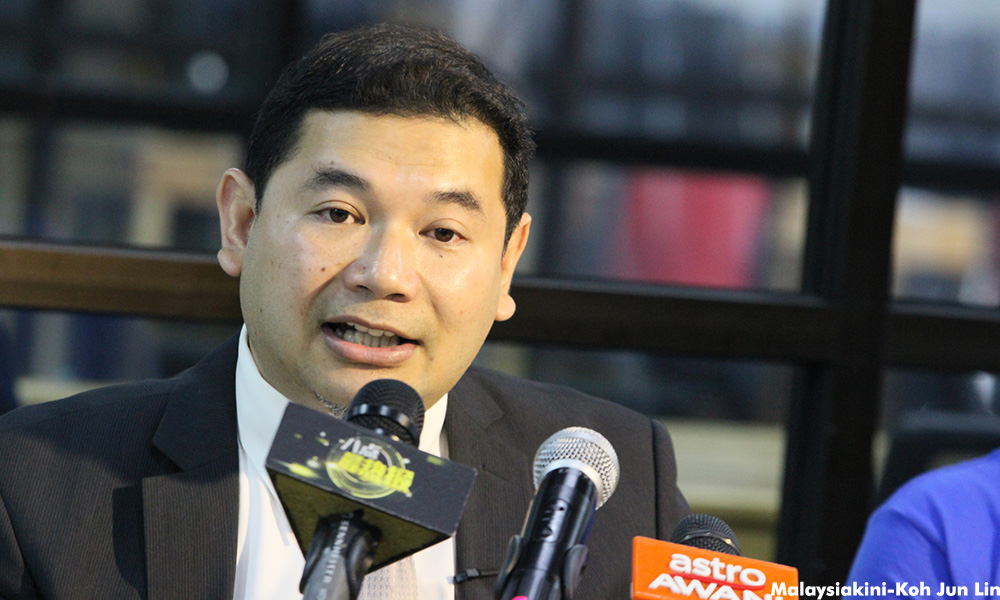

Rafizi, Media Rakyat obtain leave to challenge fair comment decision
PKR vice-president Rafizi Ramli and Media Rakyat owner Chan Chee Kong today obtained leave from the Federal Court to challenge the decision to strike out several paragraphs on fair comment in their defence.
This is in relation to a defamation suit filed by Prime Minister Najib Abdul Razak and his wife Rosmah Mansor over a jibe made by Rafizi, who is also Pandan MP, at a 2014 forum on petrol subsidies, a video of which was uploaded by Chan on social media.
Chief Justice of Sabah and Sarawak Richard Malanjum, who headed the three-member bench in the Federal Court, allowed four novel questions regarding the defence of fair comment to be posed by Rafizi and Chan's lawyers, who were led by Razlan Hadri Zulkifli...
PKR vice-president Rafizi Ramli and Media Rakyat owner Chan Chee Kong today obtained leave from the Federal Court to challenge the decision to strike out their defence of fair comment.
This is in relation to a defamation suit filed by Prime Minister Najib Abdul Razak and his wife Rosmah Mansor over a jibe made by Rafizi, who is also Pandan MP, at a 2014 forum on petrol subsidies, a video of which was uploaded by Chan on social media.
Chief Justice of Sabah and Sarawak Richard Malanjum, who headed the three-member bench in the Federal Court, allowed four novel questions regarding the defence of fair comment to be posed by Rafizi and Chan's lawyers, who were led by Razlan Hadri Zulkifli.
“We are inclined to give leave (permission) to all the questions posed for both appeals (by Rafizi and Chan),” said Justice Malanjum after hearing the submissions.
The four questions which were accepted by the apex court to be answered were:
- Whether allegedly defamatory words spoken in jest could qualify for the defence of fair comment;
- Whether allegedly defamatory words spoken in a hyperbolic or exaggerated fashion could qualify for the defence of fair comment;
- Whether it was appropriate for a judge hearing the striking-out applications to decide whether allegedly defamatory words spoken were fact or opinion; and
- Whether it should only be left to the trial judge, after hearing viva voce (oral) evidence, to decide whether the allegedly defamatory words spoken were fact or opinion.
It was previously reported that Najib and Rosmah filed the suit over Rafizi's jibe that subsidy cuts were being maintained to allow Rosmah to purchase more diamond rings. They are seeking general, aggravated and exemplary damages deemed fit by the court, as well as interests and costs.
The Court of Appeal had allowed Najib's application to strike out the defence of fair comment from Rafizi and Chan's statement of defence last year.
The other judges who were unanimous in allowing leave were Justice Ramly Ali and Justice Zaharah Ibrahim.
A novel issue
Lawyer Razlan said the questions of law posed were related to a novel issue, as the main issue in this case was slander, given that the allegedly defamatory comments were not made in an article but a video recording.
Additionally, he argued that the Court of Appeal had made the decision to strike out the paragraphs in Rafizi and Chan’s defence based on the text provided, and had not watched the original video footage.
“I cannot find any authority or case law on slander where a court could rule, there and then, that the matter does not need to go to trial after allowing the application to be struck out without watching the video,” he said.
Razlan also brought up the fact that Kuala Lumpur High Court judge Noraini Abdul Rahman had previously decided against striking out the paragraphs on fair comment, and had opined that the matter should proceed to trial after ruling that the court had not watched the video and heard the testimony of the witnesses.
Central to Rafizi's defence of fair comment was the remark he made that the “oil subsidy was cut so that the savings could be used to be placed in Rosmah's pocket to purchase a ring,” which Razlan told the court was said in jest and hence should be considered fair comment.
“One has to see the video to see the movement of the speaker and the reaction of the crowd. An objective judge would look at those things before deciding not to strike out the suit,” he said.
Razlan further said that as an MP, Rafizi was required to raise issues of public interest and government policy, including abolishing fuel subsidies.
“These are all issues which an MP should and could have raised,” he added.
Najib and Rosmah's lawyer, Wan Azmir Wan Majid, said the appellants were attempting to expand the fair comment principle to include saying something hyperbolic or made in jest.
The court, Wan Azmir said, could deliberate on whether Rafizi’s words constituted a fair comment or a statement of fact.
"The appellant has agreed that it relies on humour and exaggeration. The issue is whether the statement is not made in jest but is considered malicious,” he said, adding that Rafizi as an MP was making a blatant and malicious statement.
In response, Razlan asked how one could determine malice without examining the witnesses, and stated that the matter should proceed to trial.


Are you sure you want to delete this comment?
This action cannot be undone.