



Human trafficking: M'sia moves out of US' Tier 2 watch list
Malaysia has moved out of the "Tier 2 watch list" in the US State Department's latest Trafficking in Persons Report (TIP) and has been upgraded to the "Tier 2" list.
Countries on the Tier 2 list are countries that do not fully meet the US Trafficking Victims Protection Act's minimum standards but are making significant efforts to meet those standards.
However, being on the Tier 2 watch list subscribes to the same definition above, in addition to having a significant increase in the absolute number of victims and failure to provide evidence of increasing efforts to prevent human trafficking, among other yardsticks.
"The government (of Malaysia) demonstrated increasing efforts compared to the previous reporting period; therefore, Malaysia was upgraded to Tier 2.
"The government demonstrated increasing efforts by expanding trafficking investigations, prosecutions and convictions," the TIP report states...
Malaysia has moved out of the "Tier 2 watch list" in the US State Department's latest Trafficking in Persons Report (TIP) and has been upgraded to the "Tier 2" list.
Countries on the Tier 2 list are countries that do not fully meet the US Trafficking Victims Protection Act's minimum standards but are making significant efforts to meet those standards.
However, being on the Tier 2 watch list subscribes to the same definition above, in addition to having a significant increase in the absolute number of victims and failure to provide evidence of increasing efforts to prevent human trafficking, among other yardsticks.
"The government (of Malaysia) demonstrated increasing efforts compared to the previous reporting period; therefore, Malaysia was upgraded to Tier 2.
"The government demonstrated increasing efforts by expanding trafficking investigations, prosecutions and convictions," the TIP report states.
However, the report noted that efforts to protect victims of human trafficking were "largely inadequate".
It noted that newly implemented laws to shelter victims while providing free movement and right to employment were flawed due to bureaucratic delays.
"Of the 1,558 victims identified, the government conducted only 106 risk assessments and ultimately granted six victims work visas and 12 special immigration passes for freedom of movement.
"An additional 28 victims were approved for freedom of movement, but delays in obtaining required passports from their home countries meant that they either had returned home or remained waiting at the end of the reporting period," the report read.
The report urged Malaysia to improve the implementation of laws related to human trafficking and to smoothen the process to allow victims freedom of movement and employment.
The TIP is a diplomatic tool by the US, used to engage with other governments on methods to tackle human trafficking. It is published annually.
Malaysia was placed on the Tier 2 watch list between 2010 and 2016, save for 2014 when the country was placed on the Tier 3 list, alongside countries such as North Korea and Libya.
Meanwhile, Human Rights Watch has criticised the report for having whitewashed Malaysia’s poor to mediocre record on combating human trafficking for the second year in a row.
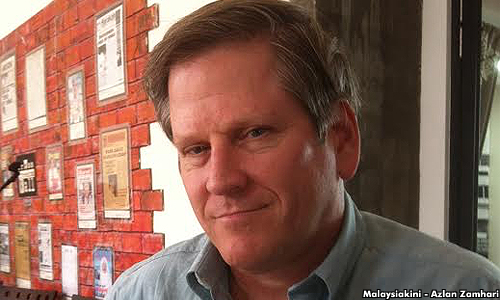 “The reality is that Malaysian officials identify very few victims compared to the numbers present in Malaysia. Foreign workers from Southeast and South Asia are debt-bonded and controlled, and the government’s efforts to shelter and care for victims is really sub-par and marred by bureaucratic red-tape,” Human Rights Watch’s deputy director for Asia, Phil Robertson (photo), said in a statement today.
Robertson said Malaysia only needs to look next door to Thailand to see how to run an effective shelter system. Yet, the government was instead busy outsourcing its responsibilities to NGOs and then dragging its feet on providing the funding needed.
However, he said, in adopting that approach, Malaysia was aligning with the poor practices of Cambodia in dealing with trafficking victims.
“Malaysia has also made no effort to untangle wholly different concepts of ‘people smuggling’ from human trafficking in Malaysia’s anti-trafficking law, leaving frontline officials with a buffet line choice of whether to designate a person as an illegal immigrant or a trafficking victim.
“Not surprisingly, effective identification of trafficking victims falters in all but the most obvious cases, and the Malaysian anti-trafficking efforts stumble at the first hurdle.
“Amendments to the law in 2015 to create an inter-agency committee are far from sufficient to deal with the larger problems the law creates,” Robertson said.
Failure to prosecute lambasted
Robertson also lambasted the Malaysian government’s failure to prosecute officials for their involvement in the Rohingya smuggling camps, which he said was a testament to odious impunity to commit trafficking abuses, and demonstrates a fundamental lack of political will by the government.
“It’s a joke to say that ‘investigation is continuing’ into the Rohingya cases when, for all intents and purposes, the investigations have finished in Malaysia and Thailand.
“Corruption of Malaysian officials, failures to identify victims, overcrowded shelters, moderate reforms not yet implemented - these are all indications of a problem still not fully addressed.”
Thus, he said, it is no exaggeration to say the section on Malaysia undermines the credibility of the TIP report.
Robertson urged the US Congress to call Secretary Tillerson up to Capitol Hill and demand for an explanation.
“Progress can constitute many things, but calling a move from near zero to 10 percent still means that you’ve got 90 percent of the way to go – a fact which seems to be lost on whoever decided to upgrade Malaysia’s ranking to Tier 2.
“In fact, some of the justifications for ‘progress’ in Malaysia’s record are as clear as mud, and would be laughable if the rights issues at hand were not so serious,” he added.


Report this comment
Are you sure you want to delete this comment?
This action cannot be undone.