



Experts offer alternatives to Harapan Youth’s PTPTN proposal
Experts have offered alternatives to Pakatan Harapan Youth’s latest proposal that the National Higher Education Fund (PTPTN) loan repayments need only be made once a borrower earns RM4,000 a month and above.
Repayments should start when a borrower has found a paying job, argued Institute of Strategic and International Studies (Isis) deputy chief executive Steven Wong.
“There is importance in acknowledging liability and limiting moral hazard, although initial repayment may not be high”, Wong said.
Asian Strategy and Leadership Institute (Asli) director Ramon Navaratnam criticised Harapan Youth’s proposal for encouraging borrowers to be “indifferent to their responsibility”.
“People must repay their loan, but only after your first salary starts. Preferably after three months of employment,” Ramon said.
Rather than a salary threshold, Voon Zhen Yi of the Centre for Public Policy Studies (CPPS) suggested that repayment amounts be tailored to individual borrowers.
“It should be on an individual case-to-case basis, since as the costs of living and other circumstances vary in terms of place and the individual.
“More considerations should be given to allow debtors with legitimate circumstances to defer their PTPTN repayments to enable them to channel their financial resources to more urgent areas of need,” Voon added.
Penang Institute political analyst Ooi Kok Hin said that only a few Malaysians earned a monthly salary of RM4,000 and above.
“How many people can earn RM4,000?
“What about outside the Klang Valley? How many years would it take them?” Ooi asked...
Experts have offered alternatives to Pakatan Harapan Youth’s latest proposal that the National Higher Education Fund (PTPTN) loan repayments need only be made once a borrower earns RM4,000 a month and above.
Repayments should start when a borrower has found a paying job, argued Institute of Strategic and International Studies (Isis) deputy chief executive Steven Wong.
“There is importance in acknowledging liability and limiting moral hazard, although initial repayment may not be high”, Wong said.
Asian Strategy and Leadership Institute (Asli) director Ramon Navaratnam criticised Harapan Youth’s proposal for encouraging borrowers to be “indifferent to their responsibility”.
“People must repay their loan, but only after your first salary starts. Preferably after three months of employment,” Ramon said.
Rather than a salary threshold, Voon Zhen Yi of the Centre for Public Policy Studies (CPPS) suggested that repayment amounts be tailored to individual borrowers.
“It should be on an individual case-to-case basis, since as the costs of living and other circumstances vary in terms of place and the individual.
“More considerations should be given to allow debtors with legitimate circumstances to defer their PTPTN repayments to enable them to channel their financial resources to more urgent areas of need,” Voon added.
Penang Institute political analyst Ooi Kok Hin said that only a few Malaysians earned a monthly salary of RM4,000 and above.
“How many people can earn RM4,000?
“What about outside the Klang Valley? How many years would it take them?” Ooi asked.
The Department of Statistics reported that the median salary of working Malaysians in 2016 was RM1,703 while the salary averaged at RM2,463.
Ooi also questioned whether the proposal signalled a U-turn in Harapan’s education policy.
“(PKR vice-president) Rafizi Ramli (previously) proposed to abolish PTPTN and waive tuition fees for public universities, which Anwar (Ibrahim) seconded.
“Is Pakatan Harapan carrying on with its manifesto or has it given up?” he asked.
In 2012, Anwar, the de facto opposition leader, stated that Pakatan Rakyat had intentions to waive the PTPTN loan all together.
More support from Netizens
Netizens on social media, however, were more supportive of the proposal.
More than 2,600 responded to a Malaysiakini poll on Twitter, with 63 percent responding “yes” to the question “Pakatan Harapan Youth wings' manifesto - PTPTN repayments only kick in once you make RM4,000 a month. Do you agree?”
On Facebook, 60 percent of the 879 netizens who voted agreed with the proposal.
Many commented their views.
By the time we graduate, some of us have a few thousands outstanding to be repaid. With a sizeable income, we can settle part payment with..
— Hannah Nanneri (@Hannah_nannerie) July 5, 2017
ease and not having to struggle as we do now. A huge part of our meagre allowance/salary goes to the initial repayment. This causes ...
— Hannah Nanneri (@Hannah_nannerie) July 5, 2017
us to stumble from the first month of work. Also, with bad credit, many opportunities and needs are affected. :)
— Hannah Nanneri (@Hannah_nannerie) July 5, 2017
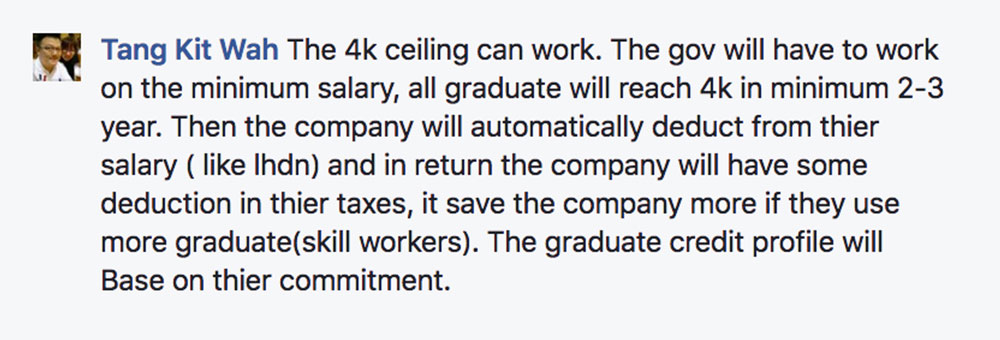 Despite the polling data, an overwhelming majority of comments on both social media platforms criticised the proposal, saying it would delay the sense of responsibility towards loans and debt of borrowers. Like the experts, they also had counter-proposals.
No, because by not making repayments, you're denying less students to successfully apply for PTPTN. The money has to come from somewhere.
— Suraya Zainudin (@surayaror) July 5, 2017

Apart from experts and the social media, Malaysiakini previously put Harapan’s latest proposal to the test with members of the public and those currently repaying their PTPTN student loans.
Many of those interviewed disagreed with the salary threshold, citing similar concerns as netizens and emphasising the importance of paying back any money owed accordingly, especially since loans were funded by public funds and PTPTN already allowed flexible modes of payment.
PTPTN loan recipients themselves doubted many would surpass the RM4,000 salary threshold, suggesting a time threshold instead, as they had all struggled to repay when they first entered the job market.
Current regulations require recipients to begin repaying their PTPTN loans six months after graduation, with options to defer payment or to convert loans into scholarships if they obtain a First Class Honours in their degree.
While it does list defaulters on Bank Negara’s Central Credit Reference Information System (CCRIS) and bans them from travelling abroad, PTPTN offers borrowers loan restructuring services, online direct debit repayment options, EPF repayment options and even discounts.
Selected PTPTN branch offices are also open past office hours as well as on weekends.


