
No money to send undocumented Cambodian workers home
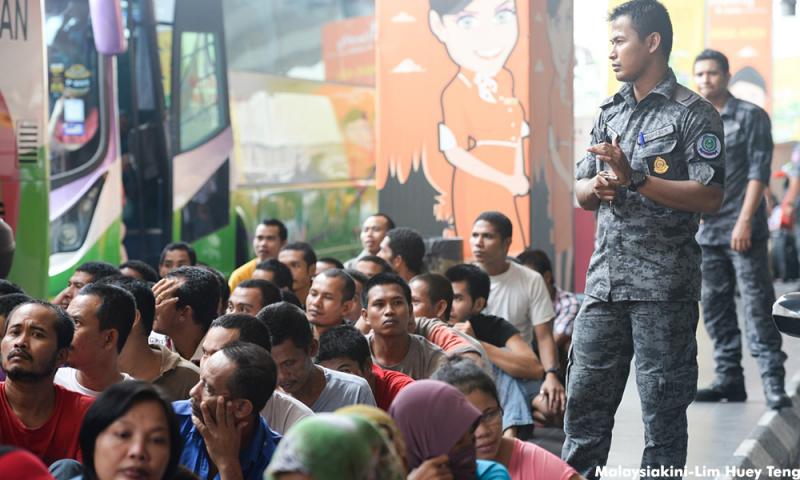
Many undocumented Cambodian workers who have sought shelter at the Cambodian Embassy in Kuala Lumpur are unable to return home because of the lack of funds.
They sought shelter at the embassy following the crackdown on undocumented workers in the country recently.
"Our embassy is also unable to send them back home because we lack the funds to do so," an official at the embassy was quoted as saying by the Cambodia Daily news portal...
Many undocumented Cambodian workers who have sought shelter at the Cambodian Embassy in Kuala Lumpur are unable to return home because of the lack of funds.
They sought shelter at the embassy following the crackdown on undocumented workers in the country recently.
"Our embassy is also unable to send them back home because we lack the funds to do so," an official at the embassy was quoted as saying by the Cambodia Daily news portal.
The embassy’s counsellor for labour affairs, Nou Bunnara, said the current situation was chaotic as the workers did not have money to support themselves.
Bunnara said some of the workers also did not possess the relevant legal documents.
There are 1,854,684 foreigners on temporary work permits in Malaysia as of Sept 30, 2016.
It is mandatory for all employers who want to apply to hire foreign workers to do so online, starting April 1.
Deputy Prime Minister Ahmad Zahid Hamidi had said the ruling would apply to foreign workers from all source countries, except for domestic helpers.
“The embassy is appealing for support from the non-governmental organisations (NGOs) in Malaysia to help us," Bunnara said.
A spokesperson of the Cambodian Foreign Affairs Ministry, Chum Sounry, said that the ministry was not sure how much money was needed to repatriate the undocumented workers staying temporarily in the embassy.
According to the Cambodia Daily, 30 Cambodian nationals have sought refuge at the embassy, while 79 undocumented workers were arrested this month following the crackdown on foreign labour.
“The Malaysian government has informed the embassy that it was entirely up to Malaysia to determine if the arrested workers should be deported or stand trial,” Bunnara said.
“Employers are also to be blamed because the (Malaysian) government has given them time to process documents for the migrant workers,” he said.
“(But) the workers had little time to fill up the documents as the employers had failed to process the paperwork (to apply for the E-Card," Bunnara said.
The deadline for the E-Card registration was June 30.
The E-Card functions as a temporary confirmation of employment for illegal workers, which replaces valid travel documents from their respective countries.
Meanwhile, Adrian Pereira, executive director of North South Initiative, a human rights organisation, said that his NGO has been working with the embassy to help finance some of the Cambodians.
“We have saved some undocumented workers from trafficking and even from being arrested,” the Cambodia Daily reported Pereira as saying.
He cited the efforts made to negotiate a safe passage for an undocumented Cambodian woman who gave birth after Immigration authorities tried to detain her at a hospital.
“Malaysian hospitals are required to notify the Immigration Department when undocumented migrant workers seek treatment,” he said.
Meanwhile, Bangladesh Expatriates Welfare and Overseas Employment Minister Nurul Islam said that Bangladeshi workers would not be detained until December.
According to The Dhaka Tribune online portal, this was the result of an agreement between Malaysia and Bangladesh in a bid to solve the issue of undocumented workers.
Nurul said he was in close contact with the Malaysian government to find a solution to the problem of undocumented workers.
Registered Bangladeshi workers in the country totalled 282,287, while Indonesia still tops the list with 828,283 workers, followed by Nepali workers at 526,933.


Are you sure you want to delete this comment?
This action cannot be undone.