


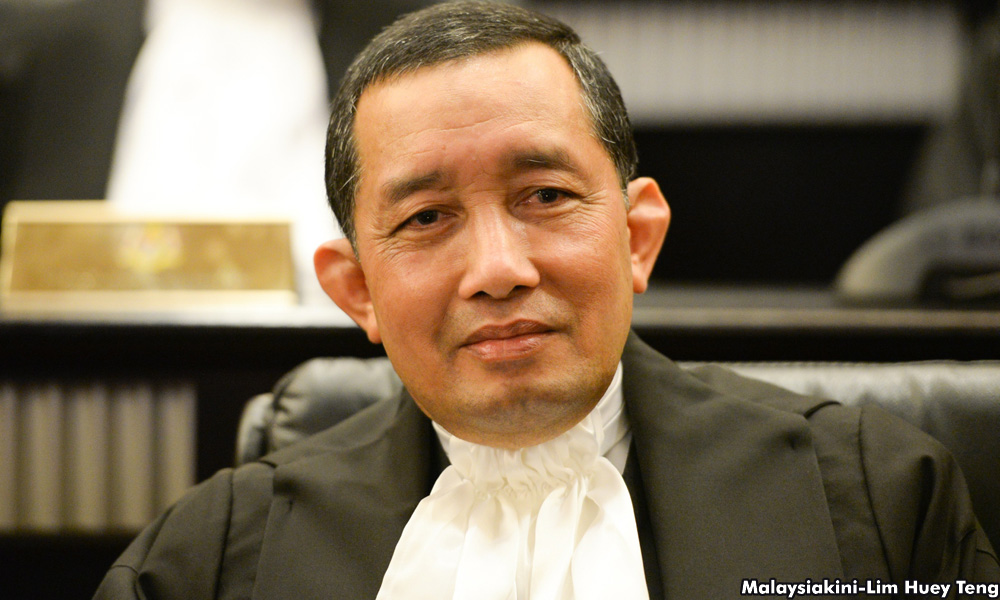

Appellate court judge in Guan Eng's case recuses himself
A judge hearing the appeal by Penang Chief Minister Lim Guan Eng and businessperson Phang Li Koon in the Court of Appeal today recused himself after an oral application from lawyers representing the appellants.
The lawyers argued that Justice Idrus Harun, who wrote the judgment in the case involving lawmaker Tony Pua on his right to travel, had given a restrictive view on Article 5 of the Federal Constitution on the liberty of a person, one of the points to be submitted in this appeal.
The application was made by Gobind Singh Deo, who represented Lim, and V Sithambaram, who acted for Phang...
A judge hearing the appeal by Penang Chief Minister Lim Guan Eng and businessperson Phang Li Koon in the Court of Appeal today recused himself after an oral application from lawyers representing the appellants.
The lawyers argued that Justice Idrus Harun, who wrote the judgment in the case involving lawmaker Tony Pua on his right to travel, had given a restrictive view on Article 5 of the Federal Constitution on the liberty of a person, one of the points to be submitted in this appeal.
The application was made by Gobind Singh Deo, who represented Lim, and V Sithambaram, who acted for Phang.
Gobind said he does not want to be placed in a position where he would have to criticise the decision by Justice Idrus in Pua's case and put the judge in an embarrassing situation as they will also file an appeal on that case.
The prosecution, led by DPP Mohd Masri Daud, objected to the application but Justice Idrus decided to recuse himself.
The hearing of the appeal has been fixed on Aug 7.
This is an appeal by Lim and Phang to challenge the constitutionality of Section 62 of the Malaysian Anti-Corruption Commission (MACC) Act 2009.
"We would be making a submission that the provision in Article 5 of the (Federal) Constitution involves other rights for personal liberty, including the right to remain silent and the presumption of innocence,” Gobind said.
“In Pua's case, Justice Idrus held that Article 5 should be held restrictively while our position, as with other provisions in the constitution, is that it should be read liberally. I do not want that it comes to an embarrassing position where I have to say Justice Idrus was wrong in making this finding and this would make it much more difficult for Justice Idrus to decide in this case (if he stays),” he added.
Sithambaram said he also did not want to come to unpleasant circumstances as what they were doing was acting or trying to act in their client's best interests.
“It is nothing personal but if you look at the situation, we are of the view that Article 5 should be given a generous liberal meaning,” he said.
Justice Idrus in Pua's case had written that by reason of its clear provision, Article 5 does not require an expansive or uninhibited interpretation and in "our judgment, it certainly does not import, and in fact, excludes any other rights".
The prosecution led by DPP Mohd Masri Daud objected to the application, saying that this was not a fit and proper case to recuse a judge.
“We have three judges and if we allow the application, it would open the floodgates for them to find other judges when the decision is not in their favour,” he said.
Embarrassing situation
However, Gobind, in his reply, said Justice Idrus would be put in an embarrassing situation if it is highlighted that the judge did not follow the principle of stare decisis (to stand by things decided) and that he was disobedient of a Federal Court judgment.
“My client is entitled to have a bench which has a clear mind,” the lawyer added.
Despite reservation by Justice Umi Kalthum Abdul Majid who was leading the bench, Justice Idrus decided to recuse himself.
“I have considered the application by the defence and submission of both parties and find there is merit. I will recuse myself,” said Justice Idrus, who was formerly the solicitor-general.
Justice Umi Kalthum said it would not be easy to find a new judge and fixed case management today to set up a new panel without Justice Idrus. The third judge on the bench was Justice Abdul Rahman Sebli.
Following the case management, the hearing of the appeal has been fixed on Aug 7.
This is the second time that the case had been postponed on appeal. The first time was when the Court of Appeal sought rectification of the Penang High Court order.
Lim claimed trial on June 30, last year, to two counts of corruption charges related to land conversion (from agriculture to housing), and the purchase of an RM2.8 million bungalow at below market value.
He was charged under Section 23 of the Malaysian Anti-Corruption Commission 2009 for allegedly using his position to obtain gratification for himself and his wife, Betty Chew Gek Cheng, by approving the land conversion in Balik Pulau for Magnificent Emblem Sdn Bhd. Lim was accused of doing so when chairing a meeting of the Penang state planning committee on July 18, 2014.
If convicted, Lim faces a jail term of up to 20 years and a fine of not less than five times the amount of graft involved, or RM10,000, whichever is higher.
The second charge against Lim involves him allegedly purchasing the bungalow in Jalan Pinhorn on July 28, 2015, from Phang, who owns 30 percent of Magnificent Emblem.
Phang, as the former owner of the bungalow in Jalan Pinhorn, pleaded not guilty to charges of conspiring with Lim for him to obtain the bungalow at below market price at the same place and date.
Phang was charged under Section 109 of the Penal Code read together with Section 165, which provides for a jail term of up to two years, or fine, or both, if convicted.
Lim and Phang wanted to challenge the constitutionality of Section 62 of the MACC Act 2009.
The section states that “once the prosecution submits documents pursuant to Section 51A of the Criminal Procedure Code, the accused shall before the trial begins, submit (a) statement of defence and (b) a copy of any document that can be presented as part of the evidence for the defence".


Are you sure you want to delete this comment?
This action cannot be undone.