
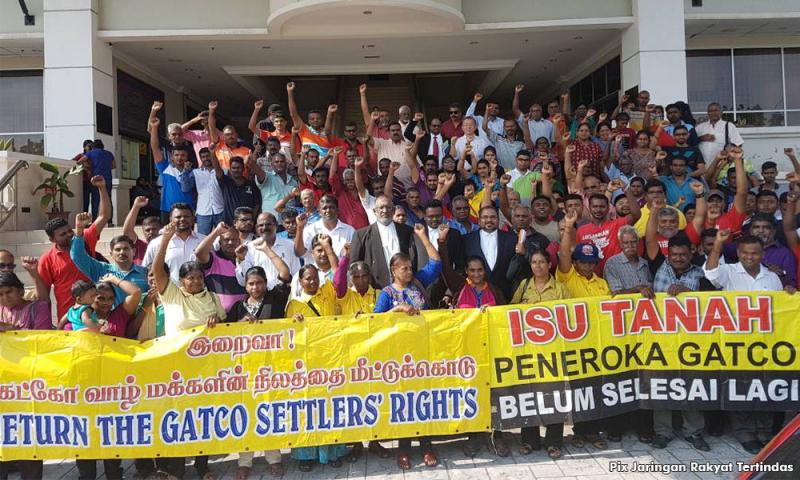
Bravo to police for arresting senior citizens of Kampung Gatco
COMMENT | There is something seriously wrong with the Malaysian police force. It is totally unimaginable that 28 villagers, including 13 women, all of them in their 50s and 60s, of Kampung Gatco, Serting Ilir, Negri Sembilan would be detained by the police for trying to protect their rights as bona fide settlers.
These villagers, who are former members of the National Union of Plantation Workers (NUPW), were arrested on the afternoon of July 18, 2017 for trying to block lorries sent by Thamarai Holdings Sdn Bhd from transporting rubber logs out of the village.
However, upon appeal by the villagers' lawyer, the High Court in Seremban overturned the decision of the lower court by refusing to grant the police a three-day remand, citing the health conditions of the villagers.
The origins of the problem
In the mid-1970s, hundreds of former rubber plantation workers from all over the country participated in a settlers' land scheme initiated by the NUPW. In the first phase, more than 400 settlers and families were settled in the scheme, which was to be managed by the Great Alonioners Trading Corporation Berhad (Gatco), a wholly-owned subsidiary of the NUPW.
The land was originally owned by the Negri Sembilan State Economic Development Corporation (SEDC), who leased it to Gatco for 99 years.
Before the second phase could be started, the resettlement collapsed under the weight of corruption and mismanagement...
COMMENT | There is something seriously wrong with the Malaysian police force. It is totally unimaginable that 28 villagers, including 13 women, all of them in their 50s and 60s, of Kampung Gatco, Serting Ilir, Negri Sembilan, would be detained by the police for trying to protect their rights as bona fide settlers.
These villagers, who are former members of the National Union of Plantation Workers (NUPW), were arrested on the afternoon of July 18, 2017 for trying to block lorries sent by Thamarai Holdings Sdn Bhd from transporting rubber logs out of the village.
However, upon appeal by the villagers' lawyer, the High Court in Seremban overturned the decision of the lower court by refusing to grant the police a three-day remand, citing the health conditions of the villagers.
The origins of the problem
In the mid-1970s, hundreds of former rubber plantation workers from all over the country participated in a settlers' land scheme initiated by the NUPW. In the first phase, more than 400 settlers and families were settled in the scheme, which was to be managed by the Great Alonioners Trading Corporation Berhad (Gatco), a wholly-owned subsidiary of the NUPW.
The land was originally owned by the Negri Sembilan State Economic Development Corporation (SEDC), which leased it to Gatco for 99 years.
Before the second phase could be started, the resettlement collapsed under the weight of corruption and mismanagement.
There were two prongs to the development of this land settlement. The first was the provision of houses and one-acre land plots for the settlers, and the second was the allocation of a 10-acre plot for each settler family for agricultural purposes.
The first prong was done successfully while the second prong hit a snag as result of the mismanagement of the land scheme by Gatco.
Gatco, unable to service its loans taken from banks and finance companies, was forced to hand over the property to a liquidator, who in turn sold it to Thamarai Holdings in 2004 with the consent of the Negri Sembilan government.
Thamarai Holdings is a subsidiary of the Lotus Group of Companies.
Villagers' conflict with Thamarai Holdings
The standoff between the villagers and Thamarai Holdings began when the latter bought approximately 4,700 acres of land from the liquidator appointed by Gatco to settle its outstanding debts to finance companies and some commercial banks.
Before the land was sold to Thamarai Holdings, the villagers wanted to purchase the land from Gatco, but unfortunately Gatco went ahead without informing the workers and sold the property to Thamarai Holdings.
This sale was done in bad faith because the land was meant to be distributed in parcels to the villagers as per their original agreement with Gatco.
This is the reason why the villagers have hired a lawyer to commence legal proceedings against Gatco and Thamarai Holdings for acting in bad faith and for negating the rights of villagers.
Basically, the villagers think that the land should not have been sold without their consent, since they had a stake in the land by way of their earlier agreement with Gatco.
Since they are bona fide settlers, they believe that the liquidator should have resolved the matter with them rather than roping in a third party, Thamarai Holdings.
They hope that a court intervention will be able to force the settlers, the new land owner, and the state government to come together and amicably resolve the issue, which has lasted more than 30 years.
They have gathered together a few times since the land was sold to protest the slow but steady incursion of the owner, who has been cutting down rubber trees to clear the land.
It is not altogether clear why a reputable Malaysian Indian business family would buy the land in the interior of Negri Sembilan, knowing very well the existence of various legal and political impediments on the land.
I am not sure what kind of assurance was given by the Negri Sembilan government to Thamarai Holdings to boldly venture into this property purchase. Was the entire piece of land sold according to the market rate, or was it sold cheap? What kind of assurance did the Negri Sembilan government give to the new owners on the purchase of the land?
I understand that the Gatco land matter was brought to the attention of the elected representatives in one or two sittings of the Negri Sembilan state legislative assembly. May I know what the outcome was, and what was the response of the menteri besar on this matter?
Is it true that Thamarai Holdings hired contractors and thugs to cut down the rubber trees and threaten the villagers who opposed them? Why did the otherwise "inactive" police take an overzealous stand in protecting the rights of the new landowner, Thamarai Holdings? Did Thamarai obtain a court injunction to prevent the villagers from blocking the cutting and transporting of the rubber logs?
Inspector-general of police (IGP) Khalid Abu Bakar, who recently congratulated the police for their quick and efficient action against "gangsters", should also extend the same praise to the Negri Sembilan police for detaining, arresting, handcuffing and forcibly taking 28 villagers, all in their 50s and 60s, to the nearest police station.
How these elderly people would constitute a national threat is a question best understood by our gung-ho IGP.
It took the High Court judge Siti Mariam in Seremban to highlight the utter cruelty of the police, by rejecting their request for a three-day remand of the senior citizens. In dismissing the police’s application, she reportedly said that she was concerned about the health of the elderly detainees.
P RAMASAMY is Deputy Chief Minister II of Penang and the state assemblyperson for Perai.
The views expressed here are those of the author/contributor and do not necessarily represent the views of Malaysiakini.


Are you sure you want to delete this comment?
This action cannot be undone.