



Hadi's flawed understanding of Islamic governance
COMMENT | Islam is "deen", which in Arabic means a total way of life. But a total way of life does not mean it must be totalitarian.
This is the fundamental mistake of all Islamic political parties in the world. By seeking totality, they confuse what is indeed holistic and complete with totalitarianism.
The latter, in a sense, is "shirk", which in Arabic means a polytheistic view of Islam.
When one creates a system of government that is totalitarian - even when the actual noble intention is to seek a total way of life that is compatible with every aspect of Islam - the government will be more important than God Himself.
Take certain countries in the Middle East which purport to be Islamic. Their systems are completely rigid, and there is no rule of law except rule by decree or by the state. What the state says is totalitarian and final.
In such a state, where is the concept of mercy, compassion, civility and empathy that a true Islamic government is required to have?
In fact, mercy and compassion are so important that of all the 144 chapters in the Quran, which was revealed to humankind as a mercy to all, the opening chapter is "In the name of Allah Most Merciful and Most Compassionate" which in prayer is rendered as "Bismillah Al Rahman Al Rahim".
The one chapter that does not begin with "Bismillah Al Rahman Al Rahim", is a chapter where Muslims were cornered, and were given the permission to go to war as a means of self-defence. Other than this proviso, Allah is mercy embodied and revealed in the Al Quran.
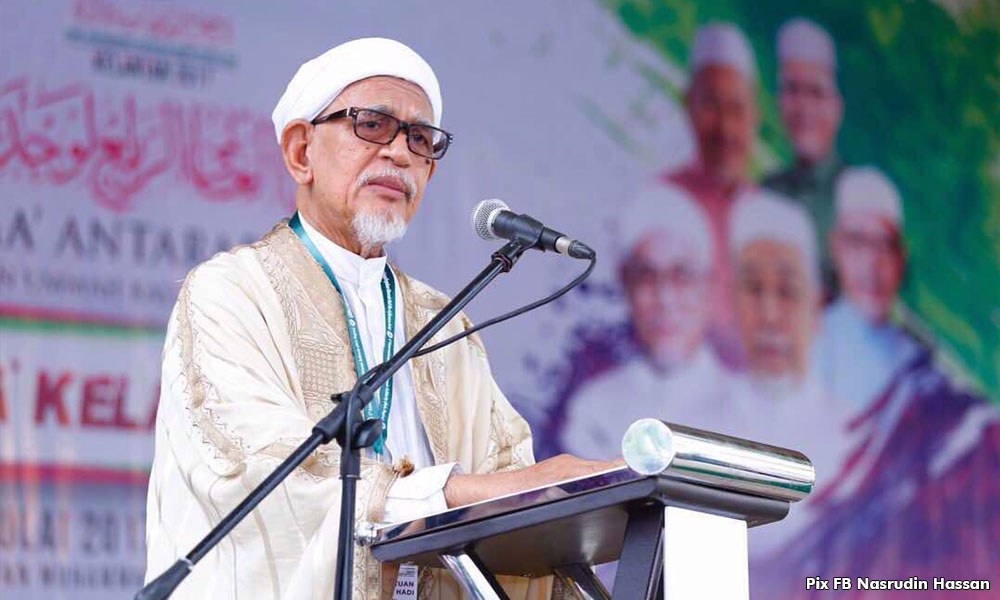
So when political leaders like PAS president Abdul Hadi Awang, whose political party has never petitioned the Parliament and the prime minister to show mercy and compassion to the poor, insists time and again to be given a chance to rule with the whip of Islam, one wonders if he knows Islam as a holistic and total way of life, or Islam as a totalitarian system?...
COMMENT | Islam is "deen", which in Arabic means a total way of life. But a total way of life does not mean it must be totalitarian.
This is the fundamental mistake of all Islamic political parties in the world. By seeking totality, they confuse what is indeed holistic and complete with totalitarianism.
The latter, in a sense, is "shirk", which in Arabic means a polytheistic view of Islam.
When one creates a system of government that is totalitarian - even when the actual noble intention is to seek a total way of life that is compatible with every aspect of Islam - the government will be more important than God Himself.
Take certain countries in the Middle East which purport to be Islamic. Their systems are completely rigid, and there is no rule of law except rule by decree or by the state. What the state says is totalitarian and final.
In such a state, where is the concept of mercy, compassion, civility and empathy that a true Islamic government is required to have?
In fact, mercy and compassion are so important that of all the 144 chapters in the Quran, which was revealed to humankind as a mercy to all, the opening chapter is "In the name of Allah Most Merciful and Most Compassionate" which in prayer is rendered as "Bismillah Al Rahman Al Rahim".
The one chapter that does not begin with "Bismillah Al Rahman Al Rahim", is a chapter where Muslims were cornered, and were given the permission to go to war as a means of self-defence. Other than this proviso, Allah is mercy embodied and revealed in the Al Quran.
So when political leaders like PAS president Abdul Hadi Awang, whose political party has never petitioned the Parliament and the prime minister to show mercy and compassion to the poor, insists time and again to be given a chance to rule with the whip of Islam, one wonders if he knows Islam as a holistic and total way of life, or Islam as a totalitarian system?
The distinction is extremely important because, in a total way of life, Islam does not have to begin with the state. If an individual loves Islam and wants to follow syariah (which means the path or way-to-be-followed), he or she can do it first by the rectitude of his or her action based on the five pillars of Islam and six articles of faith.
The five pillars of Islam involves the Shahadah testimony, or testifying that there is no other God but Allah, and Muhammad is the Messenger of Allah; praying; paying the compulsory tithe (zakat); fasting during Ramadan; and making the Haj pilgrimage if one can afford it.
The six articles of faith include belief in Allah; His Angels; His Scriptures; His Messengers; the Day of Judgment; and divine predestination.
Indeed, if one carefully examines the works of Professor Hashim Kamali, who is a profound scholar based in Malaysia, syariah is something that constantly expands with the need of the time.
If a knowledge economy is important, for example, then part of the holistic solution of Islam in any government run by Islamic leaders, is to improve the resources and training to train knowledge workers.
Indeed, Islamic governance is extremely wary of "fitnah", or calumny. In an environment of calumny, where honesty is hidden and truths are shielded, Islam chafes at those who protect themselves but not the underprivileged.
In seeking to implement Islamic approach in government, Hadi is asking for carte blanche to do things his way. But Islam, as understood through Islamic jurisprudence, does not allow anyone the free licence to try anything that may invite doubt.
As the Prophet Muhammad SAAS said, "When something is in doubt, stay away, do not try it." For that is the better way to keep Muslims safe.
Hadi Awang has not even recovered completely from his heart illness nor removed himself completely from Umno, let alone received the consensus of the religious council in PAS to work with or for Umno.
When one is in poor health and recuperating from a major surgery, Islam encourages that person to take a leave of absence to completely recuperate and come back healthy to lead his followers.
PAS has very well-trained leaders to take the reins in the interim to ensure its struggle is kept well within the parameters of syariah.
RAIS HUSSIN is a Supreme Council Member of Parti Peribumi Bersatu Malaysia (PPBM). He also heads the Policy and Strategy Bureau of PPBM.
The views expressed here are those of the author/contributor and do not necessarily represent the views of Malaysiakini.


