




Haze crisis a threat to Malaysia's economy: analysts
The thick haze that has enveloped parts of Malaysia, including the capital and its biggest port, poses a threat to the slowing economy if the crisis persists, analysts warn.
The thick haze that has enveloped parts of Malaysia, including the capital and its biggest port, poses a threat to the slowing economy if the crisis persists, analysts warn.
Economists said the smog, which appeared two weeks ago, has already affected productivity and consumer spending and could also harm the tourism industry which is Malaysia's second-biggest foreign exchange earner.
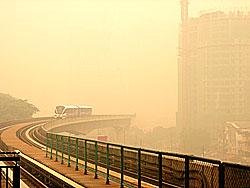 "The haze is a threat to the economy. Due to the smog, people are staying indoors," said Ramon Navaratnam, a member of the government's National Economic Action Committee working group.
"This means consumer spending is down. When people do not go to work, it affects productivity," he told AFP .
If the economy was to grow by about six percent in 2005, the choking layer of smoke and dust created by forest fires in neighbouring Indonesia would take away a few percentage points, he said.
The government has said that Gross Domestic Product (GDP) in 2005 will expand by about 5.0-6.0 percent, lower than last year when it reached 7.1 percent, and rising oil prices have already threatened to undercut the forecast.
Haze has become an annual phenomenon in Southeast Asia, due to the burning practices of farmers in Indonesia's Sumatra and Borneo islands.
The worst-ever bout, in 1997 and 1998, cost the region an estimated 9.0 billion dollars in damages by disrupting air travel and other business activities.
Last week a state of emergency was declared in two towns on Malaysia's coast, including Malaysia's main shipping centre of Port Klang, where operations were halted temporarily as the haze soared to extremely hazardous levels.
Kuala Lumpur's second airport was closed due to poor visibility, and contingency plans were made in case the countrys main Kuala Lumpur International Airport was forced to shut.
The state of emergency was lifted Saturday, but while the air cleared in Port Klang and the capital Kuala Lumpur, the shifting winds sent the smoke north, triggering warnings to tourists on the resort island of Penang.
Cancelled tours
Navaratnam, a former deputy secretary-general of the treasury, warned that unless proactive measures are taken to fight the haze, tourists may give Malaysia a miss.
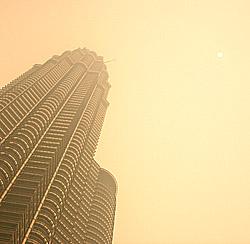 "If I was a tourist coming to Malaysia, I want to see the sun and enjoy the sea. The smog will put a black spot on Malaysia," he said.
But tourism industry officials said that despite the fears, which are particularly acute as August is peak season for the lucrative Middle East market, early indications showed no significant drop in arrivals.
Tourism ministry secretary-general Victor Wee said that while some 100 people had cancelled tours, there had not been any major hotel cancellations in the capital Kuala Lumpur.
"We are cautiously optimistic that the situation will improve", he told AFP Friday after a meeting of officials and industry players to assess the impact.
The Malaysian stock market experienced a downtrend last week over fears the haze would impact on the economy. By Friday the composite index had dipped 6.37 points or 0.7 percent over the week to 937.04.
Economists said investors' fears could be alleviated if there were signs that regional governments were cooperating more actively to combat the haze.
Investors "not only want commitment from Malaysia and Indonesia but also Singapore, Thailand and the Philippines" on fighting the problem, said Wong Chee Seng, chief economist with ECM Libra Securities.
"The market would also like to see what is the concerted long term plan," he said.
Food sellers suffer
The haze has already cut into the livelihoods of small business owners, particularly traders and open-air food vendors.
 Khong Chee Seng, an advisor to two associations representing 1,300 hawker traders in suburbs south of Kuala Lumpur, said food sellers had suffered a 50 to 70 percent drop in business during the week.
"They cook the food but regular customers are staying away because of the haze," he said.
Meteorological officials have said the haze could linger until October, when winds from the dry southwest monsoon, which blow from Sumatra island, finally shift.
"If this haze remains for a longer period, then there will be enough reasons for us to be worried," said Kevin Chew, research fellow with the Malaysian Institute of Economic Research.


