
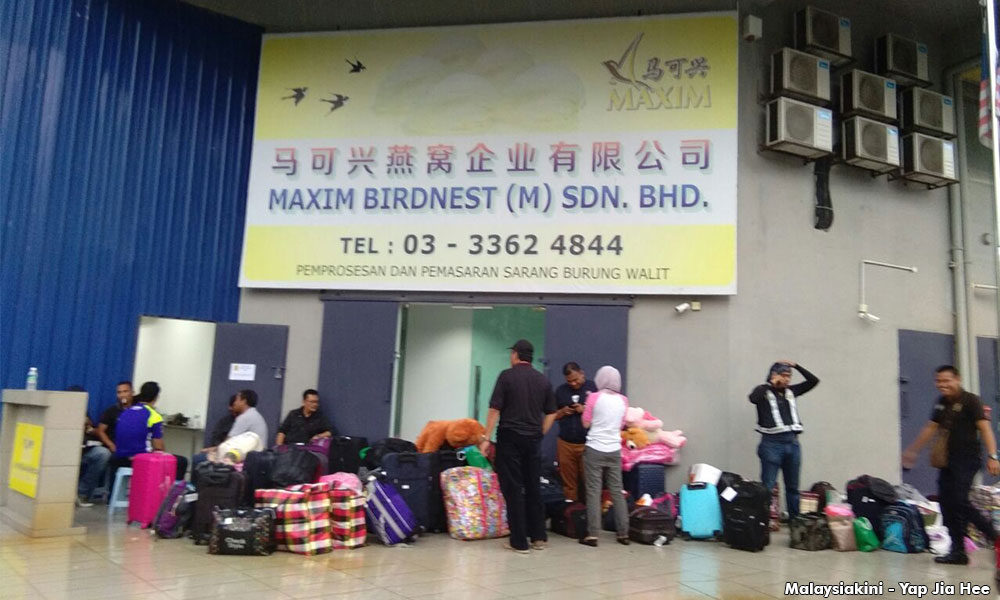

The working conditions of 156 staff rescued from a bird’s nest factory in Klang have been described as “hell on earth” by none other than Immigration director-general Mustafar Ali, who was present during the multi-agencies operations in March.

At the time, many of the workers told Malaysiakini that all they wanted to do was to go home to Indonesia and never return to Malaysia again.

Since then, more than five months have passed and questions were raised as to why charges were only brought against their employer - Maxim Birds Nest Sdn Bhd - under the Employment Act 1955 and the National Wages Consultation Council 2011.

The Selangor Labour Department had named the company as a defendant in the case involving 11 Indonesian employees, involving 105 counts of alleged labour law infringements, which was first heard at the a magistrate’s court in Klang on June 15.

The same question on the lack of criminal prosecution was also raised by a group of migrant rights activists during a meeting with the Bar Council's migrants, refugees and immigration affairs committee chairperson M Ramachelvam yesterday.

When contacted, Ramachelvam said he had advised the activists to formally write to the Attorney-General's Chambers (AGC) and request for criminal prosecution under the Anti-Trafficking in Persons & Smuggling of Migrants (Atipsom) Act.

“If the AGC refuses to take criminal prosecution, then it should give the reasons for not prosecuting.

“I am of the view that the enforcement action taken thus far in respect of this case is absolutely inadequate,” Ramachelvam said, and noted that ongoing prosecution by the Labour Department was only for a small number of workers from the total rescued.

Among the complainants is labour activist Abdul Aziz Ismail, who told Malaysiakini that he would be writing an official letter to the AGC next week on behalf of NGO Selangor Anti-Trafficking in Persons Council.

“There are discrepancies in the handling of this (Maxim) case.

“For example, many of the workers said their passports were withheld (by the employer) but there is no charge under the Passport Act 1966,” he explained.

Referring to the letter to the AGC, Abdul Aziz said he would also be highlighting media reports and first person accounts from the workers that their work permits were issued under the name of Kiss Produce Food Tradings - a company that shared the same registered address as the Maxim bird's nest factory in Lorong Gudang Nanas, Klang - as well as a green technology company in Shah Alam.

Klang MP Charles Santiago said that the shifting of workers is an offence under the Immigration Act 1959.

“Any element of forced labour can also constitute human trafficking,” Santiago said when contacted.

Jakarta-based NGO Migrant Care had in April also highlighted the discrepancies in the placement of workers at Maxim.

‘Challenges to charge under Atipsom Act’

In a recent interview with Malaysiakini at his office in Putrajaya, Mustafar revealed that he was informed by investigating police officers of the challenges in framing a charge against Maxim under the Anti-Trafficking in Persons and Smuggling of Migrants Act 2007 (Atipsom Act).

“At that particular time when we went in, (elements of) the human trafficking offences were there,” he said when asked for comments.

“But later, when the police discussed with the Attorney-General’s office, they (AGC) are not really into it,” Mustafar (photo) said, and added that it involved technicalities surrounding chances to sustain a conviction in court.

Among others, he confirmed that all of the workers he talked to at the department’s shelter home only wanted to go back to Indonesia, thus making it difficult to record their statements or present them as witnesses in court.

“I asked them personally. Everybody raised their hands when I asked ‘siapa nak pulang?’ (who wants to go home?),” he recalled.

On behalf of the Immigration Department, Mustafar said, he held discussions with the Attorney-General’s Chambers (AGC) and the Malaysian Council for Anti-Trafficking in Persons on measures to strengthen their overall cases.

“When you talk about the victims’ statements, you must have at least a 90 percent chance (to secure a conviction) before you go to court

“If not, then gone case,” he stressed.

Five days before the operation was conducted, Malaysiakini had, in a joint special report with Tempo magazine from Indonesia, highlighted the alleged exploitation of foreign workers at the factory.