


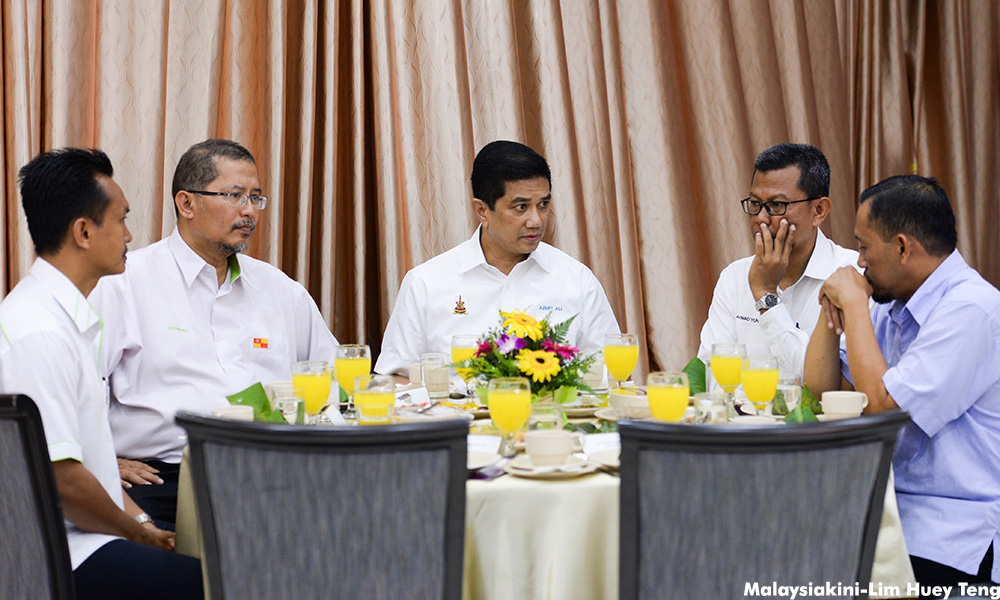

Why is Azmin Ali still engaging with PAS?
COMMENT | Why is Selangor Menteri Besar and PKR deputy president Azmin Ali still engaging with PAS? What can PKR possibly have in common with PAS under its president Abdul Hadi Awang?
PAS has firmly established itself since the demise of former president Nik Aziz Nik Mat as a fundamentalist, radicalised, reactionary and exclusionary Islamic party that has now fully adopted the Umno political ideology of Ketuanan Melayu and wrapped it in Islamic credentials, simply in order to be seen as a viable partner to Umno while hoping to retain its dwindling support among its core rural Malay-Muslim voter base.
PAS’ only political role at present is to ensure that Umno remains in power, if necessary, with a PAS crutch in order to ensure Malay-Muslim dominance of the political system and to strengthen Islam in the country in the Wahhabi mould that inspired most of the PAS leadership. Umno, of course, wants to oblige PAS as a matter of political survival.
That is why the debate about enhancing syariah laws, the gradual implementation of hudud, the empowerment of the syariah courts and eventually creating a dual-legal system in the country for Muslims and non-Muslims is being encouraged by Umno and the Islamic religious authorities in the country.
In this discourse, Umno is not bothered about the erosion of our semi-secular Federal Constitution, the negation of fundamental freedoms and human rights and the overarching imposition of Islamic values, beliefs and practices on our way of life that not only impedes Muslims but interferes with non-Muslims as well and is gradually destroying our national identity, and even Malay culture and customs.
PKR has always prided itself as a multiracial, multireligious centrist political party with liberal views on politics and the economy. Although the PKR leadership is dominated by Malays, a political necessity given our demographics, the party has successfully projected a platform that appeals to middle Malaysia by not over-emphasising race and religion while espousing the causes of other races and religions in a spirit of unity, acceptance and moderation.
The bane of PKR since inception
The bane of PKR since its inception in 1999 has been the inability of the senior leadership, including de facto leader Anwar Ibrahim, to completely disavow and distance the party from the Umno mindset and the desire to obtain and retain power at all costs.
Sometimes, in the eagerness to seek power, various factions within the party are willing to sacrifice integrity and principle for the sake of political expediency.
PKR, like most political parties in Malaysia, is riddled with factionalism.
But unlike other parties that are successful in keeping a lid on factionalism through strong leadership, PKR suffers from weak and indecisive leadership.
This is because of Anwar’s prolonged incarceration and the inability of PKR president Dr Wan Azizah Wan Ismail and her daughter, party vice-president Nurul Izzah Anwar, to steer the party away from fratricide caused by various competing interests within the party centred around Azmin and PKR vice-president Rafizi Ramli, and their surrogates and proxies...
COMMENT | Why is Selangor Menteri Besar and PKR deputy president Azmin Ali still engaging with PAS? What can PKR possibly have in common with PAS under its president Abdul Hadi Awang?
PAS has firmly established itself since the demise of former president Nik Aziz Nik Mat as a fundamentalist, radicalised, reactionary and exclusionary Islamic party that has now fully adopted the Umno political ideology of Ketuanan Melayu and wrapped it in Islamic credentials, simply in order to be seen as a viable partner to Umno while hoping to retain its dwindling support among its core rural Malay-Muslim voter base.
PAS’ only political role at present is to ensure that Umno remains in power, if necessary, with a PAS crutch in order to ensure Malay-Muslim dominance of the political system and to strengthen Islam in the country in the Wahhabi mould that inspired most of the PAS leadership. Umno, of course, wants to oblige PAS as a matter of political survival.
That is why the debate about enhancing syariah laws, the gradual implementation of hudud, the empowerment of the syariah courts and eventually creating a dual-legal system in the country for Muslims and non-Muslims is being encouraged by Umno and the Islamic religious authorities in the country.
In this discourse, Umno is not bothered about the erosion of our semi-secular Federal Constitution, the negation of fundamental freedoms and human rights and the overarching imposition of Islamic values, beliefs and practices on our way of life that not only impedes Muslims but interferes with non-Muslims as well and is gradually destroying our national identity, and even Malay culture and customs.
PKR has always prided itself as a multiracial, multireligious centrist political party with liberal views on politics and the economy. Although PKR leadership is dominated by Malays, a political necessity given our demographics, the party has successfully projected a platform that appeals to middle Malaysia by not over-emphasising race and religion while espousing the causes of other races and religions in a spirit of unity, acceptance and moderation.
The bane of PKR since inception
The bane of PKR since its inception in 1999 has been the inability of the senior leadership, including de facto leader Anwar Ibrahim, to completely disavow and distance the party from the Umno mind-set and the desire to obtain and retain power at all costs.
Sometimes, in the eagerness to seek power, various factions within the party are willing to sacrifice integrity and principle for the sake of political expediency.
PKR, like most political parties in Malaysia, is riddled with factionalism.
But unlike other parties that are successful in keeping a lid on factionalism through strong leadership, PKR suffers from weak and indecisive leadership.
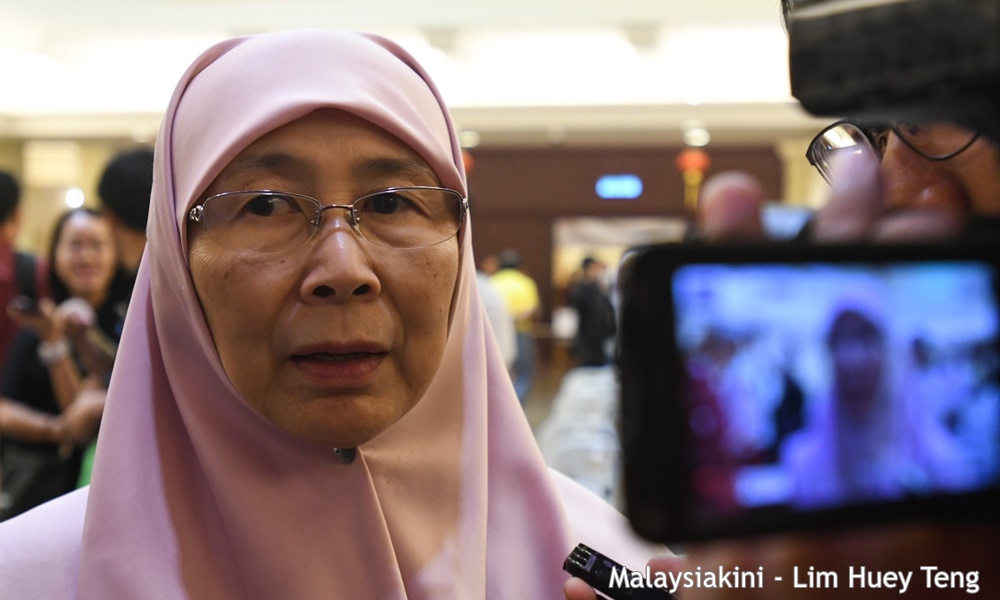 This is because of Anwar’s prolonged incarceration and the inability of PKR president Dr Wan Azizah Wan Ismail (photo) and her daughter, party vice-president Nurul Izzah Anwar, to steer the party away from fratricide caused by various competing interests within the party centred around Azmin and PKR vice-president Rafizi Ramli, and their surrogates and proxies.
Very often, public service within PKR is confused with publicity and as a result, party discipline suffers. Unlike the DAP, and even the nascent Parti Pribumi Bersatu Malaysia (Bersatu), PKR suffers from endemic weak grassroots organisation and mobility.
Perhaps that is why Azmin still hopes for an electoral pact with PAS, because he fears PKR on its own cannot mobilise the semi-urban Malay voter base. In the last two general elections, even in Selangor, PKR depended largely on PAS to deliver the Malay votes in crucial marginal semi-urban or semi-rural seats.
But what Azmin has failed to appreciate is the strong presence of Bersatu under the leadership of chairperson Dr Mahathir Mohamad, who has caught the attention of Malay voters from every segment and has galvanised support for Pakatan Harapan, even in once-safe Umno seats.
Within Umno, there is an increasing realisation that with Mahathir as the visible leader and face of the opposition, the next general election is going to be a tough fight and a close call.
Among the older generation of Umno members and those in their 50s and 40s who owe their political futures and economic success to Mahathir, there is still a sense of loyalty and gratitude to the father of modern Malay nationalism and progress. These Umno members are going to secretly cast their ballots for Harapan or abstain from voting for Umno-BN.
This will spell trouble for Umno-BN under Prime Minister Najib Abdul Razak. Despite his huge financial resources, incumbency and all the trappings of state power and authority, Najib is still able to overcome his integrity deficit and the stigma of suspicion over the 1MDB scandal and his perceived mismanagement of the economy that has precipitated the introduction of the goods and services tax (GST).
Impact of the GST
The GST has impacted the lives of every income group, but most notably the Malay middle class and the lower income earners who include Umno’s traditional voter base, namely the civil servants, teachers, pensioners, army, police, small and medium businesses and petty traders.
PKR, like DAP, ought to be linchpins of Harapan while Bersatu and Amanah, being newer political parties but entirely Malay-dominated, should be allowed to take the lead in challenging Umno and PAS in their own traditional seats.
Despite PAS repeatedly slamming the door at Harapan and Bersatu, Azmin seems to still be hoping for the impossible while seeming duplicitous.
Mahathir is absolutely right to tell PAS to get lost, now that the party has become an appendage to Umno and a lifeline to Najib. Harapan has made it clear that PAS is a lost cause and deserves to face the same fate as Umno at the hand of the voters.
So why is Azmin still trying to persuade, if not convert them, to his point of view? To all and sundry, it seems futile at best and self-serving at worst.
Is Azmin not confident of his own track record as menteri besar and PKR’s two-term helming of the state government that is widely regarded as a success by voters in Selangor? Even if PAS achieved something credible in Selangor, it was entirely due to the support and endorsement of PKR and the DAP.
The sophisticated voters of Selangor
Selangor being the most industrialised and urbanised state in the country, with incomes and a standard of living equivalent to any advanced Western country, has a highly educated and well-informed voter base. Internet penetration is the highest in Selangor and alternative news portals and websites are well accessed and read on a regular basis.
The sophisticated voters in Selangor, including those in semi-urban and semi-rural seats, as well as Malay-Muslims, are not enamoured by PAS’ version of Islam and its penchant for condemning everybody else as deviant and non-conformist.
These are moderate Muslims with a healthy respect and understanding of living in a multiracial society while retaining their religious piety.
For them, Islam at its core is about mercy and compassion and not the PAS obsession with form and judgment, like that being advocated by the Taliban and Islamic State, resulting in Islam being associated with violence and intolerance.
In Selangor, it is obvious from PAS’s public statements that it wants to contest 42 state seats, other than those held by Umno and independents sympathetic to Umno-BN. So where is the room for compromise?
It is beguiling that Azmin still wants to work with PAS. And for what? Just to remain as menteri besar? The office of menteri besar has not been gifted to Azmin. It is the right of the voters to decide and for the Sultan to approve.
What is more important is securing the state for Harapan and advancing the march to capture the federal government. It is time that PKR stops this mollycoddling of PAS and declare its full support for Harapan and its position on PAS.
If there is to be three- or four-cornered fights in Selangor during the next general election, so be it. Leave the choice to the wisdom of the voters and to their judgment of the current state government.
Even if Harapan is defeated in the GE14, let it be a defeat with honour. With their pyrrhic victory, PAS can sail into oblivion with Umno at the helm.
GERARD LOURDESAMY is a lawyer who has been in practice for 25 years, and is a former PKR member.
The views expressed here are those of the author/contributor and do not necessarily represent the views of Malaysiakini.


Report this comment
Are you sure you want to delete this comment?
This action cannot be undone.