


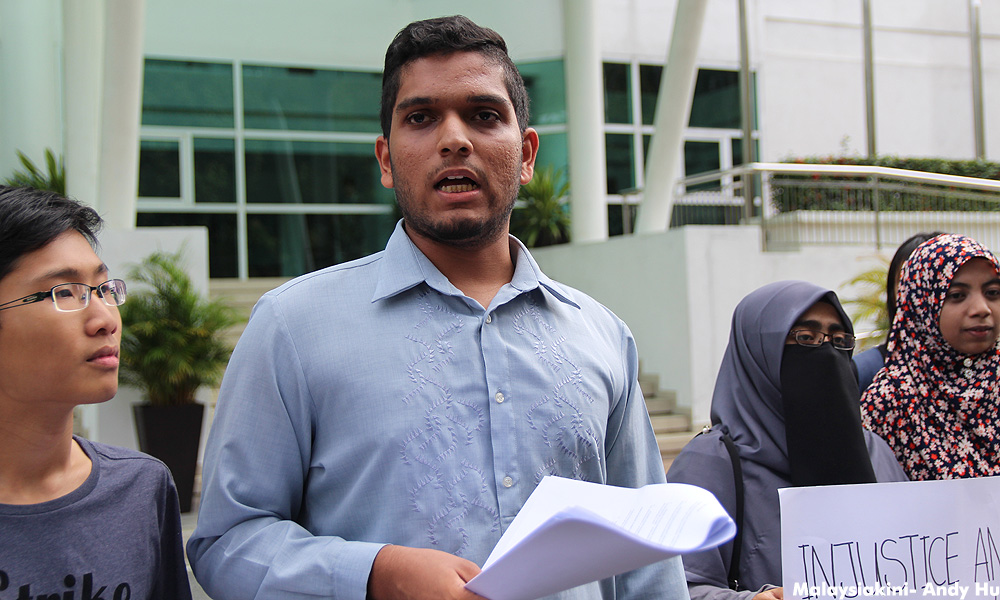

UM4, Asheeq, fail in bid to challenge suspension from varsity
Four Universiti Malaya (UM) students and a Universiti Kebangsaan Malaysia (UKM) student today failed in their bid to challenge disciplinary action imposed on them by their universities for taking part in the Tangkap Malaysian Official 1 rally last year.
Justice S Nantha Balan of the High Court in Kuala Lumpur dismissed the students' originating summons, saying Section 15 (3) of the University and University Colleges Act (UUCA) used against them was constitutional. The judge said the students should have filed a judicial review instead...
Four Universiti Malaya (UM) students and a Universiti Kebangsaan Malaysia (UKM) student today failed in their bid to challenge disciplinary action imposed on them by their universities for taking part in the Tangkap Malaysian Official 1 rally last year.
Justice S Nantha Balan of the High Court in Kuala Lumpur dismissed the students' originating summons, saying Section 15 (3) of the University and University Colleges Act (UUCA) used against them was constitutional. The judge said the students should have filed a judicial review instead.
Despite the decision, UKM's Asheeq Ali Sethi Alivi said he and the others would continue to fight for the abolition of the UUCA, which "limits the participation of students in outside activities".
"We are disheartened, but note that the UKM4 were successful in their action," he said, adding that he and the others would appeal against the decision. He also slammed the university authorities for seeking costs of RM15,000, despite the case being of public interest.
Justice Nantha Balan dismissed the universities' application for costs saying that the issue was a public litigation matter.
Besides Asheeq Ali, the other four UM students are Anis Syafiqah Md Yusop, Mohamad Luqman Nul Haqim Zul Razali, Muhammad Luqman Hakim Mohd Fazli and Suhail Wan Azhar.
Anis Syafiqah and Luqman Nul Haqim were also punished by UM for trespassing into Universiti Teknologi Mara's premises when they went there.
The UKM4 refers to four students of the UKM, who successfully challenged their suspension for participating in a political campaign during the Hulu Selangor by-election, which resulted in the court declaring their suspensions unconstitutional.
Justice Nantha Balan said the students should have filed a judicial review, rather than an originating summons, to challenge their cases.
“UM and UKM are public authorities and the disciplinary action taken against the students was based on the rules, which are statutory provisions (by way of subsidiary legislation), which grant universities the right to take action against the students for breach of discipline.
“Hence, there is more than a sufficient element of public law to attract the remedies of administrative law, making it amenable for judicial review including seeking the declarations being sought in the present originating summons,” the judge said, adding on that grounds alone, the court should have struck out the suit.
'Court decided to look into merits'
Despite that, the court decided to look into the merits of the case, he said.
“It is important to note that Section 15 (3) of the UUCA merely prohibits students from doing anything to show sympathy or support to 'any society, organisation, body or group of persons which the board determines to be unsuitable to the interests and well-being of the students or the university'.
“The fact that the universities had construed the act of their students in organising and participating in a rally without the consent of the owners of the premises, trespassing into property belonging to another, being questioned by police or being detained by the police as being contrary to the role of the plaintiffs as students.”
At any rate, Justice Nantha Balan said, he is of the view that the students have not identified the purported inconsistency between Section 15 (3) of the UUCA or the rules with Article 10 of the Federal Constitution pertaining to the freedom of speech.
“It is clear there is nothing in Section 15 (3) UUCA that prohibits the right of the plaintiffs to assemble, it has to be a total prohibition before it can be said to violate the fundamental liberties of the plaintiffs.
“In any event, if Section 15 (3) UUCA is deemed restrictive of the freedom granted by Article 10 of the Federal Constitution, I hold that such restriction (if any) is within the ambit of Article 10 (2) (a) of the Federal Constitution,” Justice Nantha Balan said.
He added that matters of discipline of students and regulation of student behaviour and conduct within and outside the university must necessarily form part of public order or morality.
“A university is where students gain knowledge and continue their learning and training on what is right and wrong, what is legal and what is not. An education institution may act morally in the proper constitutional sense of that term. Hence, the restriction, if any, is reasonable and justifiable on grounds of public order and morality.”
Justice Nantha Balan also said the question of police not taking action on the students was a separate matter, and universities do not have to wait for criminal proceedings before taking any action against their students.
“In my view, Section 15 (3) UUCA and the rules are not restrictive of the plaintiffs' rights to the extent of violating Article 10... and the mere fact that the mere behaviour of the students within and outside the university is regulated does not mean that their constitutional rights are curtailed. I take the view that Section 15 (3) UUCA and the rules are not in violation of Article 10 of the Federal Constitution.
“I am not convinced that a university's disciplinary rules, which require students whilst outside the university to behave in such a way as to bring disrepute to the university, can be construed as being in violation of Article 10.
“To my mind, if the student does not engage in any illegal activity and does not contravene the law, then he is unlikely to bring disrepute to the university,” Justice Nantha Balan said in dismissing the suit.
UKM was represented Amsa Damadaran Naidu while Adam Abdullah appeared for UM. Lawyer Firdaus Husni held a watching brief for the Bar Council.
The students were represented by Surendra Ananth and Marcus Lim.


Are you sure you want to delete this comment?
This action cannot be undone.