



TNB's sirens gave inadequate warning, flood victims tell court
The sirens that were supposed to warn Cameron Highlands residents of impending floodwaters in 2013 were inadequate, witnesses told the High Court in Kuala Lumpur today.
One witness, 54-year old domestic worker Kang Ai Moy, said the siren had sounded frequently in the past, but this did not always indicate that a flood was coming.
Responding to a question when cross-examined by Tenaga Nasional Bhd’s (TNB) lawyer R Harikannan, Kang said she understood the siren to be a signal "to standby.”
Asked whether "to standby" means to prepare to evacuate, she rebutted that the siren would be sounded “whenever it likes.”
“It (the siren) sings in the day; it sings in the night; it sings whenever it likes. Why would I run?” Kang said.
She replied in the affirmative when asked whether she considered the siren to be a normal occurrence...
The sirens that were supposed to warn Cameron Highlands residents of impending floodwaters in 2013 were inadequate, witnesses told the High Court in Kuala Lumpur today.
One witness, 54-year old domestic worker Kang Ai Moy, said the siren had sounded frequently in the past, but this did not always indicate that a flood was coming.
Responding to a question when cross-examined by Tenaga Nasional Bhd’s (TNB) lawyer R Harikannan, Kang said she understood the siren to be a signal "to standby.”
Asked whether "to standby" means to prepare to evacuate, she rebutted that the siren would be sounded “whenever it likes.”
“It (the siren) sings in the day; it sings in the night; it sings whenever it likes. Why would I run?” Kang said.
She replied in the affirmative when asked whether she considered the siren to be a normal occurrence.
Kang was testifying as the third witness in a lawsuit filed against TNB by her and 99 other Cameron Highlands residents.
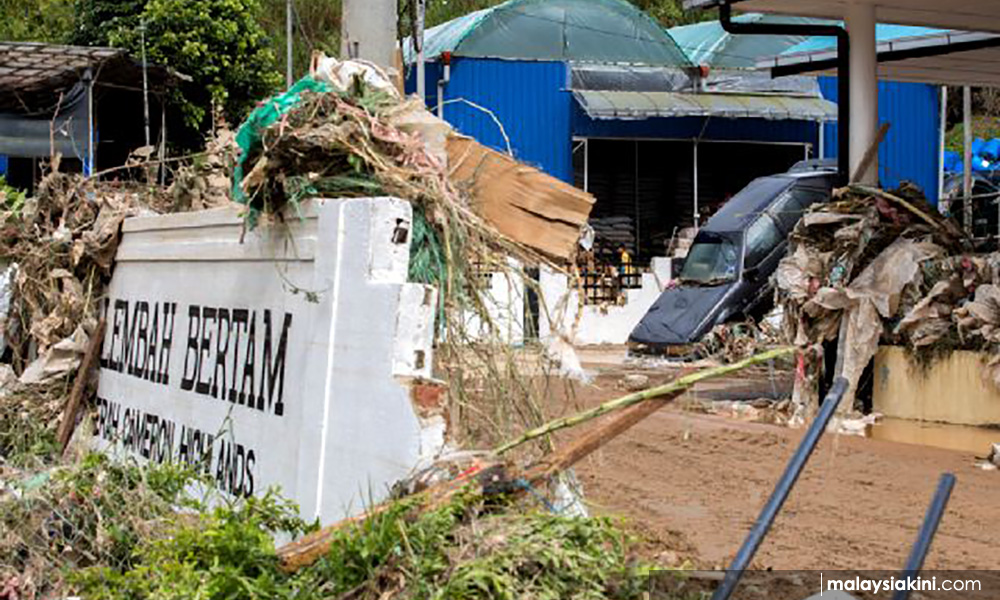
They are claiming that TNB had negligently caused a flash flood in Bertam Valley on Oct 23, 2013, when it released water from the Sultan Abu Bakar Dam as water levels there approached critical levels.
Five people died in the incident, while 203 people from 47 families in Kampung Baru Ringlet and Bertam Valley had to be evacuated.
RM2 million in special damages sought
The plaintiffs are seeking over RM2 million in special damages, in addition to aggravated, general and exemplary damages. The case is being heard before High Court judge Nordin Hasan.
Lawyers M Manogaran and Thulsi Manogaran appeared for the plaintiffs, while TNB was represented by Harikannan.
Among the plaintiffs’ accusations is that TNB had not given warnings, or if given, the warnings had been inadequate. It was previously reported that the sirens are meant to warn people downstream of Bertam River that Sultan Abu Bakar Dam’s spillways would be opened.
Kang testified that she used to work at a farm, about half-an-hour's drive away from her home, with her husband. However, her husband died of a heart attack while fleeing the floodwaters.
She said she and her neighbours were used to the sounds of the sirens, but rarely experienced any emergency, including floods. Even if it did flood, it was not as bad as the 2013 incident.
When the sirens sounded at about midnight, Kang said, water started rushing into her home within minutes.
The fourth witness, Kanesen Andythaven, 52, said he would normally head out of his house to check on water levels whenever he hears the siren.
However, in the wee hours of Oct 23, he said he could not hear the siren until he went outside, upon realising that water was rushing into his house.
Kanesan added that his house rarely flooded in the past, and when it did, the water did not cause any damage, unlike the 2013 flood.
The second witness in the case, Sapiah Bakar, 66, said she lived about 20 metres from the Bertam River. She said she heard the siren, and agreed with Harikannan’s contention that this was a signal for her to leave.
However, she said, she did not leave because the siren and minor floodings were a normal occurrence. However, she said, this time she had to flee through the window because the rushing waters prevented her from opening her door.
During the hearing, the court also viewed three videos on the 2013 floods, which were tendered by the first witness in the case, Wong Seng Yee.
The first video showed the interior of a flood-damaged house. The second was a KiniTV video showing the extent of the damage around Bertam Valley. The original footage for this had been provided by Wong, a 37-year old farmer.
The final airing was a portion of a documentary, ‘The Disappearing Hills”. The entire documentary had been tendered as evidence.
The hearing will continue on Nov 20, 21 and 22.


Report this comment
Are you sure you want to delete this comment?
This action cannot be undone.