
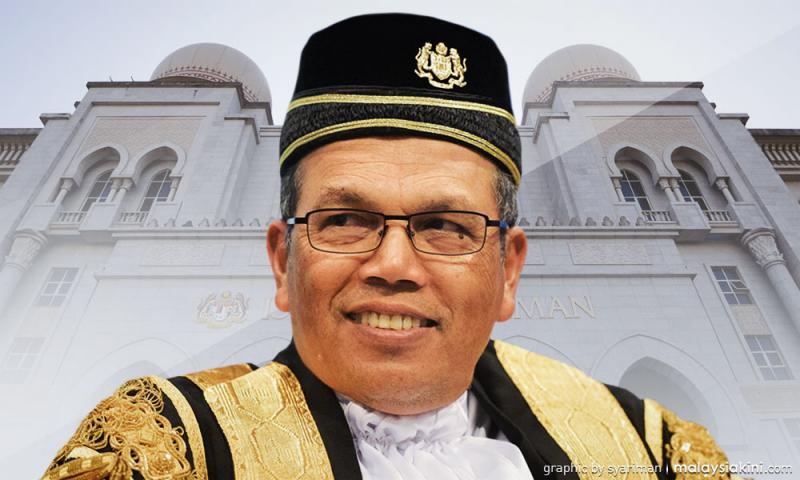
The Federal Court today granted leave to the National Registration Department (NRD), and will soon decide whether Section 13A of the Births and Deaths Registration Act 1957 (BDRA), on registering a child conceived out of wedlock to take on his or her father's surname, applies to Muslim children or Malaysians as a whole.

This came after a three-member bench led by Chief Justice Md Raus Sharif allowed three questions of law to be posed, with the crux of the issue being the question above.

The apex court granted the leave, despite an objection made by lawyer K Shanmuga who represented the Muslim child and the parents.

The lawyer argued that Section 13A of BDRA should stand as is, as it does not specify any distinction on its applicability to Muslims and non-Muslims.

Section 13A states "(1) The surname, if any, to be entered in respect of a legitimate child shall ordinarily be the surname, if any, of the father, (2) The surname, if any, to be entered in respect of an illegitimate child may where the mother is the informant and volunteers the information, be the surname of the mother; provided that where the person acknowledging himself to be the father of the child in accordance with Section 13 requests so, the surname may be the surname of that person."

The matter came up after the NRD and two others filed an appeal against the Court of Appeal's landmark ruling in July that a child conceived out of wedlock can take on his or her father's surname, and that the edict on this by the National Fatwa Committee does not have the force of law.

The other judges who presided with Justice Raus were Court of Appeal president Zulkefli Ahmad Makinudin and Justice Aziah Ali.

The three questions of law were submitted by senior federal counsel Suzana Atan, along with counsels Arik Sanusi Johari and Shamsul Bolhassan.

The Johor Islamic Council was represented by senior lawyer Sulaiman Abdullah, while Shanmuga appeared with lawyer Nizam Bashir.

Three out of four questions allowed

Earlier, Suzana informed the court that there are four questions, but Justice Raus noted the first two questions are similar.

The three questions of law are:

  1. Whether in performing the registration of birth of a Muslim child, the registrar of birth and death may refer and rely on sources of Islamic law.
     
  2. Whether the civil court may determine questions or matters on the legitimacy of Muslim children in respect to naming and ascription of paternity.
     
  3. Whether Section 13A of BDRA applies to registration of birth for Muslim children, enabling the children to be named with the personal name of a person acknowledging to be the father of the children.

Sulaiman said the Johor Islamic Council, an intervener in this case, wanted to pose seven additional questions as the case involves Islam and the state's jurisdiction.

In his rejection, Justice Raus said the council should submit on the three questions as the issue of jurisdiction was not raised during the hearing or appeal.

Meanwhile, in his objection to the leave application, Shanmuga said: “It is very clear that the statute (Section 13A of BDRA) applies to all children in Malaysia regardless of race or religion. If leave is granted, it would prolong the inevitable.”

He noted that a decision, in this case, may affect other children with a similar situation.

Justice Raus replied that the apex court, being the highest court of the land, should be allowed to make a decision on this issue, and said the court would fix an early hearing date.

Justice Zulkefli added that the Federal Court does not always answer all of the questions posed.

Shanmuga also applied to the court for an order that the name of the child and parents are not revealed.

In 2003, the National Fatwa Committee decided that a child conceived out of wedlock (anak tak sah taraf) cannot carry the name (tidak boleh dinasabkan) of the person who claims to be the father of the child, if the child was born less than six months of the marriage.

In this case, the seven-year-old child was born five months and 24 days (or five months and 27 days according to the Islamic Qamariah calendar) after the parents got married.

Justice Abdul Rahman Sebli, who wrote the Court of Appeal's unanimous landmark decision, said the NRD director-general was not obligated to apply, let alone to be bound by a fatwa issued by a religious body, such as the National Fatwa Committee.

“For him (the NRD director-general) to do so would amount to an abrogation of his power under the BDRA and surrendering it to the religious body.

"That would in effect be to take away the statutory right accorded to the father by Section 13A(2) to have his name ascribed as the child's surname in the birth certificate.”

“Such abrogation of power will render Section 13A(2) of BDRA completely otiose and gives the impression that Parliament had enacted the provision in vain, a proposition that has no place in legislative interpretation,” he wrote.