




PAS blames police for chaos at political rallies
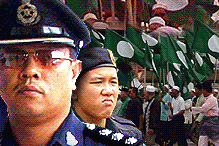
Hardline Islamic opposition party PAS on Sunday blamed police after two political rallies in Terengganu descended into chaos, with police firing tear gas and protestors throwing bricks.
Hardline Islamic opposition party PAS on Sunday blamed police after two political rallies in Terengganu descended into chaos, with police firing tear gas and protestors throwing bricks.
 "Police action was the cause of the public disturbance and the police were not friendly as stated in their slogan," PAS Terengganu commissioner Mustafa Ali, was quoted as saying by
Bernama
.
"Police action was the cause of the public disturbance and the police were not friendly as stated in their slogan," PAS Terengganu commissioner Mustafa Ali, was quoted as saying by
Bernama
.
Police said they had arrested a total of 12 people, including five on Sunday, in connection with two rallies on Friday in the village of Enam Batu.
"So far, police have detained 12 men to assist in the investigation concerning two illegal assemblies organised by a political party on Friday," said senior police chief Saiful Azly Kamaruddin.
Police had used tear gas and water cannon to try to disperse the PAS gatherings of over 2,000 people. Party president Hadi Awang had been scheduled to speak at one of them.
Protestors responded by hurling chili paste, rocks and water bottles at the police and damaged several police cars and two flagpoles, media reports said Sunday.
The protestors later attacked a branch office of the ruling Umno and a police base, throwing bricks through the windows, said the New Straits Times .
No police permit
Mustafa said PAS had not obtained a police permit for the gatherings but he vowed to continue holding what he called political talks.
 "We will continue holding lectures because they are part of our activities and we will not bow to actions in breach of the law. And we hope people will respect this principle," he said.
PAS has foundered since its humiliating election defeat in 2004 general elections which slashed its presence in parliament from 27 seats to five and lost it the former heartland of Terengganu state.
It underwent a series of leadership changes and other reforms in June to make itself more attractive to Malaysia's Chinese and Indian communities so that it can become a viable alternative government.
Both PAS and Umno promote themselves as advancing the interests of Malays who account for about 60 percent of the country's 25 million population.


