




Merdeka: Too much worries, no mood to celebrate
 Shackled by bills to pay and worries over their children's future have become such a burden that ordinary people find it hard to be excited or passionate about Merdeka celebrations.
 Shackled by bills to pay and worries over their children's future have become such a burden that ordinary people find it hard to be excited or passionate about Merdeka celebrations.
It's not just the young who do not express much enthusiasm for Merdeka. Among the people malaysiakini interviewed on the streets were two senior citizens who have plied the same trade, one in the same location, for more than Malaysia's 48 years.
For 73-year-old gas station attendant Liong King Hong, who has worked at Shell petrol stations since his early 20s, he's seen more and more of the Chinese and other races who have gotten ahead of him and many others.
For pockets in our the population like Liong, they are still slogging through life trying to sustain their families with meager incomes despite the upward spiral of prices.
But there have indeed been changes since our independence from the British.
"Before 1957, it was either orang putih or orang cina . They were the only ones who could afford cars before 1957. At that time, I was working at the Shell gas station in Jalan Pahang in front of the Institute of Medical Research," he told malaysiakini while attending to customers along Jalan Bangsar, Kuala Lumpur.
"Of course, there are now more Malays and Indians with their own cars."
However, Liong lamented the change of pace in life since Merdeka.
"Nowadays, everybody's in a rush to go somewhere else. They are always in a hurry. No time to chat or make small talk...," he sighed.
How does he feel about Independence Day celebrations?
"What about it? Let other people get all crazy over it. To me, it's just another day, biasa lah . Fuel prices have gone up. Food prices have gone up. I have to pay more for the same things. And I'm still working as an attendant at a Shell gas station," he added.
Still working
A stone's throw away down the same road, 65-year-old P Ayakunnan, speaks of seeing the changes happening to Malaysia from within his shoe-box barber shop which he has rented and subsequently owned since 1935.
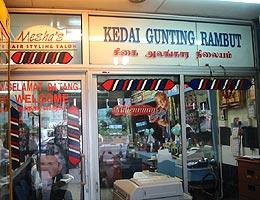 As Ayakunnan looked outside to the busy six-lane thoroughfare, a Light Rail Transit train passed noisily overhead, followed by a KTM commuter train rattling on the tracks on the other side of the road.
He harkened back to a more laid-back, slower Malaysia pre-1957.
"That road in front of us used to allow only two vehicles when this shop first opened. On one lane, a bullock cart can go towards town, on the other lane another bullock cart goes towards Lembah Pantai before turning around and back to town again," he said.
Our conversation was punctuated by the sound of sirens and the blaring of horns as police outriders and a ministerial convoy screamed by.
Ayakunnan also lamented how he now has less conversation to enjoy with his customers who seem always in a rush to go elsewhere. The only thing constant, he says, is the hike in cost of living.
"I've seen the price for a haircut rose over the years from 40 sen to RM8. Inflation happens very fast. Faster, it seems, than salaries can increase," he says.
Moral decline
Unlike Liong and Ayakunnan, 65-year-old imam Abdullah Abdul Rahman has been a beneficiary of both the government's pro-bumiputra policies as well as the increasing state patronage of Islam.
 He notes, however, that neither policies have produced any significant improvement in the general moral character of the Malay-Muslim community.
"Back when I started work as one of the first Al-Azhar University graduates to be imam in Selangor, we used to get paid a mere RM180 monthly," he said.
"The government did not recognise religious studies graduates as they did those from other disciplines. So there were very few students from Selangor who took up Islamic studies. The state authorities would have to hire graduates from other states," he added.
"Now, we have more and more religious officers on the payroll of the government who are hired generally on the same terms as graduates of the secular disciplines. I see religious officers now with two or three cars each and big houses.
And the changes he has seen over the past five decades?
"Yes, we definitely see more people dressing and behaving in a more Islamic manner. Many years ago, many women, for example, did not wear the hijab (veil).
"But you don't hear of crimes happening as often as they do nowadays. You didn't have as much corruption. The Muslim community at large has declined," said Abdullah.
"I don't know how Merdeka should be celebrated. We've become more corrupt generally."
Scared for my kids
Abdullah's concerns were echoed by a Malay Malaysian mother of two, a post-Merdeka generation, 31-year-old restaurant proprietor Irdayu Nirza Mohd Yamin.
 Despite having achieved political independence 48 years ago, many families were now burdened by fears for their children's safety and moral development, she said.
"I guess Merdeka means being free. But I don't think we're free to any great extent. In a way, the moral laxity of today's youth is scaring me. When I see the kind of material that gets passed from one teenager's mobile phone to another, I'm scared for my young children," said Irdayu.
"Before, my parents used to worry about the opportunities for education. Now it's not so much of a worry. With all this education, including moral and religious education, the young have become so unruly," she added.
"It seems as if Malaysia, although 48 years old, has yet to mature. She's still crawling to forge some kind of identity. She will forever be clawing for an 'identity' as long as we ape what other people are doing."
Mixing with wrong crowd
Domestic worker V Parames, 45, added that social problems are her foremost concerns as she compares the upcoming Merdeka with her memories of Malaysia's early years.
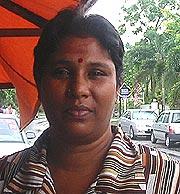 "My mother had 10 children. I am the last of them. But she had it easier in raising her children to be good and decent citizens," she said.
"I only have two children, a 19-year-old boy and a girl, 18. But I worry constantly about them. I don't worry about whether they can get a job or an education, which is what my parents worried about.
"I'm worried about whether my kids are going to get into trouble, mix with the wrong crowd or don't come home at night. I'm worried about these things.
"Malaysia at 48 years has become good at erecting tall buildings and structures. But raising and developing good human beings, that's where our problem is. Plus, of course, the increasing fuel and food costs."
More mature now
 Fifty-seven-year old M Mumusamy, who retired from the water supply department seven months ago, expresses more appreciation for Merdeka as he has seen more and more Indians getting involved in the Hindu temple activities.
"I'm happy that parents seem to emphasise religious piety more than previous years. I can't speak for the other religions, but I definitely see more Indians and their children at the temples.
"On the whole, I believe people are more mature and understanding of each other and other races and religions. We've reached newer levels of maturity. Things are good," said Mumusamy.


