


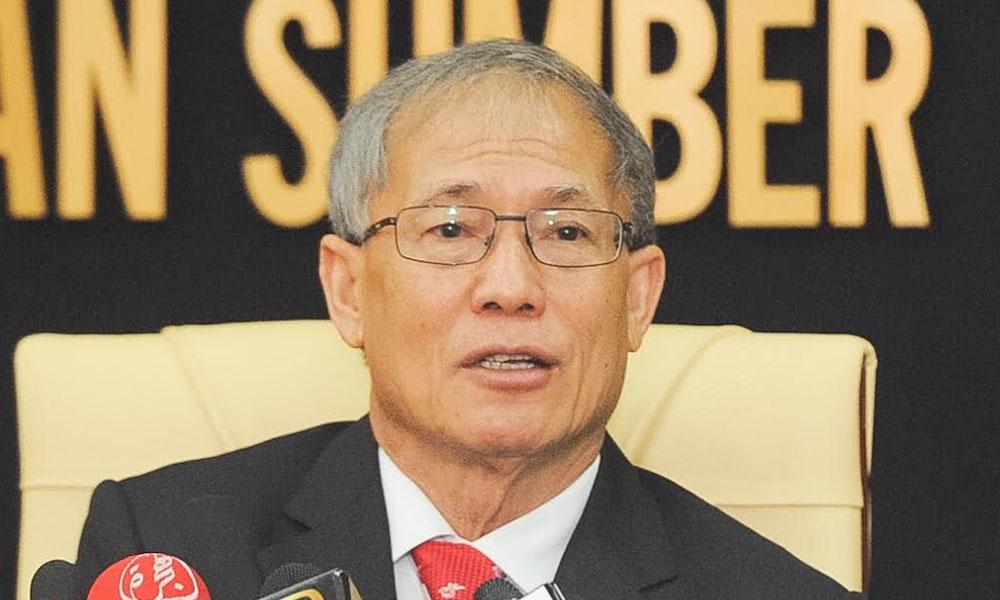

Riot: EIS contribution rate dropped to 0.2pct from 0.5pct
After facing repeated criticisms from all sides over the higher contribution rates initially proposed, the human resources ministry has bowed to pressure for a lower Employment Insurance System (EIS) contribution rate.
Beginning 2018, some 57,282 persons who lost their jobs would be eligible for the interim EIS payment, with fund collection in the same year estimated at RM479 million, according to Bernama.
Human Resources Minister Richard Riot Jaem said that the EIS, a social safety net aimed at helping workers who lost their earnings due to loss of employment, was expected to be tabled in Parliament on Oct 24.
Riot said that after numerous discussions with various stakeholders, which have led to several postponements of the bill’s passage, it was then agreed that the contribution rate of the "people-centric" scheme should be reduced to 0.2 percent from 0.5 percent, which would be contributed equally by both employers and employees...
After facing repeated criticisms from all sides over the higher contribution rates initially proposed, the human resources ministry has bowed to pressure for a lower Employment Insurance System (EIS) contribution rate.
Beginning 2018, some 57,282 persons who lost their jobs would be eligible for the interim EIS payment, with fund collection in the same year estimated at RM479 million, according to Bernama.
Human Resources Minister Richard Riot Jaem said that the EIS, a social safety net aimed at helping workers who lost their earnings due to loss of employment, was expected to be tabled in Parliament on Oct 24.
Riot said that after numerous discussions with various stakeholders, which have led to several postponements of the bill’s passage, it was then agreed that the contribution rate of the "people-centric" scheme should be reduced to 0.2 percent from 0.5 percent, which would be contributed equally by both employers and employees.
'The lowest rate of contribution in the world'
Four ministers - Wee Ka Siong, Paul Low, Richard Riot and Johari - were tasked to coordinate talks with stakeholders, including NGOs and groups representing employers and employees.
Among those who criticised the initial rate was Parti Sosialis Malaysia (PSM) who mooted for the monthly contribution to be decreased to just 50 cents a month.
PSM workers’ bureau chief M Sivaranjani said that 0.5 percent would prove to be too high, “especially for low-income employees.”
Klang MP Charles Santiago was also concerned over the large amount of annual surplus under the EIS.
“Why collect a huge amount of money when the retrenchment payment is only 30 percent of total collections?
“This money will be underutilised and sit idle,” the DAP lawmaker pointed out.
However, Riot has responded that this (0.2 percent) is “the lowest rate of contribution in the world.”
Not all jobless will qualify
The EIS, which will be managed by the Social Security Organisation (Socso), aims at providing immediate financial assistance to enable beneficiaries to cover their living expenses during the transition period until they obtain suitable employment.
However, not everyone who is out of a job would qualify. Under the EIS, workers who left their employment voluntarily worked on fixed terms contracts, retired or were dismissed due to misconduct, will not be eligible to claim the EIS benefits.
Riot added that the EIS is based on the concept of a "solidarity fund, pooling of resources and sharing of risks.” It would also provide job matching and job placement to help displaced workers get re-employed as well as reskilling and upskilling training to improve their employability.
He also pointed out that the EIS has already been implemented in more than 75 countries including Vietnam, Thailand, Taiwan, South Korea, China and Japan, and stressed that most of the countries that introduced the EIS during stable economic environments had proven that the scheme significantly helped displaced workers during challenging economic situations.
"Therefore this is the perfect time to implement the EIS, which is an important safety net for our workers, who are assets to the nation," he added.
The scheme was announced by Prime Minister Najib Abdul Razak in March, and the government has touted it as benefiting an estimated 6.5 million local employees in the private sector.


Report this comment
Are you sure you want to delete this comment?
This action cannot be undone.