


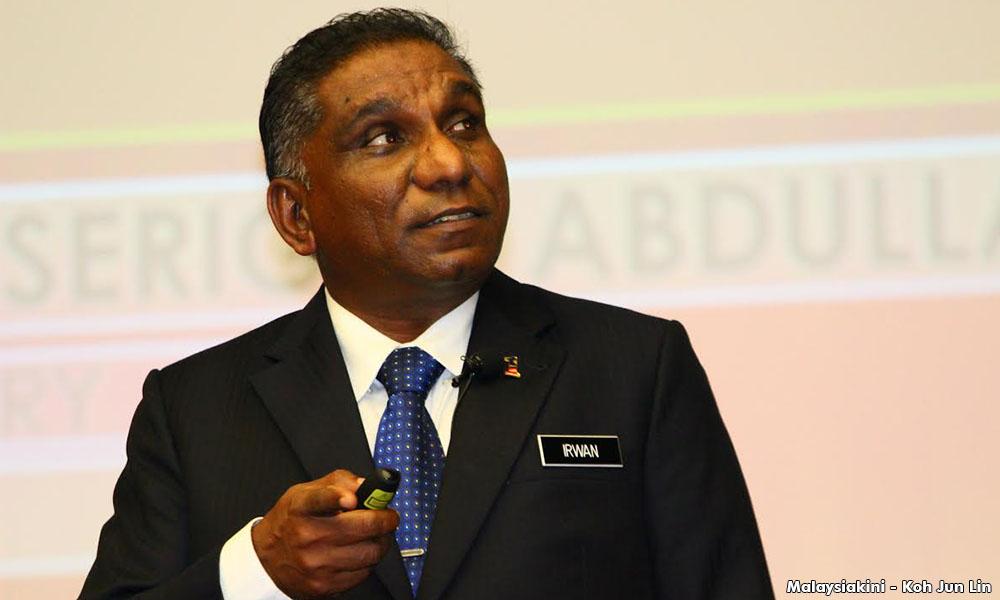

Is it time to hate Irwan for his views on poverty, asks economist
Is it time to hate Treasury secretary-general Irwan Serigar Abdullah for expounding the theory that there are no reasons for Malaysians to be poor, economist Shankaran Nambiar asked.
He said Irwan had given an important message when he suggested that the way out of poverty is through the night markets.
"At its core, in one interpretation, is the following unspoken text. Do not depend on the government; you cannot continue to depend on the government; you have to take responsibility for your wellbeing," said Shankaran, a senior fellow at the Malaysian Institute of Economic Research...
Is it time to hate Treasury secretary-general Irwan Serigar Abdullah for expounding the theory that there are no reasons for Malaysians to be poor, economist Shankaran Nambiar asked.
He said Irwan had given an important message when he suggested that the way out of poverty is through the night markets.
"At its core, in one interpretation, is the following unspoken text. Do not depend on the government - you cannot continue to depend on the government; you have to take responsibility for your wellbeing," said Shankaran, a senior fellow at the Malaysian Institute of Economic Research.
"This is a harsh world and you have to do battle for yourself. Use the market to your advantage, if you can."
But alongside this message, one should note that Irwan, given his position, worked towards formulating the BR1M policy, reminded Shankaran, who hails from Penang.
"On the face of it, the man who had a hand in designing a system of targeted subsidies now turns his back on handouts. Why this sudden backflip?" asked the author of the book "Malaysia in Troubled Times".
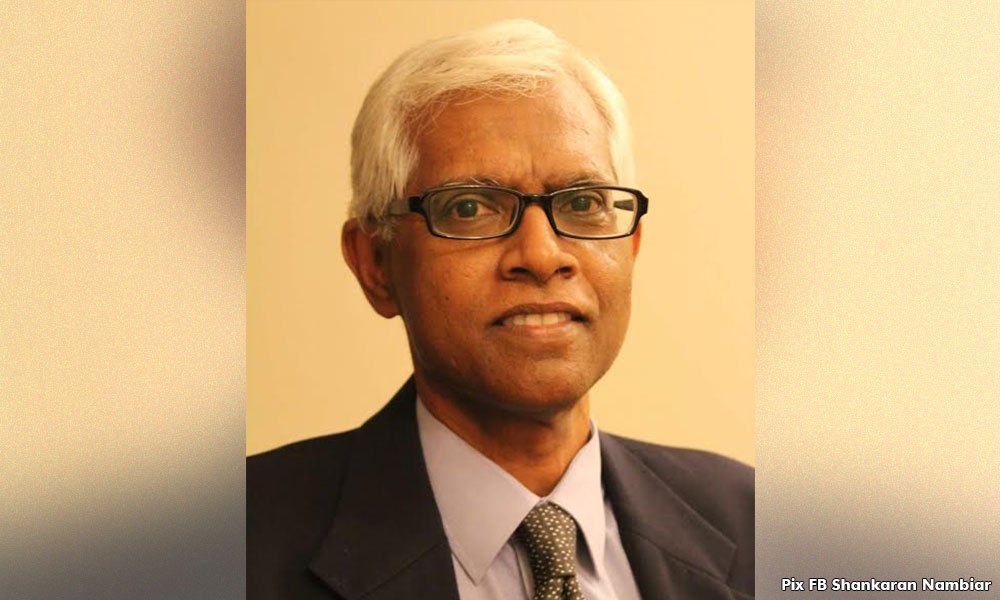 Shankaran (photo) was responding to Irwan's suggestion that the way out of poverty is entrepreneurship.
Irwan's theory has been criticised by others like Penang Deputy Chief Minister II P Ramasamy who said his view was a "superficial understanding" of poverty.
Irwan had cited the example of migrants who have made good as petty traders in Chow Kit to illustrate how the disadvantaged can, through their own effort, seize the opportunities thrown by the market system.
If foreign workers with absolutely no endowments can secure reasonable income through sheer dint of hard work and entrepreneurship, why can’t Malaysians, was Irwan's message, said Shankaran.
After years of fiscal imprudence, wasteful public investments, and an educational system that has not put Malaysia on the technological forefront, "the future of government support lies in doubt", he added.
Shankaran said the flow of government revenues may not be what it was for some time to come, maybe for a long time to come.
If the public debt cannot be contained or brought down, there will have to be a gradual tightening of government subsidies, he added.
Culture of dependency
In time to come, Shankaran said, subsidies will have to be cut (or more politely, rationed), government expenditure reduced, and taxes raised.
"Not that this scenario has not already made its entrance. Irwan, in a rather blunt and dramatic manner, possibly, wants to prod people out of the culture of dependency.
"Who, 20 years ago, would have imagined that Malaysia’s oldest university would have to take a 30 percent budget cut?" he asked.
"That is the direction in which we are heading, although there are good reasons why education and healthcare should be protected from crass commercial interests."
Shankaran said there are fewer scholarships to study abroad, student loans are less generously given, and there are fewer vacancies in the public service sector to accommodate the ever-increasing number of graduates now.
He added that government institutions which thought that their responsibility was to solely focus on how to spend their allocations will now have to function differently.
"Public universities must now raise funds and in time, people must work on being job creators rather than job seekers. Many questions will have to be answered as we slide into the new state of affairs," Shankaran said.
"At the limit, or as government largesse diminishes, how will ethnic considerations be traded off against need and social inclusion?"
Shankaran said groups that have relied very heavily on government support will suffer from the withdrawal of support and subsidies.
"This can create discontent. How will the transition be managed? Will meritocracy, productivity and outcome-based processes ever matter? Will entrepreneurship be the favoured instrument to reduce inequality?"
Shankaran also wanted to know will government support for entrepreneurship be open to all aspiring entrepreneurs or will it be restricted on the basis of selected criteria.
"Entrepreneurship is set to be the new game in town. At least, a new game for those accustomed to the culture of dependence."


Are you sure you want to delete this comment?
This action cannot be undone.