
No GST, BR1M with a twist in Harapan's 'spend wisely' budget
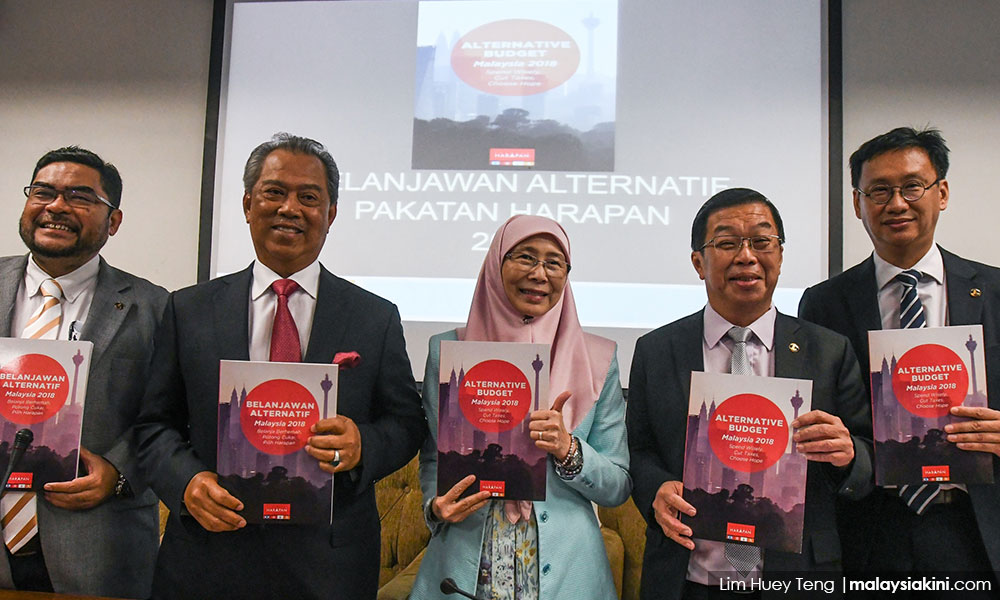
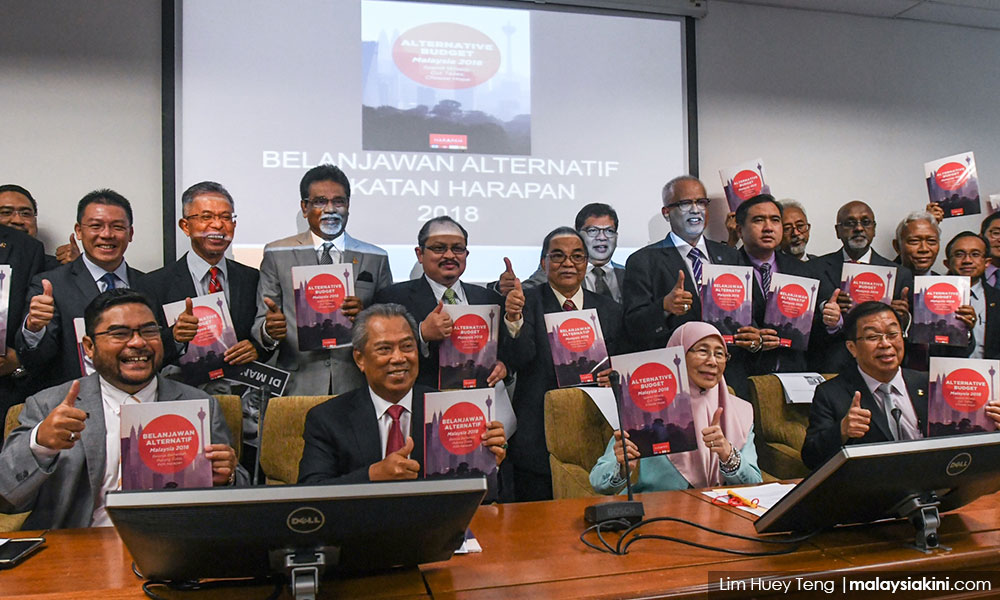
Pakatan Harapan has unveiled its shadow budget, which promises to scrap the goods and services tax (GST) and revert to the sales and services tax (SST) within a year of winning the election.
While GST is expected to contribute RM42 billion in revenue for 2018, Harapan's plan to reinstate the previous taxation system would only net RM16.5 billion in revenue.
As for the RM25.5 billion shortfall, Harapan claimed that channelling the revenue collected into the economy would, in turn, increase federal revenue as consumer consumption and business activities would boom...
Pakatan Harapan has unveiled its shadow budget, which promises to scrap the goods and services tax (GST) and revert to the sales and services tax (SST) within a year if it wins the coming election.
While GST is expected to contribute RM42 billion in revenue for 2018, Harapan's plan to reinstate the previous taxation system would only net RM16.5 billion in revenue.
As for the RM25.5 billion shortfall, Harapan claimed that channelling the revenue collected into the economy would, in turn, increase federal revenue, as consumer consumption and business activities would boom.
The coalition hopes to collect an additional RM2.81 billion in corporate income tax (Cita), RM1.46 billion in excise duties on goods (except motor vehicles) and RM1.82 billion in real property gains tax (RPGT).
Harapan also expects a 20 percent increase in car sales following the abolishment of GST, which would contribute to RM1.93 billion in revenue through the collection of import tax, excise and motor vehicle licence fees.
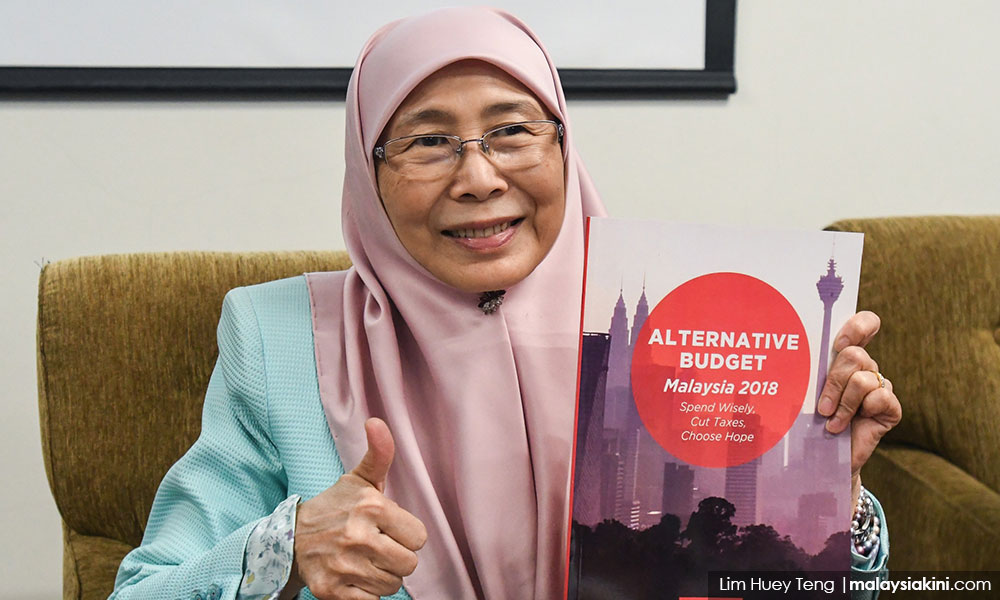
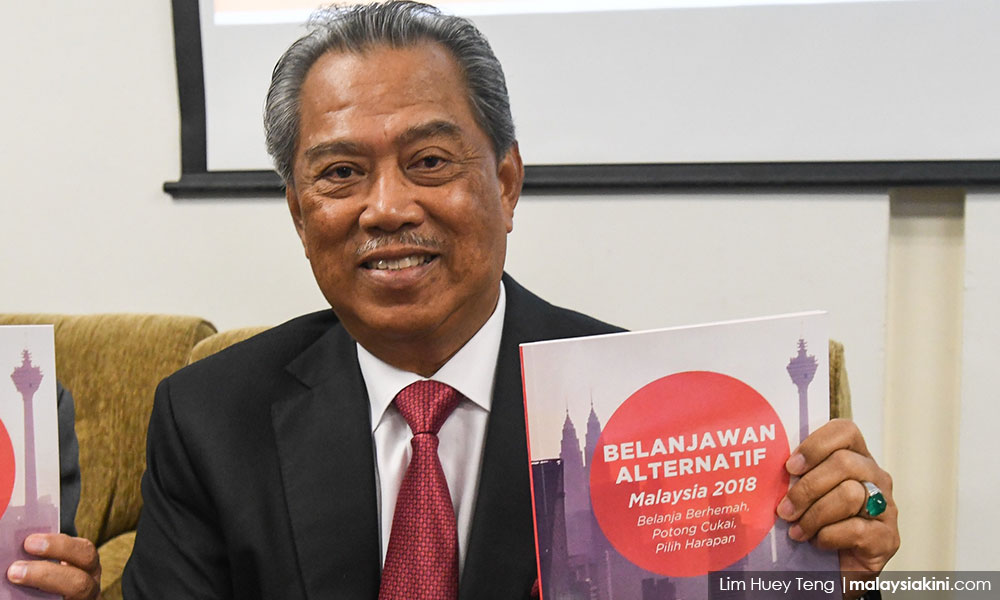
"For 2018, we are determined to eliminate RM20 billion from wastage and corruption by slashing the budget of the Prime Minister's Department," the coalition stated in its fiscal plan titled "Spend Wisely, Cut Taxes, Choose Hope".

The alternative budget was unveiled in Parliament today, ahead of Prime Minister Najib Abdul Razak's tabling the government's budget for 2018 in the August House on Friday.
The salient points of Harapan's budget:
- Total budget allocation is RM258.52 billion, with estimated revenue collection of RM229.44 billion. Estimated deficit is two percent.
- Operating expenditure is RM200.16 billion, while development expenditure is RM58.35 billion.
- RM85.52 billion to be spent on civil service emoluments.
- All ministries must be compelled to practice dignified simplicity in hosting events and functions.
- Slash Prime Minister's Department's allocation to RM8 billion, from the RM22 billion expected to be allocated for the department next year by the BN government.
- Reinstate RM2 billion in grants for public universities.
- Allocate RM700 million to a special fund to be used for improving facilities of all types of schools, where RM210 million will go to national schools and RM70 million for each category of school.
- Allocate RM1 billion for fuel subsidies for the people.
- Continue the handout of BR1M, but impose certain conditions, such as recipients staying employed for at least three months. Such conditions will be waived for retirees and disabled persons.
- Taking cues from the Norwegian Sovereign Wealth Fund, Petronas will contribute at least RM10 billion a year to Kumpulan Wang Amanah Negara (KWAN) annually to reduce Malaysia’s dependency on oil and gas revenues. In addition, there will be restrictions on how much of KWAN funds may be used to finance government deficits.
- Establishing a natural resource fund for Sabah and Sarawak.
- Adopt and ratify the International Labour Organisation's fundamental conventions and recommendations. With workers’ rights in place, the goal is to increase the income tax base from the current 15 percent of the workforce to 50 percent within five years.
- Minimum wage will be RM1,500 per month. This will be funded by a co-pay system where the government and employers will each fund half of the increase. This is expected to cost the government RM2.5 billion per year, with the minimum wage amount reviewed every three years.
- The revenue reporting system implemented under GST would be maintained.
- If eliminating wastage and corruption is insufficient to achieve a balanced budget, other progressive tax policies will be considered. These include higher taxes for the richest 10 percent, a 10 percent capital gains tax, and a 10 percent inheritance tax for assets above RM10 million. However, these taxes would only be implemented as a last resort.
- Oil producing states of Kelantan, Terengganu, Sabah, and Sarawak are expected to take on more budgetary expenditure, with more powers over what the money would be spent on.
- Government surpluses will be used to settled matured bonds. Instead of automatically rolling-over matured bonds, the Pakatan Harapan-led government will retire them. The money for this will be raised through management buyout programs for GLCs, which is expected to raise “billions over the next decade.”
- Management buyouts of GLCs will also be used to boost Bumiputra equity in the economy, which is expected to surpass the current government’s 30 percent target.
- Adopt anti-bribery measures such as ISO 37001 and BS 10500. This is expected to cost about RM20 million.
- Ministries will be merged to reduce the number of redundancy and overlapping jurisdictions between ministries. The savings through sharing equipment and properties is estimated at RM5 billion. However, the consolidation will not result in civil servants losing their jobs.
- Bank Negara and MACC would be made independent from the executive branch of the government. Both would be accountable only to the parliament, while the government would no longer have the power to overrule Bank Negara’s Monetary Policy Committee.
- Allocate RM200 million for public universities to attract and maintain top academics in Islamic finance.
- Electronic payment gateways and cryptocurrency exchanges will be regulated, including implementing stringent know-your-client standards, to deter money laundering, tax avoidance, terrorism financing, and fraud.
- For the Klang Valley area, introduce RM100 monthly public transportation passes that allow for unlimited rides on RapidKL buses, LRT, and MRT. This would later be expanded to include the KTM network.
- Add 1,000 buses to serve areas not currently covered by the rail networks, especially in areas of low-cost or affordable housing.
- For places outside the Klang Valley, expand the bus coverage and build more transportation hubs.
- Consolidate all statutory housing bodies into one authority to provide uniformed and quality affordable housing, including through rent-to-own schemes and price controls. Tax incentives would be provided for developers to adopt industrialised building systems.
- PTPTN loans will be restructured to make its repayment contingent on the borrower’s income. Fresh graduates earning below RM4,000 a month would not have to service the interest due on the loans.
- Increase the foreign worker levy by about 10 percent per year until 2020 for the manufacturing, services, and construction sectors in order the increase the cost of importing new foreign workers. Illegal workers may be registered and legalised for a cost, and would be permitted to work for different employers, but only with a fixed contract.
- Refugees in Malaysia would be allowed to work as a means to reduce demand on foreign labour.
- Allocate RM500 million to incentivise local companies to reduce their dependency on foreign labour, such as technological upgrades, capital investment, and automation.
- Offer free tertiary education within ten years. To do this, conduct a full audit and study on the cost, wastage, and corruption in public universities in order to determine the necessary investment to achieve this.
- Place greater emphasis on technical and vocational education and training (TVET), including through expanding the German Dual Vocation Training programme in Penang to the national level.
- Introduce laws to ensure equal pay for women compared to men doing the same work. All government bodies and listed companies will be required to have at least one woman director, and have women make up at least 30 percent of their boards within five years.
- Expand maternity leave in the government sector from 90 days to 120 days with full pay, which can be extended by 60 days with half pay. The private sector will be given tax breaks to adopt this standard. After five years, the 120-day maternity will be fully enforced.
- Half of maternity leave may be converted into paternity leave for husbands. Women taking a career break for a few years to raise their children may not be discriminated against, and would receive at least their previous pay when they re-enter the job market.
- Set up the Malaysia Women Contribution Fund where husbands contribute RM50 per month, which will be matched by the government. The fund would be used to support widows in the event of divorce or death of their husbands, and would cost the government RM2.5 billion per year.
- Introduce a two-tier tender system for government contracts: Half of government contracts below RM1 million would be open to poor and middle-class Bumiputeras only, while the remainder would be open to all. For contracts RM10 million and below, 30 percent will be open to Bumiputera bidders only.
- Allocate RM2 billion for a fund to provide four-percent interest loans for eligible Indian Malaysian bidders.
- Implement a "Stay In School" programme, where poor families are given a monthly stipend of RM50 per month if their school children maintain an attendance rate above 95 percent at primary schools and secondary schools.
- Allocate RM200 million for grants to Indian social welfare NGOs. Political appointments will be banned in such NGOs, and no more than 15 percent of the grant may be used for administrative purposes.
- Allocate RM60 million a year over the next five years for improving Chinese new villages and fishing villages. There are over 600 such villages in Malaysia, and the allocation would amount to about RM100,000 per year of each village.
- Offer low interest loans for small businesses at Chinese new villages and fishing villages.
- Offer interest-free planting loans up to RM2,000 per month for Felda settlers with debt forgiveness up to 50 percent; build a Felda university and/or provide preferential entry for their children to public universities.
- Invest “billions of ringgit per year” on research and development in the oil palm and rubber sector, in areas such as better mechanisation and harvesting technologies.
- Commit one percent of total exports of palm oil and rubber products for trade promotion of these industries, and spend another 0.5 percent on sustainability and best practices certification.
- Study the government’s subsidy and grant scheme for smallholder paddy farmers and consider converting it to a RM1,500 minimum income scheme, as long as yield targets are met.
- Reestablish the National Paddy and Rice Board to supervise and regulate all matters related to the national rice stockpile.
- Increase the cash aid for fishers to RM300 per month, and allocate RM100,00 per year for fishing villages to develop new facilities to support the fishing industry. The villages will decide how the money should be spent.
- Increase SME Corp’s budget to RM100 million to improve support for small and medium enterprises. In addition, consider setting up overseas trade offices to help Malaysian SMEs entering foreign markets by providing advice on local laws, regulations, and market conditions.
- Commit one percent of total exports for the promotion of goods manufactured by Malaysian SMEs to external markets.
- Offer special individual tax rates of 10 percent for Malaysian experts in artificial intelligence, robotics, nanotechnology, and biotechnology, compared to the 15 percent currently offered through Talent Corp.
- Withholding tax for foreign experts in digital economy would be abolished to help the sector and transfer expertise.
- Allocate RM5 billion per year to develop skills and ecosystems to be ready for the Fourth Industrial Revolution, including incentives to retain local IT experts and digitise government administration.
- Ask China to put the East Coast Rail Line project on hold pending a review of its cost and benefits.
- With regards to the High Speed Rail project, prioritise the Kunming-Bangkok-Kuala Lumpur section of the line over the Kuala Lumpur-Singapore section of the line, since the latter is already adequately served by existing road and air routes.
- Honour existing agreements between Malaysia and China including those critical to national security (ports and electrical supply). However, contracts for these deals would be released, and Pakatan Harapan would seek China’s cooperation to negotiate portions of the agreements if found to be "unconscionable."
- The further creation of foreign enclaves similar to Forest City would be discouraged. Instead, Chinese developers must integrate their projects to include domestic market demands.


Are you sure you want to delete this comment?
This action cannot be undone.