




Newspaper editor forgotten hero of WWII
The editor of the now defunct Straits Echo was among the unlikely heroes of Penang during World War II, leading its people out of chaos following the relentless bombing of the island by the Japanese.
The editor of the now defunct Straits Echo was among the unlikely heroes of Penang during World War II, leading its people out of chaos following the relentless bombing of the island by the Japanese.
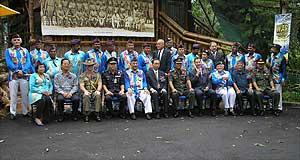
M Saravanamuttu, popularly called Sara, was among those remembered yesterday during an event to commemorate the 60th anniversary of the end of the war. Held at the Penang War Museum in Batu Maung, the event was officiated by Chief Minister Dr Koh Tsu Koon.
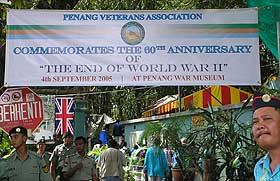 Among the many survivors of the war was Penang Veterans Association (PVA) president HV Spedelwinde, who recalled Sara's heroic services at a time of looting and lawlessness.
The bombing of Penang began on Dec 11, 1941, three days after war was declared. The Japanese went on to occupy Malaya for 1,354 days, establishing a regime of extreme cruelty.
In the immediate aftermath, while the British were technically still in control, he said the Straits Echo was one of the handful of offices that remained open as Sara and his team printed news sheets.
Sterling job
When the British military and civilian administration abandoned Penang, Sara and sub-editor RS Gopal lowered the Union Jack and hoisted the white flag of surrender since there were no other volunteers.
"He commented that it was a unique experience to lower the Union Jack while still a British citizen," said Spedelwinde.
Sara also formed the Penang Service Committee to take charge of administration. It organised a group of volunteer police, opened a godown and distributed rice to civilians.
Comprising three members from the four different ethnic communities, they were duly elected to run the town, meeting twice daily to co-ordinate affairs.
Sara, together with his bodyguard Oswald Foley and Speldwinde also put some stranded British officers in a tongkang at midnight, to escape to Singapore.
 When the Japanese arrived, he appealed to the commander not to molest the local people. Because of his diplomacy, the Japanese entry into Penang was "peaceful".
Nine days later, however, Sara was imprisoned for nine months in a solitary confinement in a 8x8ft cell.
"He and the boys did a gallant job but there was never any thanks for their work from the British," said Speldewinde.
Sara was later appointed high commissioner for Ceylon to Singapore and Malaya from 1950-57, Ceylon Minister Plenipotentiary and Envoy Extraordinary to Indonesia from 1954-57 and Honorary Consul-General for Ceylon in Bangkok from 1958-61.
Enhanced facilities
The building in which the war museum is located was built in the 1930s by the British as part of a military complex to protect the island. It has tunnels with ventilation shafts, an intelligence and logistics centre, halls, offices, canon bays, sleeping quarters, cookhouses and an infirmary.
Several of the participants at yesterday's event felt that the site can be better promoted as a tourist attraction, and that its facilities can be enhanced. Others pointed out that the entrance fee of RM20 for foreigners and RM10 for Malaysians is too high.
Koh, who toured the area with PVA members, expressed confidence that it has the potential to achieve "world class status".
At a press conference, Koh said the state would work with the PVA and British and Japanese governments to improve the site. The Penang government will discuss allocating additional funds for upgrading works.
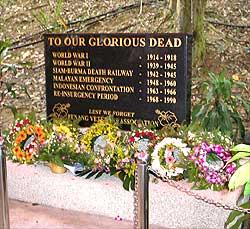 "It is hoped that the site will serve as a reminder to all people and families about the importance of peace and stability," he added.
According to records, 8,708 Commonwealth Military Forces were killed or wounded in action and 130,000 men were taken prisoner. There were 2,000 civilian casualties, while the invading forces had 9,657 men killed or wounded in action.
Following the first atomic bomb dropped on Hiroshima on Aug 6, 1945, and the second dropped on Nagasaki on Aug 9 - killing more than 120,000 and injuring 140,000 - Japan surrendered unconditionally on Aug 14, 1945.
SUSAN LOONE is malaysiakini 's Penang-based stringer.


Are you sure you want to delete this comment?
This action cannot be undone.