



What Harapan’s shadow budget is and isn't
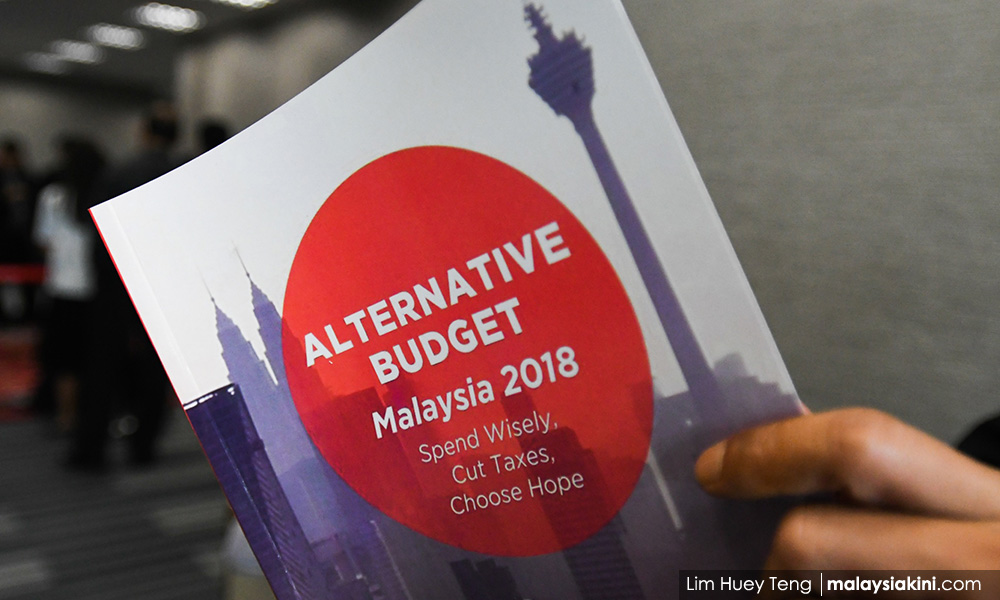
COMMENT | I saw two comments on Facebook from people who had read Pakatan Harapan’s shadow budget.
One was from a journalist who said he had a headache after skimming through the document and had to take a break before reading the whole thing, the other was from a researcher who described reading it as “tiring”.
I suppose not too many people will read the entire 75-page document.
There may be space later to examine in detail many of the initiatives in Harapan’s budget, if Prime Minister Najib Abdul Razak’s actual budget hasn’t taken up all the attention by then.
For now, perhaps we can reflect a little on what the shadow budget is, and what it isn’t. We can then perhaps spend some time thinking about further and better ways that Pakatan can similarly invest their time and resources.
Better to have one than not
While some points below may be critical, I think that overall, it is definitely better for Pakatan to have a shadow budget than to not have one.
The first thing that a comprehensive shadow budget indicates is that there are leaders within Pakatan who are sufficiently competent to at least put together a sufficiently considered financial roadmap for the nation.
Whether or not we agree with all the directions and assumptions of this roadmap is another matter, of course.
Nevertheless, I think we can say with relative certainty that the shadow budget is, at the minimum, credulous.
This means that the shadow budget is probably not, among other things, completely unimplementable, or a document so far removed from the standards of actual budgets as to be laughable.
This also indicates that there are leaders within Harapan who will likely be able to lead the nation’s economy - or at least not perform abysmally worse than the current people at the helm.
Perhaps this may seem obvious or an insult to point out, but given that we are still a nation that has never been ruled by a coalition other than BN, these doubts are still sometimes a psychological block of some sort...
COMMENT | I saw two comments on Facebook from people who had read Pakatan Harapan’s shadow budget.
One was from a journalist who said he had a headache after skimming through the document and had to take a break before reading the whole thing, the other was from a researcher who described reading it as “tiring”.
I suppose not too many people will read the entire 75-page document.
There may be space later to examine in detail many of the initiatives in Harapan’s budget, if Prime Minister Najib Abdul Razak’s actual budget hasn’t taken up all the attention by then.
For now, perhaps we can reflect a little on what the shadow budget is, and what it isn’t. We can then perhaps spend some time thinking about further and better ways that Pakatan can similarly invest their time and resources.
Better to have one than not
While some points below may be critical, I think that overall it is definitely better for Pakatan to have a shadow budget, than to not have one.
The first thing that a comprehensive shadow budget indicates is that there are leaders within Pakatan who are sufficiently competent to at least put together a sufficiently considered financial roadmap for the nation.
Whether or not we agree with all the directions and assumptions of this roadmap is another matter, of course.
Nevertheless, I think we can say with relative certainty that the shadow budget is, at the minimum, credulous.
This means that the shadow budget is probably not, among other things, completely unimplementable, or a document so far removed from the standards of actual budgets as to be laughable.
This also indicates that there are leaders within Harapan who will likely be able to lead the nation’s economy - or at least not perform abysmally worse than the current people at the helm.
Perhaps this may seem obvious or an insult to point out, but given that we are still a nation that has never been ruled by a coalition other than BN, these doubts are still sometimes a psychological block of some sort.
What the shadow budget is not
That said, there are a few qualities or indicators that I would not ascribe to this shadow budget.
First and foremost, I would not say that the shadow budget gives an extremely reliable indicator of what a Harapan-led economy would be like.
A long time ago, I had a little first-hand experience with the drafting of opposition coalition documents, in particular the very first Pakatan Rakyat common manifesto.
I’m not saying that things may not have changed significantly from then, but I have a feeling that the difference between now and then may not be a day-versus-night type of scenario.
The drafting of these documents seldom involves a very large, representative cross-section of party leaders - much less the party as a whole. It more likely involves just a few individuals, who usually have particular talents in the relevant fields.
Understandably though, this is likely one of the only ways to actually complete a draft, which is then passed on to the higher-ups for approval.
Often times, there is not a lot of debate, or back-and-forth regarding this draft. One reason being, it takes too long to nitpick at all the finer details and calculations in a document such as this.
Perhaps the bigger reason however, is that people don’t often care all that much what is written in these documents.
The leaders don’t feel beholden to these documents in any binding way, and the wider swaths of the voting public do not scrutinise the finer details of such a document - if they scrutinise the contents of the documents at all.
Wong Chin Huat recently wrote on the benefits of forming post, rather than pre, election coalitions.
One of these benefits was that the terms of a post-election coalition were actually binding, and keeping to them would be the basis of keeping a ruling coalition together and in power.
On the other hand, a pre-election coalition is like any other party, and can make all sorts of promises, none of which they are under any real pressure or obligation to keep.
My best guess is that most people cannot really remember what promises either coalition made prior to the last general election in Malaysia, much less track how well they are doing in fulfilling those promises.
The importance of a shadow cabinet
The last thing I’m looking to do is to belittle all the hard work that has gone into Harapan’s latest shadow budget.
While a shadow budget like this is also most unlikely to be touted as a central document going into the next general elections, perhaps it will form a basis for Harapan’s manifesto when the time comes.
It also shows to the few who may be watching, that there is some ideological undercurrent to the coalition as a whole.
That said, something resembling a shadow cabinet may serve Harapan better in the long run. Perhaps better yet, a committee of individuals from each component party, instead of just one individual, to shadow each ministry.
Proposed budgets come and go, often forgotten within weeks of the passing of the actual budget.
A shadow cabinet however, is much less ad hoc, and allows a coalition to showcase its policies, ideologies, and approaches to problems throughout the year - giving voters a better, more consistent idea of what the coalition is really about, and what their approach to the nation’s problems are.
So, good job so far to the team that put the shadow budget together - let’s hope to see them go further and deeper.
NATHANIEL TAN remembers with fondness and gratitude the help he received from friends with various drafting projects over the years.
The views expressed here are those of the author/contributor and do not necessarily represent the views of Malaysiakini.


Report this comment
Are you sure you want to delete this comment?
This action cannot be undone.