



Harapan’s alternative budget: Responding to the critiques
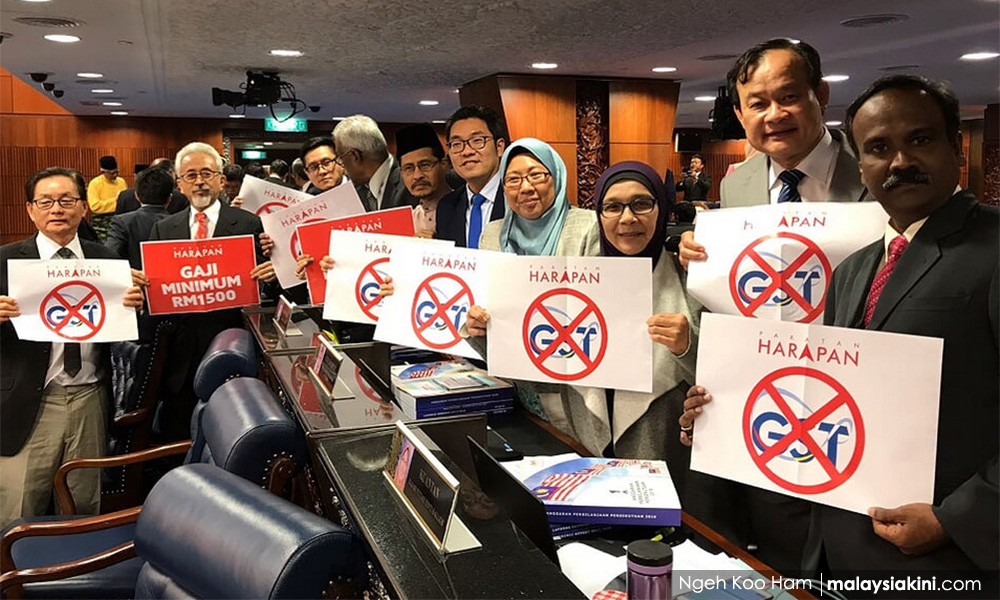
MP SPEAKS | I have been digesting the comments and commentaries made about the 2018 Budget announced last Friday by Prime Minister Najib Abdul Razak and also the Pakatan Harapan alternative budget. I want to use this opportunity to address several critiques directed at the Harapan budget, starting with our proposal to abolish the GST.
One of the major critiques levelled against the Harapan alternative budget is that we are not being responsible or realistic by advocating for the abolishment of GST. The following are the responses to some of these critiques:
Response: We will not get rid of the GST system. All of the items which were not taxed during the Sales and Services Tax (SST) regime will be "zerorised", ie zero percent GST tax rate. All of the items which were taxed at the point of production during the SST regime will have the same tax level at the point of production. Therefore, we will use the existing GST system to collect SST related taxes.
Response: Most Malaysians do not know the meaning of "zerorising" GST or the difference between goods which are zero-rated versus exempt.
The effect on the consumer will be that they no longer have to pay GST so this effectively means we are getting rid of it.
Response: When we get rid of GST, consumers will expect prices to go down. Even if retailers don’t decrease prices by six percent, there will be competition between retailers to offer at least some discounts in order to attract customers. Getting rid of GST puts downward pressures on prices on the whole system.
Also, by collecting fewer taxes (by going back to the SST regime), we are directly and indirectly putting money back into the wallets of consumers and business and this will have a healthy multiplier effect on the economy.
MP SPEAKS | I have been digesting the comments and commentaries made about the 2018 Budget announced last Friday by Prime Minister Najib Abdul Razak and also the Pakatan Harapan alternative budget. I want to use this opportunity to address several critiques directed at the Harapan budget, starting with our proposal to abolish the GST.
One of the major critiques levelled against the Harapan alternative budget is that we are not being responsible or realistic by advocating for the abolishment of GST. The following are the responses to some of these critiques:
Response: We will not get rid of the GST system. All of the items which were not taxed during the Sales and Services Tax (SST) regime will be "zerorised", ie zero percent GST tax rate. All of the items which were taxed at the point of production during the SST regime will have the same tax level at the point of production. Therefore, we will use the existing GST system to collect SST related taxes.
Response: Most Malaysians do not know the meaning of "zerorising" GST or the difference between goods which are zero-rated versus exempt.
The effect on the consumer will be that they no longer have to pay GST so this effectively means we are getting rid of it.
Response: When we get rid of GST, consumers will expect prices to go down. Even if retailers don’t decrease prices by six percent, there will be competition between retailers to offer at least some discounts in order to attract customers. Getting rid of GST puts downward pressures on prices on the whole system.
Also, by collecting fewer taxes (by going back to the SST regime), we are directly and indirectly putting money back into the wallets of consumers and business and this will have a healthy multiplier effect on the economy.
Response: Firstly, the impression that many basic goods and services are not subject to GST is not entirely accurate. For example, the government has said that banking services are exempt from GST. But in reality, whenever you transfer money online to your friend or your employee, you have to pay the six percent GST on the cost of the financial transaction.
If you are charged for withdrawing money from a MEPS ATM terminal, you will have to pay the six percent GST for that charge. There are many such items whereby GST is charged on areas which the public think they do not have to pay GST on.
Secondly, just because an item is exempt from GST does not mean that the price of that item will not increase post-GST. For example, even though the residential property is GST exempt, this merely means that the developer cannot tack on a six percent GST charge on the final price of the property. The construction materials and the professional fees which go into building that property is still subject to GST. This means that the cost of GST will be implicitly included in the final property price.
In cases where the cost of GST cannot be passed on to the consumer because of price regulation, others have to bear the cost. For example, public transportation such as taxi fares is not subject to GST. However, the cost of maintaining the taxis and the insurance policies for the taxis are subject to GST. This means that either the taxi drivers have to bear the increase in these costs due to the GST - which is more likely or their taxi companies need to absorb these costs, which is less likely to happen.
Response: We will still be using the existing GST system to collect taxes that will be based on the SST regime. Hence, the same reporting system that was supposed to have increased tax transparency will still be in place.
At the same time, having GST is no guarantee that the amount of illicit financial flows out of the country has decreased. Malaysia was ranked as one of the top five countries in terms of illicit financial flows by the non-profit research organization, Global Financial Integrity (GFI).
Three of the other countries in the top five, Russia, Mexico and China, had GST or value-added taxes during the time period of the study. What is needed to decrease these illicit flow is a government which is committed to transparency and not dictated by self-interest.
One commentator has also said that having a GST will make it less likely that companies will evade tax by parking their profits in low tax countries. Despite the fact that Ireland has a value-added tax of 23 percent, its low corporate tax rate of 12.5 percent continues to attract many multinational companies to "park" their profits in this country.
The European Union (EU) has been clamping down on these practices of getting income tax breaks from low corporate tax countries. However, this is due to the EU having an institutional framework that has the force of law, rather than the presence of GST. There is no such framework in Asean and I would be surprised to learn if the government would go after Malaysian companies which "park" their profits in Singapore because of its relatively low corporate tax rate of 17 percent.
Response: It is true that GST broadens the tax base by taxing a larger number of people as compared to the personal income tax. Only 15 to 20 percent of the working population earn enough to pay personal income taxes whereas everyone has to pay GST on the goods and services consumed. This is the reason why GST is regressive since it shifts the tax burden from those who are rich enough to pay income tax to the larger population - the majority of which don’t earn enough to pay income tax.
Even then, the argument that implementing the GST will broaden the tax base is not necessarily accurate in the Malaysian context. Theoretically, implementing the GST and reducing the personal income tax rate should decrease the overall percentage revenue collected via the personal income tax. Instead, the percentage of total revenue collected via the personal income tax has increased from 11.1 percent in 2014 (pre-GST) to a projected 13.4 percent of total revenue in 2018.
This is in spite of the two percent reduction in the income tax rates among those who earn between RM20,000 to RM70,000. The total personal income tax collection is projected to increase from RM30.1 billion in 2017 to RM32.2 billion in 2018, an increase of seven percent. While some of this increase could be due to increasing wages and bonuses in 2018, one cannot discount the possibility that the Internal Revenue Board (IRB) will pursue a more aggressive strategy in chasing after back taxes from individuals and have their tax officials knock on more doors.
One commentator also said that having the GST will allow us to tax those who consume heavily, especially in luxury items. The example he cited was that GST would enable more than RM6 million to be collected on the sale of a diamond ring costing more than RM100 million. Perhaps he has forgotten that if this diamond ring (and other such luxury items) was bought overseas, then Malaysia would not be able to collect the GST for this diamond ring.
Response: This is the reason why Pakatan Harapan is committing ourselves to getting rid of the GST. In times of economic hardship, or if the government is forced to raise additional revenue for bailouts and massive infrastructure spending, the easiest way to increase this revenue is by raising the GST rate rather than cutting expenditure in other areas.
Increasing the GST as a way to raise additional government revenue has adverse effects, especially on the poor since they are the ones most susceptible to sudden price increases. Would anyone be surprised if the BN government is forced to increase the GST rate if they win GE14 and need to raise additional revenue to bailout 1MDB or to pay for the ECRL, for example?
Response: The countries which have implemented some form of value added tax such as the GST can be divided into two categories, more or less. The first category is the developed countries whereby most of the working population earn enough to pay income taxes. Shifting the tax burden from income taxpayers to the consumer does not have significant adverse effects in these countries since their citizens, by and large, are rich enough to absorb the value-added taxes.
For many developing countries, their tax collection systems are too weak to collect significant amounts of revenue from personal income and corporate taxes. Hence, implementing the GST is a way for them to improve their tax collection system and also a necessary means of raising additional revenue.
Malaysia is not rich enough to be categorised as a developed country, especially in terms of the percentage of the population which earn enough to pay personal income taxes.
But we are fortunate to have a relatively competent tax collection system under the Inland Revenue Board (IRB) and to a lesser extent, the Customs Department. Given this, Malaysia had the choice of postponing the implementation of the GST until we reach the status of a developed economy. The finances of the government were relatively intact prior to the implementation of the GST and there is no reason to think that under a new government, with a new mandate to decrease wasteful expenditure and corrupt practices, cannot survive without the GST.
Response: Most of the tax experts work for auditing companies such as PwC and Ernst & Young. They stand to gain from the implementation of the GST in terms of increasing their business from tax advice and auditing services. It is unlikely that they would speak out against the implementation of a policy from which they stand to gain financially.
Most economists follow conventional theories regarding taxation, some of which has been highlighted above. GST is a broad-based tax that is more efficient compared to other forms of taxation. But most economists don’t have much to say about the effects of corruption on government finances.
There are fewer conventional economic theories on this except to say that corruption is bad for the economy and for government finances. But by how much? Have economists estimated how much we can save through the reduction of corruption and wastage in the government? Not to my knowledge, at least not in the case of Malaysia.
It is also worth noting that tax experts and economists are most likely to be in the upper 20 percent of the income bracket and thus, are not likely to feel the brunt of the implementation of the GST the same way as someone in the B40 income bracket.
Response: We have shown in the Harapan budget that we can cut wastage and corruption by as much as RM20 billion, which is almost enough to fill the financial gap of RM25 billion as a result of getting rid of the GST and reverting to the SST tax rates.
But since this is an important topic, I will dedicate an entire statement to explain this in greater detail in my next statement.
ONG KIAN MING is the Serdang MP and head of the Penang Institute in Kuala Lumpur.
The views expressed here are those of the author/contributor and do not necessarily represent the views of Malaysiakini.


Are you sure you want to delete this comment?
This action cannot be undone.