



A tale of two budgets
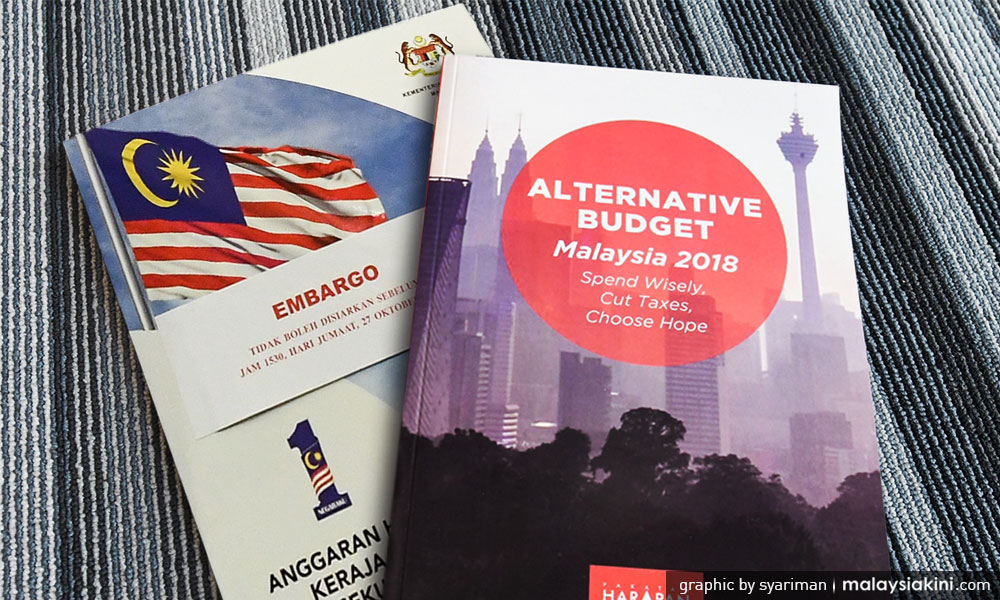
COMMENT | We can learn a number of things by comparing the BN budget with Pakatan Harapan’s shadow budget.
Before jumping into that, let’s examine briefly our attitude towards federal budgets in general.
Some use “election budget” as a derisive term (which might be mildly odd, considering the term is undoubtedly correct this time, technically speaking), while “populist budget” has been thrown by both sides at each other.
I suppose by this point we should no longer be expecting people to take umbrage at the fact that the federal budget is treated like a huge gift basket.
I suppose some of the middle class and elites believe - not incorrectly - that a federal budget should be more of a measured, responsible financial roadmap for the nation, rather than a huge Santa Claus sack.
That said, for our present time and context, perhaps it is best that we acknowledge current political realities and recognise the essentially feudal nature of our budget.
A core essence of feudalism is the “social contract” between the ruler and the ruled - where the ruler depends on the ruled to keep him or her in power, while the ruled expect their ruler to dish out resources and provide for their welfare.
In many ways, the budget is an embodiment of this system. It says to the people, you have elected me (and should continue to do so), and in return, you shall have all these goodies.
Again, however well-founded our concerns, we are unlikely to score many productive political points (electorally at least) bemoaning this practice of feudalism, and decrying poor uneducated peasants for perpetuating what is in essence their own servitude.
Rather, perhaps it is best that we acknowledge for the near future - as a transitionary period, if nothing else - that a larger portion of Malaysians will indeed continue to look to the federal budgets as an indicator of the generosity of their feudal lord...
COMMENT | We can learn a number of things by comparing the BN budget with Pakatan Harapan’s shadow budget.
Before jumping into that, let’s examine briefly our attitude towards federal budgets in general.
Some use “election budget” as a derisive term (which might be mildly odd, considering the term is undoubtedly correct this time, technically speaking), while “populist budget” has been thrown by both sides at each other.
I suppose by this point we should no longer be expecting people to take umbrage at the fact that the federal budget is treated like a huge gift basket.
I suppose some of the middle class and elites believe - not incorrectly - that a federal budget should be more of a measured, responsible financial roadmap for the nation, rather than a huge Santa Claus sack.
That said, for our present time and context, perhaps it is best that we acknowledge current political realities and recognise the essentially feudal nature of our budget.
A core essence of feudalism is the “social contract” between the ruler and the ruled - where the ruler depends on the ruled to keep him or her in power, while the ruled expect their ruler to dish out resources and provide for their welfare.
In many ways, the budget is an embodiment of this system. It says to the people, you have elected me (and should continue to do so), and in return, you shall have all these goodies.
Again, however well-founded our concerns, we are unlikely to score many productive political points (electorally at least) bemoaning this practice of feudalism, and decrying poor uneducated peasants for perpetuating what is, in essence, their own servitude.
Rather, perhaps it is best that we acknowledge for the near future - as a transitionary period if nothing else - that a larger portion of Malaysians will indeed continue to look to the federal budgets as an indicator of the generosity of their feudal lord.
Over time, hopefully, we will be able to wean ourselves off this thinking, nurture the recognition that these resources always belonged to us anyway, and inculcate the idea that budgets should be spent on capacity-building with an eye towards self-sustainability.
GST - maintain or zero-rate?
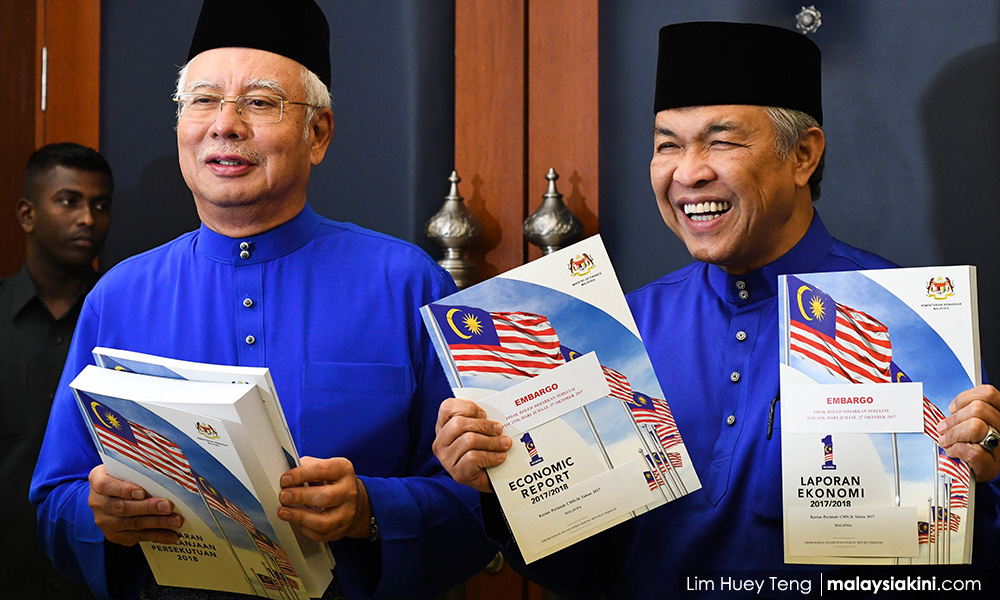
With that out of the way, let’s begin a comparison between the Harapan and BN budgets.
I wouldn’t characterise the primary difference between the Harapan and BN budgets as being ideological in nature.
Whether cause or symptom however, we can observe a few significant differences in approach between Harapan and BN.
GST is perhaps the starkest and most obvious difference. BN keeps saying it was a brilliant move that has revitalised the nation’s coffers; Harapan wants to zero-rate it.
I’m far from an expert on economics or popular sentiment, but it feels a little bit like the anti-GST movement is on the backswing, bleeding momentum.
Prime Minister Najib Abdul Razak probably timed it right, such that it has become semi-accepted and seeped in as a way of life which we have already adapted to.
Certainly, at first, there was a huge uproar about implementing GST, especially when considered alongside the perceived huge wastage and corruption by the government.
Alas, few things dilute political impact as effectively as time. Just like how 1MDB becomes more and more of a non-issue with each passing day, the negative effects of the GST appear to be increasingly muted over time - at least in the public imagination.
My observation could be wrong, but this could account for the relatively lukewarm response the GST zero-rating in Harapan’s shadow budget received.
On subsidies and BR1M
Another big difference between the Harapan and BN budgets could be on the question of subsidies.
Following what may be mainstream economic thought, BN has been moving away from subsidies, perhaps forwarding the argument that such subsidies artificially skew the market negatively.
The theory that subsidies seem to create unsustainable dependencies that put us out of sync with the world market and reduce our global competitiveness seems sound enough to make Harapan’s push to go back to subsidies seem somewhat anachronistic.

With regards to the RM1 billion in fuel subsidies allocated in the Harapan budget, one supposes that these subsidies benefit some segments of society more than others - namely those who can afford vehicles and consume more fuel.
It might be argued that such fuel subsidies benefit middle and upper classes more than they do the working classes, especially given that a drop in the cost of fuel at this point may not necessarily result in a reduction in the cost of goods and services.
Thinking about how we might most directly aid the working classes instead brings us to another interesting point of comparison between the two budgets: BR1M.
There was quite a lot of protest when BR1M was first announced, decrying it as vote-buying and feudalism at its worst.
Such criticism is not entirely unfounded of course. There’s no doubt that BR1M was created largely with the idea of creating more votes for BN.
That said, it appears to have been a fairly effective and popular form of direct aid, giving funds to citizens to spend however they see fit.
In any case, it seemed good enough for Harapan to state clearly this year that they would continue BR1M, albeit with very minor modifications.
This puts Harapan in somewhat of an awkward position. BR1M was so popular that they had to state upfront that they would not do away with it while exposing themselves to accusations of being copycats and/or admitting that BN was right.
Moving beyond zero-sum structures
This brings us back to the question of a zero-sum political structure. A simple, two-coalition, first-past-the-post system tends to encourage political opponents to try and fight and outdo one another at every turn.
Such a structure makes it difficult for opponents to cooperate across the political divide.
When both sides agree on something, this should be a good thing - an opportunity to work together for the betterment of the country.
Instead, it appears to be taken as an opportunity for gloating and belittlement - just another way to score political points.
While this structure of politics is fairly resilient and has lasted quite a while, I doubt it will last forever, for the reasons above. People will eventually tire of relentless mudslinging.
As we look towards such a future, perhaps the formation of future shadow budgets and similar initiatives should not be informed purely by the need to distinguish and differentiate oneself from the current ruling coalition.
We might even imagine a future where the opposition is not obliged to disagree with almost everything the government does, for the sake of disagreeing.
Perhaps the rakyat would respond more positively to an opposition that knows how to take the good, protest against and leave the bad, and always be ready to champion the best ideas, wherever they come from.
NATHANIEL TAN acknowledges that the Penang Chief Minister’s response to the Penang Forum dialogue is better than that of his deputy’s. He hopes it is not merely a case of good cop, bad cop.
The views expressed here are those of the author/contributor and do not necessarily represent the views of Malaysiakini.


