
Lawyer gives reason why a declaratory relief is needed in 'Allah' ban
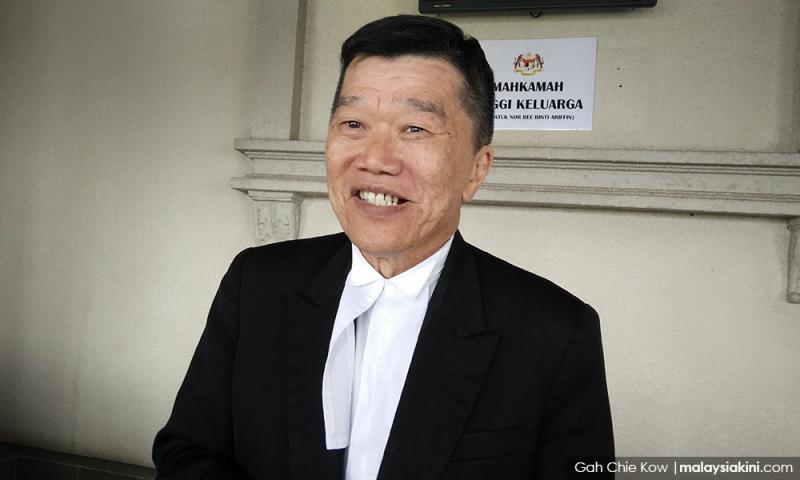
A lawyer representing Jill Ireland today cited actions by the Home Ministry officials in raiding a Sabah church as the reason why a declaratory relief on the use of the word Allah for the Bahasa Malaysia speaking Christian community is needed to be given by the High Court in Kuala Lumpur.
Lim Heng Seng, who represented Ireland, showed news portal reports last week which quoted Parti Cinta Sabah president Wilfred Bumburing, criticising the ministry official's visit to the church and urging the church officials to not use four terminologies, namely Allah, Baitullah, Kaabah and Sholat.
“Furthermore, they advised the church officials on how to design a book on Christian teachings and what font size to use on the cover design,” Lim said in reading what Bumburing's remark...
A lawyer representing Jill Ireland today cited actions by the Home Ministry officials in raiding a Sabah church as the reason why a declaratory relief on the use of the word Allah for the Bahasa Malaysia speaking Christian community is needed to be given by the High Court in Kuala Lumpur.
Lim Heng Seng, who represented Ireland, showed news portal reports last week which quoted Parti Cinta Sabah president Wilfred Bumburing, criticising the ministry official's visit to the church and urging the church officials to not use four terminologies, namely Allah, Baitullah, Kaabah and Sholat.
“Furthermore, they advised the church officials on how to design a book on Christian teachings and what font size to use on the cover design,” Lim said in reading Bumburing's remark.
Bumburing, who is also Tamparuli assemblyperson, said the incident should not have happened, especially in Sabah.
Lim pointed out that the use of the word Allah by the Christian community in Sabah and Sarawak had been in place for over 400 years, and hence, there should not be a limit to its use and the importation of praying material from overseas which uses the word on the grounds it upset public order and security.
“This has been proven historically from the affidavits affirmed, which is not rebutted,” he said.
Ireland, whose Malay-language Christian CDs and religious books were seized by the customs at the Kuala Lumpur low-cost terminal in 2008, got back the items in 2014, but is seeking declaratory relief to use materials containing the word "Allah" for religious and educational purposes.
She is seeking a declaration that her constitutional right to practice her religion was violated by the imposition of a restriction or ban on the import of educational materials.
Ireland also wants a declaration that the use of the Publication and Printing Presses Act (PPPA) 1984 and the Customs Act 1967 to seize the CDs was an infringement on equality under the law.

Lim said this in his reply to submissions from the Home Ministry's counsel, senior federal counsel Shamsul Bolhassan.
The lawyer also pointed out that the 10 point solution, which was agreed by the cabinet in 2011, which among others, recognised the rights of the Christian community in Sabah and Sarawak to use the word Allah, had superseded the 1986 cabinet directive, which barred Christians from using the word.
Section 9 PPPA not ultra vires
Earlier, Shamsul told the court that the 1986 cabinet directive is still in force as it is a policy decision to avoid conflict between the Muslim and the Christian communities.
Shamsul added that it would be incorrect to say that the 1986 decision infringes on the rights of the Christian community, as Section 9 of the PPPA gives power to the minister to prohibit and restrict, and the restriction is subject to the proper usage.
“The directive is to avoid confusion and misunderstanding as there is sensitivity in its usage between Peninsular Malaysia and Sabah and Sarawak,” he said.
Shamsul added that to suggest that Section 9 is unconstitutional or ultra vires of Article 11 (5) of the constitution, as it affects one's religion is not correct, as it is applied across the board.
He cited the prohibition of a publication of a Syiah related book as an example.

“Section 9 (1) of the PPPA states without prejudice, to anything in this Act, the minister may refuse the importation into Malaysia or withhold delivery or return to the sender outside Malaysia, any publication, which he is satisfied, contains any article, caricature, photograph, which is likely to be prejudicial to public order, morality security, or which could cause alarm,” he said in reading the section.
Ireland's counsel, Shamsul said, had claimed that she would be deprived on any publication on the near future, but as the section stipulates, the consequential release of the material can be made, and this was the case.
Regarding the 10-point solution adopted in 2011, which Ireland's counsel claimed had succeeded the 1986 cabinet directive, the government lawyer said it was a cabinet policy decision to only resolve issues pertaining to the importation, printing, distribution and usage of the Bible in Sabah, Sarawak and Peninsular Malaysia.
“The 10-point solution has in fact, already settled the qualms of the applicant (Ireland) and her fellow congregation,” he said, adding it was never an issue in Sabah and Sarawak pertaining to the use the word Allah, but Bahasa Malaysia/Indonesia bibles imported into or printed in Peninsular Malaysia must have the words “Christian Publication”.
“With these, there is no illegality with regards to the PPPA as well as the 1986 government directive,” he added.
Justice Nor Bee Ariffin reserved in delivering her decision on the matter.


Are you sure you want to delete this comment?
This action cannot be undone.