




Campus polls: Public speaking test for UIA candidates
In the past, students concerned about issues affecting their peers contested in campus polls. This seemed to be the most important requirement.
In the past, students concerned about issues affecting their peers contested in campus polls. This seemed to be the most important requirement.
However, Universiti Islam Antarabangsa Malaysia (UIA) feels otherwise. It wants aspiring candidates to not only have good grades, but also pass a 'public speaking test' and interview session.
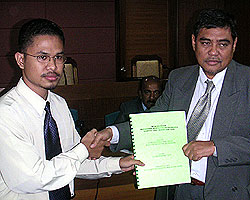 This has got the students fuming. Together with their counterparts from other universities, they showed up at the Human Rights Commission of Malaysia (Suhakam) office in Kuala Lumpur today to register their protest on the various alleged abuses during campus elections.
The polls, held simultaneously for all universities nationwide, will take place either at the end of this month or early next month.
New rulings
According to the students, UIA election commission chief Hamidon Abdul Hamid had revealed about the public speaking test, among other new rulings to be introduced, in a written document on Sept 8.
The document, a copy of which was made available to malaysiakini, stated that all prospective candidates are required to attend the test, which will be in English, on Wednesday and Thursday.
A briefing on the matter was held by the election commission, which comprises university officials, today.
"Only candidates who pass the examination shall contest in the election," said Hamidon in the four-page document.
Apart from this, prospective candidates are also required to attend a session with the vice-chancellor, deputy vice-chancellor overseeing students affairs and president of the UIA next Monday. The purpose for this meeting was not stated.
 Aspiring candidates are also required to attend an interview session next Tuesday and Wednesday. Those who are absent or fail the interview, will not be allowed to stand in the elections.
According to the document, the academic yardstick has also been raised from the cumulative grade point average (CGPA) of not less than 2.5 to 2.8 this year. Students who do not meet the required CGPA will be disqualified.
The seats up for grabs have also been slashed to 24 from 25 the previous year. While no reasons were given for this, 'anti-establishment' students claimed that it has been engineered to affect their chances.
In the partisan politics-saturated campus polls divided between 'pro-government' and 'anti-establishment' camps, UIA has always been a bastion of the latter.
'Ridiculous move'
In the meeting with Suhakam this afternoon, UIA student leader Mohd Syahir Che Sulaiman described the new ruling as a 'selection before election'.
"It violates one of the articles in the students representative council's constitution which stipulates the election of a student representative council member should be done through secret balloting," added Mohd Syahir, who is the council's deputy treasurer.
Malaysia Students Solidarity (SMM) spokesperson Ahmad Rifaudin Abdul Wahab, who was also present, said the new rulings was "ridiculous and not in tandem with the spirit of democracy".
Another UIA student Mohd Husni Abdul Karim called on Suhakam to probe the alleged cooperation between the Higher Education Ministry and university authorities to secure victory for the pro-government faction.
In the series of weekly meetings coordinated by the ministry in the run-up to the campus polls, Umno Youth and Puteri Umno officials were also invited to attend but they have since denied being involved in the polls.
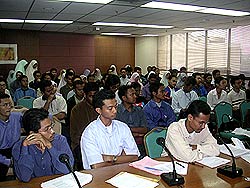
The one-hour meeting with Suhakam was attended by about 100 students and representatives from non-governmental organisations.
They also listed down irregularities, intimidation tactics and unfair election rules that were practised in the past elections.
Another restriction
 Four commissioners including its vice-president Simon Sipaun, Prof Hamdan Adnan, N Siva Subramaniam and Dr Abdul Monir Yaacob received a memorandum from the students.
Meanwhile, Hamdan opposed the 'public speaking test' and described it as an additional restriction imposed on top of the Universities and University Colleges Act (UUCA).
"Imagine if we were to have a public speaking test for our parliamentarians that wish to contest in the general election? We don't need that. As long as the person is not mentally-ill or bankrupt, he or she has the right," he said.
The commissioner also said that the one-day campaign period for students was ridiculous and it would defeat the purpose of having a campus election.
"It will be a waste of money. If you want to hold any election, don't make it a mockery of the system," he stressed, promising an investigation into the complaints.
On a more practical level, Sipaun told the students not to have much hope piled on Suhakam and have their 'expectations turn into frustrations' as the commission has its limitations.


