


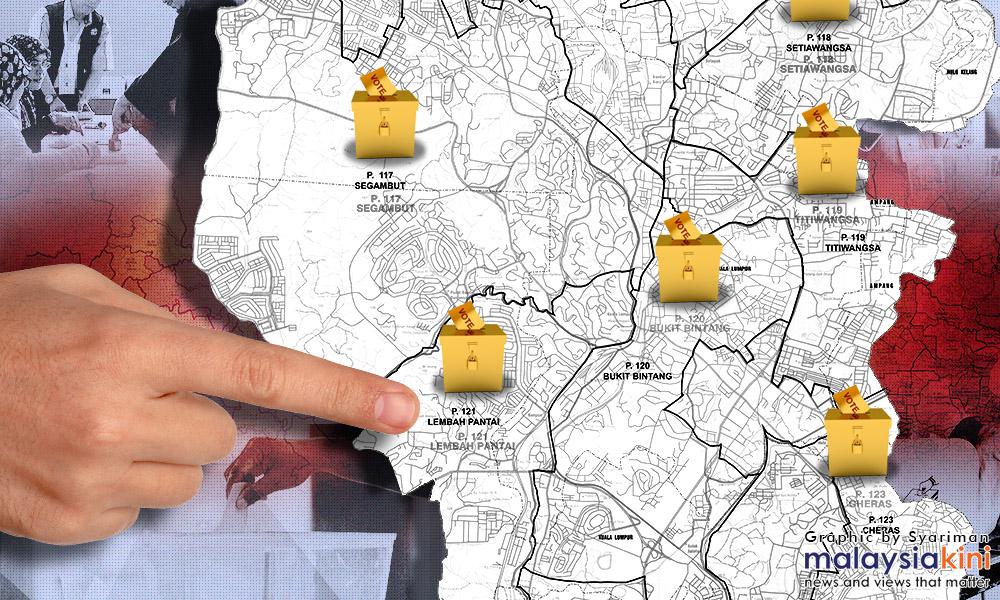

Bersih urges opposition-held states to modify electoral system
Electoral watchdog Bersih has urged opposition-held Selangor, Penang and Kelantan to introduce “Non-Constituency Seats” (NCS) alongside existing constituency seats, in order to modify the electoral system at the state level.
The NCS system allocates seats to political parties based on their share of votes, as opposed to how winners are decided by simple majority in the present First Past The Post (FPTP) system.
NCS resembles party-list seats in countries using the Party-List Proportional Representation (List-PR) electoral system, in which a constituency elects many representatives, voters vote for parties, and seats are allocated according to vote share.
“It is constitutionally possible for the states especially Selangor, Penang and Kelantan to introduce NCS as an interim measure.
“In particular, Bersih calls upon the Selangor state government to implement the NCS before the 14th general election (GE14),” Bersih said in a statement.
Articles 116 and 117 of the Federal Constitution stipulate that each state and federal constituency must be represented by one representative...
Electoral watchdog Bersih has urged opposition-held Selangor, Penang and Kelantan to introduce “Non-Constituency Seats” (NCS) alongside existing constituency seats, in order to modify the electoral system at the state level.
The NCS system allocates seats to political parties based on their share of votes, as opposed to how winners are decided by simple majority in the present First Past The Post (FPTP) system.
NCS resembles party-list seats in countries using the Party-List Proportional Representation (List-PR) electoral system, in which a constituency elects many representatives, voters vote for parties, and seats are allocated according to vote share.
“It is constitutionally possible for the states especially Selangor, Penang and Kelantan to introduce NCS as an interim measure.
“In particular, Bersih calls upon the Selangor state government to implement the NCS before the 14th general election (GE14),” Bersih said in a statement.
Articles 116 and 117 of the Federal Constitution stipulate that each state and federal constituency must be represented by one representative.
Bersih specifically urged Selangor to implement the NCS in light of the state losing its bid to challenge the Election Commission’s (EC) redelineation exercise in the Kuala Lumpur High Court.
Selangor had mounted its challenge after accusing the EC of malapportionment and gerrymandering in conducting the exercise.
“Bersih holds that malapportionment and gerrymandering can be best stopped when the seats won by parties are determined by how many votes they get (through proportional representation), not where they get the votes."
Adding the NCS element to the current FPTP system would also make politics more “inclusive and stable” by ensuring parties gain representation even when they lose in multi-corner fights and enabling more female representation in politics, said Bersih.
It added that the NCS system would also make it harder for a government to fall, should lawmakers defect to other parties.
In 2009, the opposition lost Perak after three of its lawmakers defected to BN.
Currently, the List-PR electoral system is implemented in 86 countries, including Indonesia and South Africa.
Many countries also have “mixed member” systems which combine FPTP and List-PR. Voters get two ballots, one ballot to vote for constituency representative under FPTP, and the other ballot to vote for parties under List-PR.
Adding an NCS component to the FPTP system will resemble the Mixed Member Majoritarian (MMM) system in Japan, Taiwan, Korea and the Philippines. But Malaysian state voters cannot vote directly for parties under NCS, because of Article 117.
Switch from FPTP after GE14
Thus, Bersih urged parties to “seriously study the desirability and feasibility” of switching completely from a FPTP system after GE14.
“The country will slip into greater instability if elections keep producing minority government in term of votes.
“As in the last poll (in 2013), when the ruling coalition (BN) won 60 percent of parliamentary seats with only 47 percent of votes.
“If nothing is done on the electoral system, the resumed constituency delineation exercise will likely result in not only the distortion but even the denial of the Selangor electorate if GE14 is held using the new constituency boundaries,” it cautioned.
As an alternative to the FPTP, Bersih mooted a Mixed-Member Proportional (MMP) system, which is found in Germany and New Zealand.
Under the MMP system, voters have one constituency ballot and one party ballot while lawmakers will be one of two types - constituency representatives or party-list representatives.
The percentage of votes each party gets will determine the total number of seats parties are entitled to.
“This will make gerrymandering and malapportionment simply pointless,” said Bersih.


Are you sure you want to delete this comment?
This action cannot be undone.