



Migrant rights groups propose new law to protect domestic helpers
While there are numerous laws that protect the rights of workers in Malaysia, migrant rights group Tenaganita and the Malaysian Trade Union Congress (MTUC) has drafted new legislation aimed solely at introducing better protection for domestic helpers.
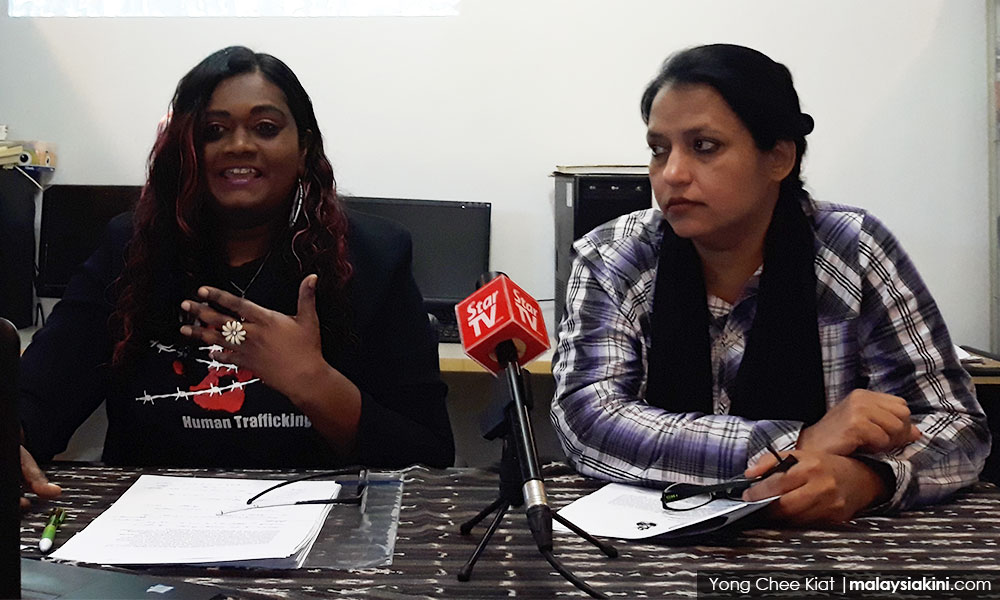
At today's press conference held in conjunction with the International Migrants Day 2017 at its office in Petaling Jaya, Tenaganita director Glorene A Das said that the new draft bill is targeted for release in Jan 2018.
“The current (existing) provisions do not really apply to domestic helpers.
“A labour inspector, for example, cannot go inside the private domain of a house to inspect how a domestic helper is doing, like how they can go inside a business domain to conduct their inspections,” Glorene said.
“If we do not have these protections in place, there will be an increase in abuses,” she stressed...
While there are numerous laws that protect the rights of workers in Malaysia, migrant rights group Tenaganita and the Malaysian Trade Union Congress (MTUC) has drafted new legislation aimed solely at introducing better protection for domestic helpers.
At today's press conference held in conjunction with the International Migrants Day 2017 at its office in Petaling Jaya, Tenaganita director Glorene A Das said that the new draft bill is targeted for release in Jan 2018.
“The current (existing) provisions do not really apply to domestic helpers.
“A labour inspector, for example, cannot go inside the private domain of a house to inspect how a domestic helper is doing, like how they can go inside a business domain to conduct their inspections,” Glorene said.
“If we do not have these protections in place, there will be an increase in abuses,” she stressed.
Glorene also noted that there are currently some 50,000 Malaysian employers still awaiting a domestic helper, as major countries such as Indonesia, Philippines and Cambodia have imposed stricter conditions for sending their citizens to Malaysia over the years.

On the government’s new online system to hire foreign domestic helpers directly, Glorene said that Tenaganita is in support of direct hiring as a general method of recruitment, as it had been proven to offer better protection for workers.
At the same time, she also urged the government to be more transparent about its plans to manage the new system, which is set to be implemented by Jan 1.
“We are hearing so many different inputs; that the Home Ministry is already working to set up agencies that will hire directly, but we still feel there is a lack of clarity in terms of the process.
“So yes we do support the concept of direct hiring, but we also call for a clear system, transparency into how we would go about hiring domestic helpers," she said.
With regards to the existing legislation, Glorene said there is a "major gap" in the understanding of what constitutes elements of labour trafficking, a long-standing issue affecting migrant workers here.
Referring to the Anti-Trafficking in Persons and Smuggling of Migrants (Atipsom) Act 2007, she pointed out that there are various violations against migrant workers which should be classified as an offence under the law.
“Unpaid wages, no days off, double places of work, contract substitution…when we go to the Labour Department or the police station, they clearly say ‘these have nothing to do with Atipsom, these have to do with labour’.
“There are clearly gaps there,” she stressed.
When met later, labour activist Abdul Aziz Ismail said the proposed new legislation was drafted based on various existing provisions under Atipsom, the Employment Act 1955 and the Industrial Relations Act 1967.
“It took us about two months to draft the law. We are also pushing to withdraw the word ‘servant’ (from existing legislation) and change it to 'domestic helper',” he explained.
Other issues highlighted during the press conference, which was jointly held with regional migrant rights group Caram Asia, included difficulties faced by domestic helpers and migrant workers in bringing their cases to the Labour Court.
Those who choose to go through the legal process are often declared "undocumented" if their employer proceeded to cancel their work permits.


Report this comment
Are you sure you want to delete this comment?
This action cannot be undone.