




Deputy police chief wants findings on Kg Medan
The police want a copy of a doctoral thesis which claimed that the March 2001 attacks near Kampung Medan in Petaling Jaya Selatan, had been organised and perpetrated by outsiders.
The police want a copy of a doctoral thesis which claimed that the March 2001 attacks near Kampung Medan in Petaling Jaya Selatan, had been organised and perpetrated by outsiders.
Deputy Inspector-General of Police Musa Hassan said the findings must be studied before a decision to start an investigation can be made.

"Forward the research to me, I want to see it. I have to see it before commenting on whether we will open the case or not," he said when contacted yesterday.
"If the researcher says the attacks were organised by outsiders, who are these outsiders?" he asked.
Musa was responding to claims by S Nagarajan who said the clashes involved "organised attacks on Tamils and (were not the result of) spontaneous group or gang fights as projected by the media and authorities".
The attacks that took place around Kampung Medan left six dead and 29 seriously injured, the majority of whom were Indian Malaysians.
Contacted today, Nagarajan said he saw no problems in submitting his research to the police.
 "It's a document that is in the UM library, in the public domain, and is available for anybody to read. It's all there in the thesis," he said.
However, Nagarajan said he does not have further information or evidence on the perpetrators, saying that his claims are based on interviews with residents of the settlements and some of the victims.
"It's not up to me to name those outsiders who (may be involved) because I don't know who they are. There have been allegations, but it should be up to the competent authorities to investigate," he said.
Wrong strategies
Among other important points contained in Nagarajan's research was his finding that the incident was not due to racial conflict among residents of the squatter settlements.
This is relevant in light of the subsequent strategies adopted by the authorities as part of efforts to prevent 'future conflicts' and to eliminate what they saw to be the root cause of the clashes, he said.
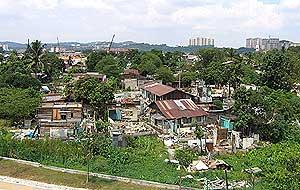 He said this misconception led the state government to believe that by demolishing squatter areas and relocating residents to low-cost flats, conflicts could be avoided.
Nagarajan said he believed that additional tensions and social ills could be exacerbated by the relocation, as low-cost flats have none of the communal support available in squatter settlements. In addition, the cost of living is higher.
"I wouldn't say that the authorities, in relocating squatter settlements to low-cost flats, are relocating potential conflict there," he said.
"I'm just saying that you are producing a new set of situations that will lead to social ills and tensions. You break up a complex and subtle community support network that has provided survival mechanisms to squatters," he added.
"When stable communities in squatter settlements are hastily broken up and its inhabitants are relocated to low-cost flats, you create potential trouble spots."


Are you sure you want to delete this comment?
This action cannot be undone.