



'Name it, or a pain is nameless': The stories of domestic violence survivors
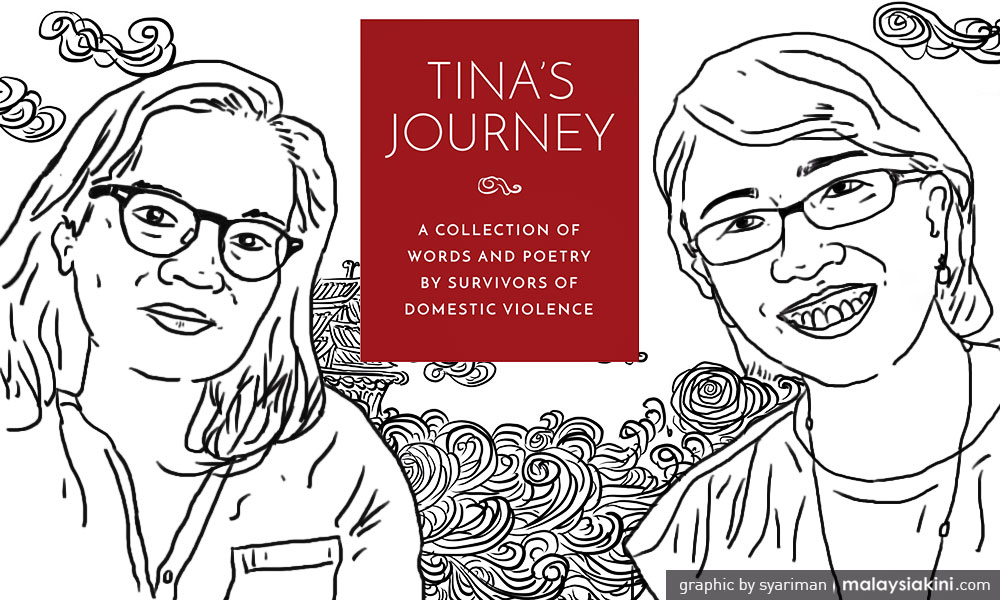
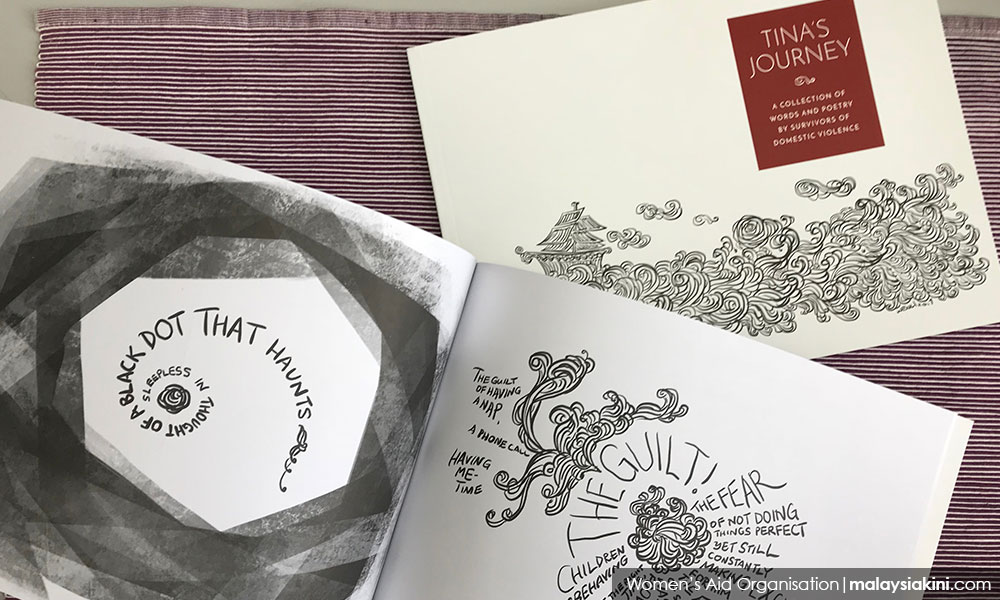
FEATURE | “Tina’s Journey,” recently launched by the Women’s Aid Organisation (WAO), collects works from the survivors domestic violence. The book is the result of a two-year creative writing workshop conducted by author Bernice Chauly in the WAO shelter since 2015.
Survivors were asked to write poems and stories, and do so in their own language. Nearly 500 works were collected.
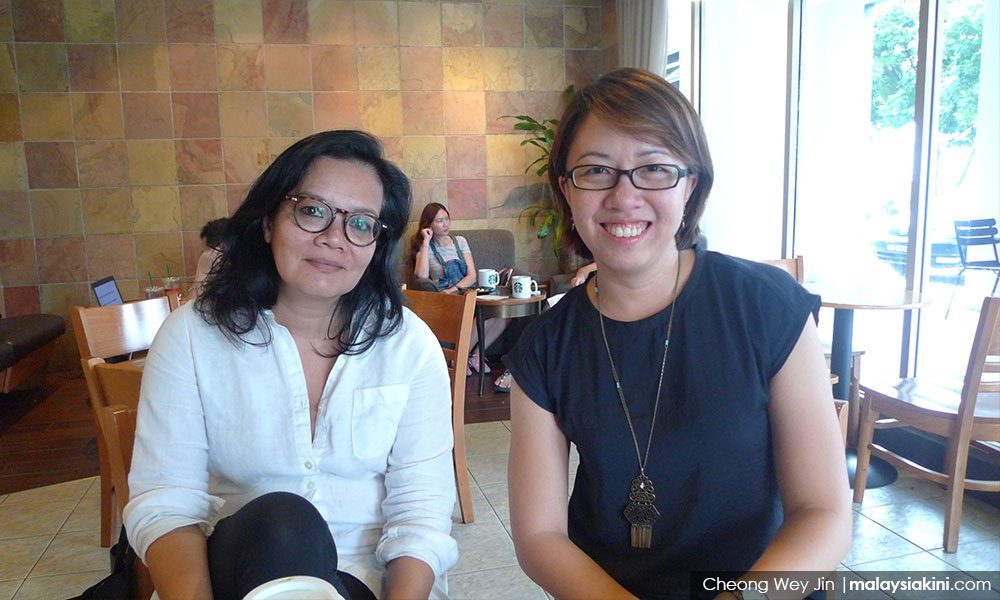
Artist Chan Wen Li was then commissioned to bring “Tina” – short for “Think I Need Aid,” the organisation’s domestic violence helpline – to life, working together with Kenny Ang, a social engagement officer from WAO.
Malaysiakini interviewed Chauly and Chan to share their views of the project.
Bernice Chauly: Seeking the social power of words
The number of workshop attendees sometimes dwindled to less than six. But Chauly didn't care; she persisted with her creative writing class for domestic violence survivors once a week, every week, for two years.
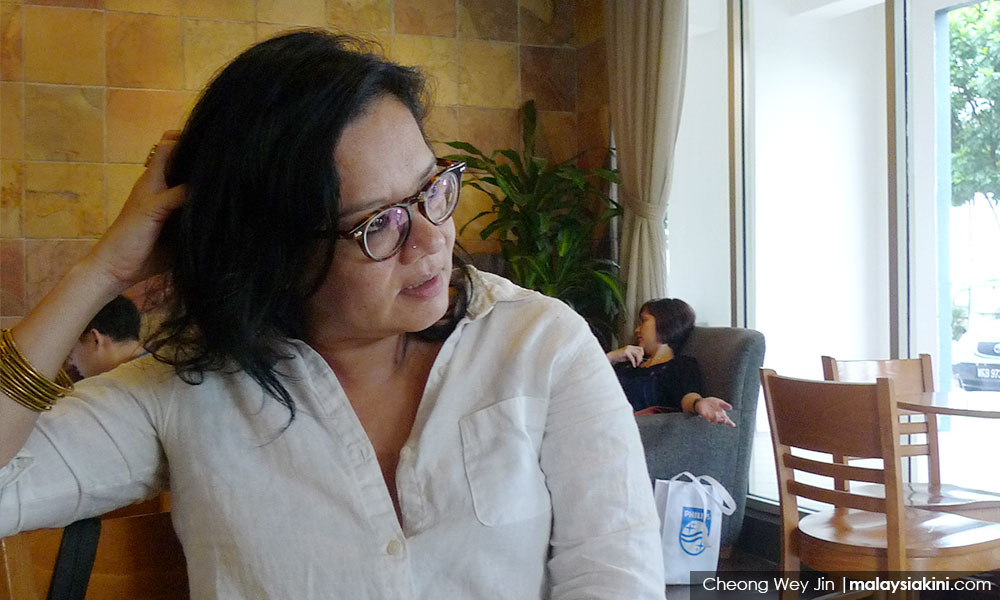
But Chauly is used to uncertainty. Perhaps this is due to her experience working with marginalised communities – visiting a jungle refugee camp just off Putrajaya ten years ago, teaching English to sex workers in Chow Kit, or most recently, judging a poetry competition for migrant workers.
The writing assignments she gave to her class sound almost too simple – write about who you are, why you’re angry, what you’re afraid of. Or she would ask participants to look into the mirror and describe themselves. As one of the survivors says, “These sound like school assignments.”
Chauly knows, however, that the simplest topics are always the most difficult to write. “Try it if you don’t believe it,” she says.
And she would know. Chauly teaches creative writing in a local university, founded the KL Writers Workshop, and is an author of six books. Her latest novel, “Once We Were There”, which was published in July this year, is one of Kinokuniya's best-selling books...
FEATURE | “Tina’s Journey,” recently launched by the Women’s Aid Organisation (WAO), collects works from the survivors domestic violence. The book is the result of a two-year creative writing workshop conducted by author Bernice Chauly in the WAO shelter since 2015.
Survivors were asked to write poems and stories, and do so in their own language. Nearly 500 works were collected.
The book is the result of a two-year creative writing workshop conducted by author Bernice Chauly in the WAO shelter since 2015. Survivors were asked to write poems and stories, and do so in their own language. Nearly 500 works were collected.
Artist Chan Wen Li was then commissioned to bring “Tina” – short for “Think I Need Aid,” the organisation’s domestic violence helpline – to life, working together with Kenny Ang, a social engagement officer from WAO.
Malaysiakini interviewed Chauly and Chan to share their views on the project.
Bernice Chauly: Seeking the social power of words
The number of workshop attendees sometimes dwindled to less than six. But Chauly didn't care; she persisted with her creative writing class for domestic violence survivors once a week, every week, for two years.
But Chauly is used to uncertainty. Perhaps this is due to her experience working with marginalised communities – visiting a jungle refugee camp just off Putrajaya ten years ago, teaching English to sex workers in Chow Kit, or most recently, judging a poetry competition for migrant workers.
The writing assignments she gave to her class sound almost too simple – write about who you are, why you’re angry, what you’re afraid of. Or she would ask participants to look into the mirror and describe themselves. As one of the survivors says, “These sound like school assignments.”
Chauly knows, however, that the simplest topics are always the most difficult to write. “Try it if you don’t believe it,” she says.
And she would know. Chauly teaches creative writing in a local university, founded the KL Writers Workshop, and is an author of six books. Her latest novel, “Once We Were There”, which was published in July this year, is one of Kinokuniya's best-selling books.
Letters to the ex
There are two women in the class. One had just come out of a very difficult separation. She and her three children were abused by her husband, but the courts had given him custody.
The other had been in prison twice for drug offences. She had been physically abused by the husband and his family. The family broke off their relationship with her. Like many of those in the WAO shelter, the two women became close friends.
But how would mere words empower these women, who had been to hell and back?
Chauly asks them to write a letter to their ex-husbands. They had never thought of this before. Once the words came out, they wouldn’t stop. Their confusion and doubts and tears soaked through the paper.
When they were done, they took their letters to the backyard and set it on fire. They could see, physically, their resentment turn to ashes.
“It is simple but very empowering,” Chauly says. “The act of putting things on paper is really powerful.”
Opening Pandora’s box
But putting words on paper is still quite an ask for many survivors of domestic violence.
Chauly saw a lot in her time at the shelter. A woman came in with her entire face swollen, and another had her hand bandaged.
WAO shelters over a hundred women each year. About 80 percent of these women are domestic abuse survivors, others include victims of rape or human trafficking. Most are from the Klang Valley area, while others are from Myanmar, Indonesia, Philippines, or as far away as Somalia, Saudi Arabia, Australia and the US. Over half of the women here bring along their children when they escape from their homes.
The majority of domestic violence survivors remain silent for various reasons. Many reach breaking point when their children start being abused too.
As such, getting them to write is like opening a Pandora’s box of shame, trauma and humiliation. Some are resistant; some are rendered speechless. Some get started, and finding themselves unable to carry on, leave. But some come back, and say they want to try.
“Because it is kind of exposing the fact that they were in bad marriages,” Chauly says. “‘I was bitten by my mother, father, husband or my stepson.’ Some women have been abused their whole lives, so it is very difficult. It is a sense of shame, a lot of shame.”
One woman starts her letter with “Dear husband, are you a murderer?” She suspects her husband had killed his ex-wife, but she suppressed this for many years. After putting it to paper, she realises that evading the question all these years also put her at great risk.
The class always gets emotional. A 60-year-old woman writes in Chinese, “I just want my husband to be nice to me, why does he scold me all the time.” She tells Chauly in Cantonese, “I have never written like this before,” and breaks down in tears.
It is common for survivors of domestic violence to adopt the perception and valuation of their abusers – seeing themselves just as their husbands see them, blaming themselves just as their husbands blamed them. Some cannot even describe in words the violence visited upon them. The hope is that with writing, they will slowly learn that this is all the result of emotional blackmail.
Chauly stresses that writing is powerful on many levels. “With writing you actually name it, you name abuse, you name the trauma, and you name the person who had done this to you.” After the “admission” of sorts, comes healing and reconciliation.
It was this realisation of the power of writing that made Chauly become an author.
Starting to write
Chauly’s mother is Chinese, and her father Sikh. They married in the late 1960s, despite resistance from both families. Her father died when Chauly was four, drowning off a beach in Penang. Images of death – tombstones, epitaphs – pervaded her early writing in school.
She grew up in Ipoh – multiracial from a distance, but with communities still living apart from one another. Not belonging to any one group, and never really knowing her father, she had something of an identity crisis.
Only by reading the books that he left behind – on the World Wars, plants and animals, and back issues of National Geographic – could she paint a picture of who her father was. And only by exiling herself to Canada, could she learn, by way of postcolonial theory, that her existence was not aberrant.
Yet, shorn of historical context, the crisis of identity lingered until Chauly’s return to Ipoh. She began to compile fragments of family history, and set it to paper. After her mother's death, she made plans to travel to London and India to trace her diasporic roots.
Nevertheless, the writing continued. As Chauly once said in an article, “My father’s death made me want to write, and my mother’s death gave me the freedom to finish it.”
Writing as social power
Writing is not just a form of self-salvation, but also a medium of intervention in marginalised communities.
After every writing class, Chauly asks participants to read out what they’ve written in their own language. Some of the women even take the initiative to help others translate their works, some offer help to those who can’t even write their own names.
And as a result, these personal experiences of domestic violence were transformed into a shared social condition that they no longer had to face alone.
“When they start writing,” Chauly explains, “they realise that ‘my problem is bad, her problem is even worse, this problem is not so bad’, but they all have the same problem that they need to deal with. That is very empowering.”
The writing has even turned into a support system for the survivors. A number of the women have kept in touch after leaving the shelter, with some even moving into new places to start new lives together.
The catharsis is one thing, but dealing with the reality of the survivors’ lives outside of the class is the most challenging part. “It is not my responsibility, but the fact is that I started them on this process. I want to know how they’re doing,” Chauly says.
A bond developed between Chauly and the women. She sometimes found herself acting as a lifeline of sorts between the women and the shelter, being more attuned to their needs – from getting calls when provisions were running low, to calls from women who had disappeared from the shelter for months, saying “I am on the street, but I am fine.”
Chauly knows, at the end of the day, that she isn’t a social worker, and that a line needs to be drawn. But she’s attracted to it, nonetheless, and finds herself discussing the management of the shelter with the women, or seeking out lawyers for them.
As a single mother who experienced domestic violence herself, Chauly gets a keen sense of her littleness when she hears their stories. “Every class was humbling,” she says. “They have absolutely nothing. They are barely alive, how do they begin. These problems are all around us.”
The two-year creative writing workshop which resulted in “Tina’s Journey” was made possible by funding from a Dutch foundation. She has plans to look for extra funding to publish the original writings of the women in the workshop, and to do more work with the transgender community.
But for now, Chauly is just looking for someone to take over the writing workshop in the WAO shelter, since society needs more people to speak out for the voiceless and marginalised communities.
“We need to voice their stories. If you can just help a very small fraction of society, that is good enough.”
When she started the KL Writers Workshop two years ago, she said that as a writer, it is important to explore not just the artistic, but the social power of creative writing at the same time.
“I always feel that, as an artist, you make art and you also need to give back, you need to help other people channel their angle, their trauma,” she says. “This is a form of healing.”
Chan Wen Li - lawyer turned artist
Chan Wen Li is outside the WAO office. She has with her two framed pictures of the 100m mural exhibition that was launched at Masjid Jamek last April, and also a toy car she plans to donate to WAO’s Child Care Shelter.
Chan was once a volunteer here, drawing different cartoons for the children at the centre.
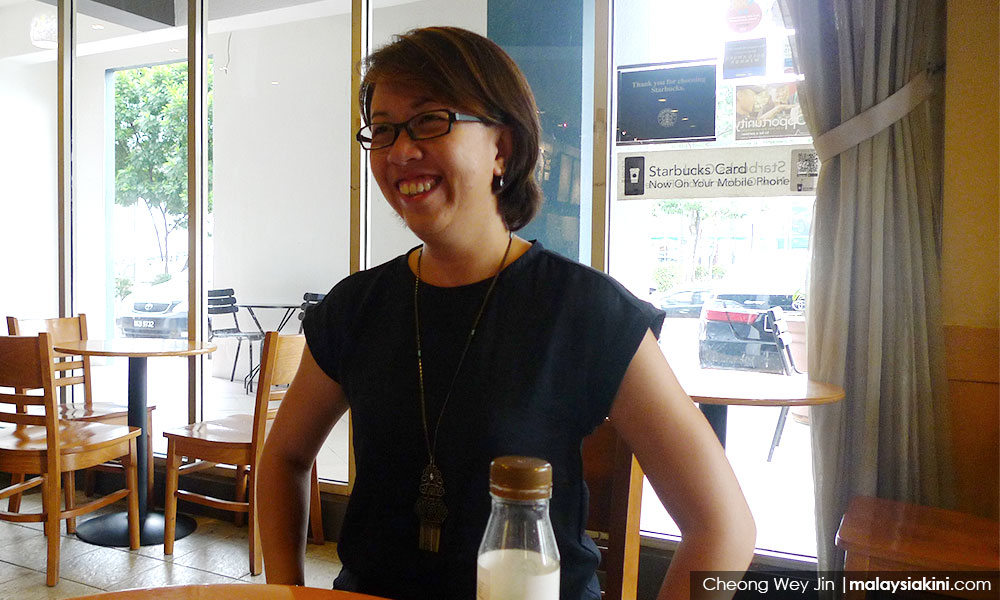
Last year, WAO contacted Chan to help produce “Tina’s Journey,” which was aimed at raising public awareness of domestic violence. She was a trained lawyer, and currently a freelance artist while teaching business law at a university.
While the workshop was still going on, Chauly passed Chan a whole stack of survivor’s writings. Working together with WAO officer Ang – who possesses a keen interest in creative writing, and who handpicked the excerpts that would make the book – Chan conceptualised the character of Tina.
Who is Tina?
The multifaceted extracts from nearly 500 poems and stories from survivors of domestic violence were composed into the journey of a singular character, Tina, named after WAO’s domestic violence helpline.
But Chan wants the 40-page picture book to be more than that. She wants those with certain problems to relate to the book, not just domestic violence survivors.
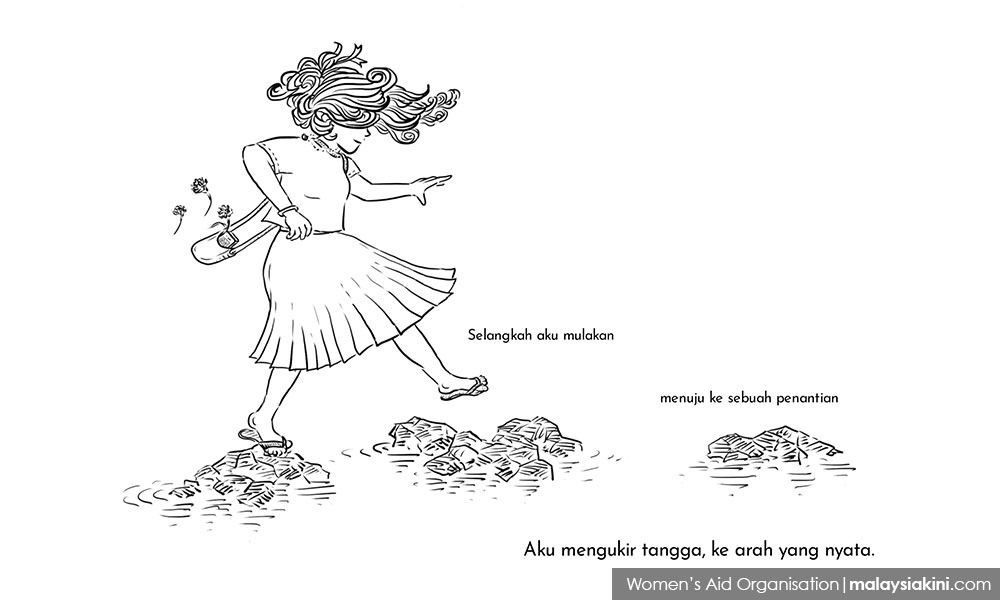
“The book focuses on the artistic rather than literal. It is not a brochure,” Chan says. “We did not want to use the typical imagery that depicts domestic violence.
“We think that using more abstract elements to deliver the underlying message would be more powerful than literal images, which can be disturbing and have more limited relatability.
“Most people ask, ‘Why don’t these women just leave their husbands?’, ‘Why is she so stupid?’, ‘Why does she still stay on?’
“But it’s more complicated than that. So many factors are at play. We can see it in their writing, some still love their husbands. Leaving is not that easy,” Chan explains.
“There are so many emotions, social pressures, making it difficult for them to make the first step.
“We want the book to reflect these conflicting views, but also the very real difficulties that are facing these women.”
Surviving depression
Having experienced a spell of depression, the bleakness faced by these survivors of domestic violence is not entirely unfamiliar to Chan.
“I am a survivor of depression, for me, I understand the hopelessness that is reflected in the writing. I can relate to it in a certain way,” she says.
When she was depressed, she felt worthless, a burden to her friends and family. Writing became a vital outlet. Her psychiatrist asked her to keep a journal, and through that, she began to realise the root cause of her condition.
Chan then took up her pen again, and began advocating for mental health awareness. She held her first solo exhibition in conjunction with suicide prevention and psychiatric organisations this year.
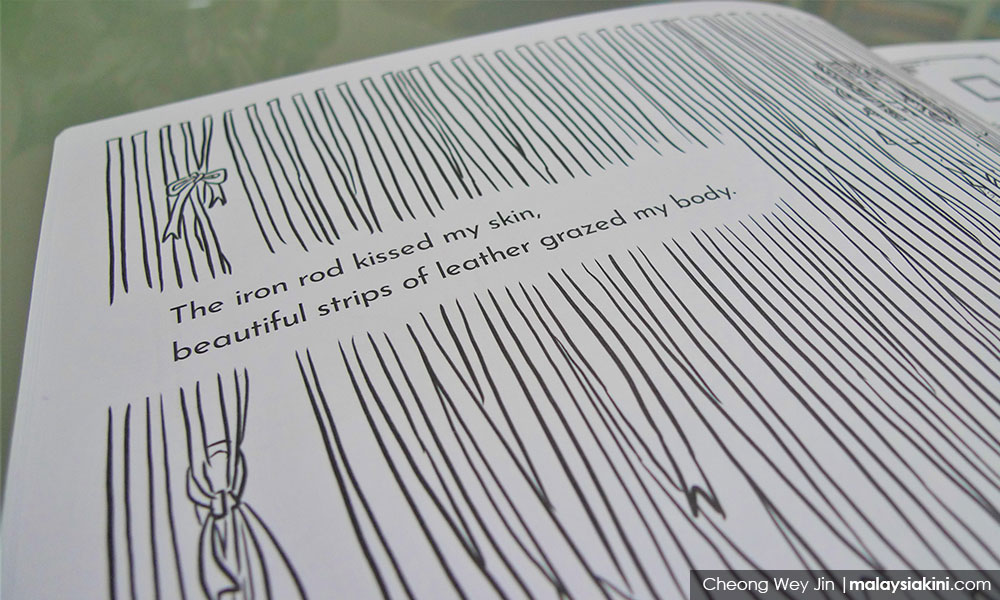
In “Tina’s Journey,” the protagonist starts off as the “ideal woman” with long, curly hair. Tina tries hard to live up to mainstream values of what is expected of a wife and a woman. But she begins to realise that this doesn’t make her equal within her family, let alone in society.
Tina’s face begins to gradually vanish, eventually not being able to see her own reflection in the mirror. She keeps her secrets in her necklace, and the curtains of soft ribbons slowly become iron bars.
After the publication of “Tina’s Journey,” some of the women from the shelter recognised their own words, and got excited. Parts of their stories were out in the world, without anyone having to speak on their behalf. For Chan, this is proof of empowerment.
But what happens to Tina in the story? As Chan explains, only after Tina writes down the reasons why “I hate him” on each ribbon, she eventually finds a sense of freedom.
NEXT
‘He didn’t allow me to smile’: A domestic violence survivor speaks out
If someone you know experiences abuse, reach out. Call the WAO Hotline at 03-7956 3488 or text ‘TINA’ at 018-988 8058.


Are you sure you want to delete this comment?
This action cannot be undone.