




ICRC: Be wary of biological attacks
The International Committee of the Red Cross (ICRC) has urged governments to tighten the regulation of biological weapons programs, saying the risk of attacks was rising as the field advanced rapidly.
The International Committee of the Red Cross (ICRC) has urged governments to tighten the regulation of biological weapons programs, saying the risk of attacks was rising as the field advanced rapidly.
While there was "huge political emphasis on terrorists, the main risk and source of an attack is still state programs," said ICRC adviser on armed violence and effects of weapons, Robin Coupland.
"We must not take our eyes off state programs as potential users and suppliers," said the Geneva-based official yesterday, while declining to name which countries were suspected of wrongdoing.
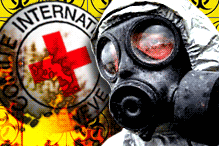 The warning came at an Asia-Pacific roundtable attended by some 40 biotechnology scientists and policy experts from 13 countries including Japan, China, Britain, the United States, Singapore and Indonesia.
Recent breakthroughs meant that existing disease agents could be altered to become more deadly, ethnically and racially specific, and easier and safer for terrorists to deliver, said ICRC regional chief Werner Kaspar.
While advances in biotechnology can benefit humanity, misuse could result in "biological weapons more effective, cheaper, more difficult to detect and hence more attractive to those with hostile intent, in violation of international law," he said.
Level playing field
Coupland told reporters that the explosive growth in knowledge about biotechnology meant that diseases such as anthrax, cholera and smallpox could now be more easily used in a bioterrorism attack.
He said countries in the West were "more likely to be the subject of an attack by a terrorist group". But "if hostility breaks out, the whole world is on a level playing field."
The ICRC also called for the strengthening of the Biological and Toxin Weapons Convention, to include codes of conduct for scientists; industry controls on dangerous pathogens; mandatory opening of scientific research facilities; and improved exchanges of information.
"Scientists in academic, industrial or military laboratories may be operating in ignorance of, or wilful disregard for, the possible uses of their work," it said in a statement.
Previous efforts to strengthen the treaty failed because some nations felt proposed regulations were too intrusive, said Peter Herby, head of the ICRC Mines-Arms Unit.
"Time is running short. Science is moving at a tremendous speed and the diplomatic process is basically frozen," he said.


