




Push govt to review restrictive laws, media told
The Human Rights Commission of Malaysia (Suhakam) is working together with the media to push for a review of existing media-related laws to allow for greater press freedom in the country.
The Human Rights Commission of Malaysia (Suhakam) is working together with the media to push for a review of existing media-related laws to allow for greater press freedom in the country.
 "Suhakam needs media support to promote and create public awareness in human rights," commissioner Prof Mohd Hamdan Adnan told
malaysiakini
after a seminar on 'Human Rights in Malaysia and Media' in Kuching today.
"Suhakam needs media support to promote and create public awareness in human rights," commissioner Prof Mohd Hamdan Adnan told
malaysiakini
after a seminar on 'Human Rights in Malaysia and Media' in Kuching today.
He said last year Suhakam submitted its recommendations to the government for a review of existing legislation, including the Printing Presses and Publications Act 1984 , the Official Secrets Act 1972 and the Internal Security Act 1960.
He said the government has yet to respond to Suhakam's recommendations but hoped that it would look at them positively.
The human rights watchdog, formed five years ago, had proposed the setting up of an independent media council with the main aim of improving the quality of the media and to introduce a code of ethics.
Sarawak-based Suhakam commissioner Dr Muhammad Hirman Ritom said it was now up to the media to follow up with the government on whether it will consider reviewing the restrictive media laws.
Bad reporting
Attributing poor reporting to bias, selectivity and sensationalism, he said the media should ensure there was no distortion and misinformation, and that the media needed to be independent and access the truth.
He urged the media to avoid the pitfalls of self-censorship.
Muhammad Hirman proposed that the media strike "a meaningful partnership" between human rights institutions and non-governmental organisations to push for the civil, political, social, cultural and economic rights agenda.
 Malaysia's independent online news organisation
Malaysiakini
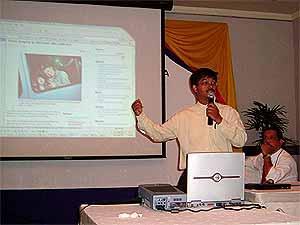
chief executive officer Premesh Chandran, who spoke at the seminar (photo), said a silent media "is a conspirator of human rights abuses".
Malaysia's independent online news organisation
Malaysiakini
chief executive officer Premesh Chandran, who spoke at the seminar (photo), said a silent media "is a conspirator of human rights abuses".
He believed that there was a need for alternative media, given a politically-owned and heavily-regulated industry, which could benefit from the evolution of communication technology.
He said advanced tools such as 3G and 4G mobile technology are now able to transmit images, facilitate live reporting and drive messages across the multi-media spectrum with speed and transparency.


