


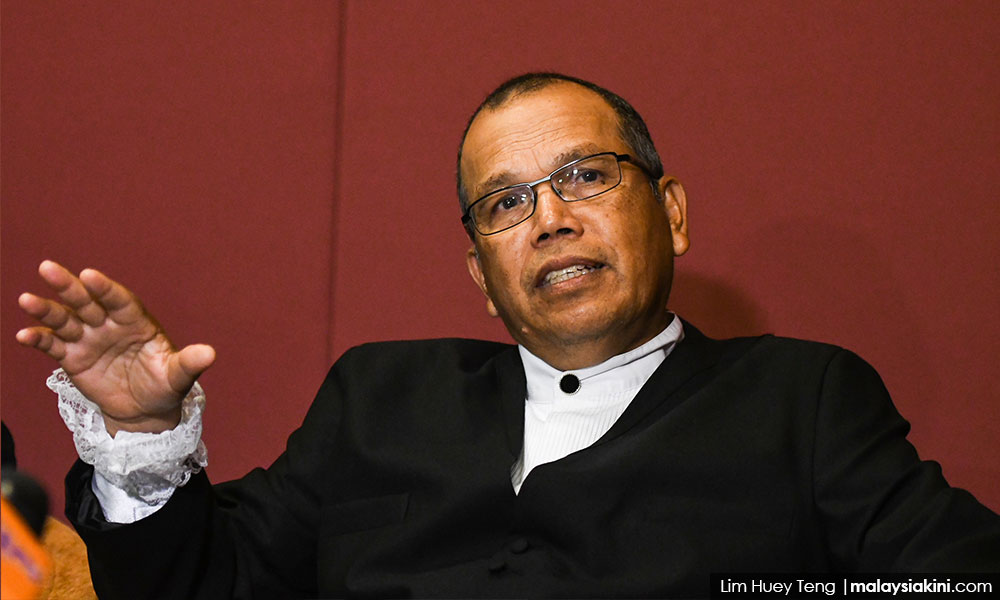

CJ: Think of victims, cut delay on child sexual crime cases
Think of the victims' rights also, Chief Justice Mohd Raus Sharif said when asked why he wanted all court cases of sexual crimes against children to be disposed within a year.
Justice Raus said while one acknowledged the rights of an accused to a fair trial, one also had to bear in mind the rights of the victim too.
“In some (child sexual crime) cases, if a case takes years, then there is a possibility the victim may not be able to recount the episode.
“If the cases take years, the victim may also want to marry but will have to relive the bad experience again in court. How would it affect the marriage?
“Hence, while courts should look after the accused rights, we have to importantly consider the rights of child sexual victims in having to testify,” he told reporters...
Think of the victims' rights also, Chief Justice Mohd Raus Sharif said when asked why he wanted all court cases of sexual crimes against children to be disposed within a year.
Justice Raus said while one acknowledged the rights of an accused to a fair trial, one also had to bear in mind the rights of the victim too.
“In some (child sexual crime) cases, if a case takes years, then there is a possibility the victim may not be able to recount the episode.
“If the cases take years, the victim may also want to marry but will have to relive the bad experience again in court. How would it affect the marriage?
“Hence, while courts should look after the accused rights, we have to importantly consider the rights of child sexual victims in having to testify,” he told reporters.
Justice Raus was asked over the haste in asking cases at the Special Court for Sexual Crimes Against Children to be disposed within a year and if the directive may affect the rights of the accused.
Since the opening of the special court last April, he said 357 cases were registered of which 287 cases had been disposed between July and December.
“In short, the court managed to dispose of 80.4 percent of its cases with 70 cases pending as of Dec 31,” he said.
Justice Raus said in 2018, the Special Court for sexual crimes will be extended in four phases where phase one will cover Sarawak, Selangor and Johor, phase two in Kedah Perlis, Kelantan and Pahang.
The third phase will be in Penang, Negeri Sembilan, and Malacca while the fourth phase in Perak and Terengganu and in Sabah as the new court complex is expected to be completed in March, there will also be the Child Sexual crimes court there.
He also announced that the judiciary intends to form a special court for human trafficking crimes by June this year.
He said the judiciary will start in Kuala Lumpur first where they would utilise one of the courts at the Jalan Duta court complex before expanding it to other states.
Prior to this, the judiciary has formed a special court specifically to cater for environment-related cases.
'Unwarranted criticism' of court judgments
Justice Raus in his speech also iterated that while the judiciary recognises the constitutional right of every citizen to challenge and test the correctness of our judgments, it must be done with respect.
“We do accept that our judgments are open to criticism by the public at large. However, this must be done constructively, respectfully and in good faith.”
“I recognise that judges are not infallible and must be open to criticism. Nevertheless, harsh and unwarranted criticism threatens the foundation of the rule of law and weakens the judiciary in the performance of its constitutional duties.
He added it is particularly important that the credibility of the courts does not suffer when it is the courts and nowhere else that the citizens could go to in order to protect their constitutional rights.
'Decline' in Bar members' standards
Justice Raus also said that the quality of the judgments by the courts is dependent on the standard of the submissions and research are done by counsel or lawyers appearing before the court.
“The Malaysian Bar must accept that there is a decline in the standard of their members appearing before the court. This must be addressed by the Bar. You cannot expect quality judgments from the judges when the judges are saddled with the poor standard of advocacy and sub-standard submissions and research,” he emphasised.
Hence, the CJ said it is important for lawyers to not only be independent but also skilful, well-educated and informed, co-operative and dedicated to serving the community, and to maintain and protect the fundamental values of justice.
He vouched that judges understand the role of an independent judiciary and the cardinal principle of separation of powers.
“This involves checks and balances between the executive, legislature, and judiciary. It is not the function of the judiciary to meddle in matters which are the responsibility of the executive and legislature.
“Similarly, we expect the executive and legislature not to meddle matters which are within the realm of the judiciary,” Justice Raus said.


Are you sure you want to delete this comment?
This action cannot be undone.