SPECIAL REPORT TV shows Malaysian Idol, Akademi Fantasia, Audition and Mentor share one common denominator. Part talent, part popularity contests, their winner is determined by the number of SMS votes he polls.
In the Malaysian Idol debut season finale, pub singer Jaclyn Victor garnered almost three-quarters of a million votes to emerge triumphant. One Malay viewer declared half-jokingly, "Do you know how much money I spent voting for Jac because I was afraid all the Malay votes would go to Dina (Faradina Mohd Nazir, runner-up)?"
She believed that Jaclyn was clearly the most outstanding among the contestants last year and in rooting for Jac, forked over a small fortune as there is no limit to the number of votes each viewer can send. Generally at more than thrice the cost of an ordinary SMS, we can do the math and see how the backers of these SMS-voting shows, not to mention the telcos, hit pay dirt!
 Interactive cross-media TV programmes have certainly caught the imagination of the Malaysian public and entire households can come to a standstill when they are aired.
Welcome to our digital era's bread and circus. In ancient Rome, emperors gave the masses a morsel of fun and games - gladiatorial fights and throwing unfortunates to the lions (the Roman arena is precursor to the circus) - as opiate to take their mind off their troubles and to keep them quiescent.
Pre-fab entertainment package
It's all about packaging, revealed Malaysian Idol finalist Norhanita Hamzah (who goes by the moniker Nita), citing judges Roslan Aziz and Fauziah Latiff. The wannabe pop stars have been packaged for bite-size consumption as media commodities. They use easy-to-remember single names like Fara, Daniel or Ash, in the footsteps of international icons the likes of Madonna, Bono or Eminem.
They are all young; the successful ones are goodlooking, pretty or cute. Some can even sing.
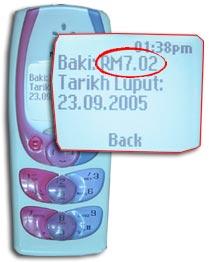 These singing shows, like soap operas, are addictive. Malaysian Idol - the show proper, result announcement and repeat - for example, run several days a week. All its time slots are magnets for endless commercials, underscoring the advertisers' firm belief that the series is drawing a large audience.
Telephony technology furthermore provides reality TV a new hook - SMS voting. As voting fans, home viewers get to become an integral part of the show's process. They rejoice and vicariously share in their favourite contestant's good fortune, as when Mawi emerged tops in Akademi Fantasia.
Pulling 58% of the 1.7 million SMS sent for the four finisher face-off, Mawi walked away with tens of thousands of ringgit, an apartment, car and European holiday. He's seen fulfilling the mini-me Malaysian Dream given that your average young man (not to mention the legions of unemployable fresh graduates) can ill-afford the above luxuries on a worker's wage.
Peripheral or hidden charges
What the fan may not be aware is that once he participates in these talent or quiz/game show programmes, he has laid bare his mobile phone to other, perhaps hidden, charges from the content provider, i.e. the number on the screen that he rings or SMSes to.
While it is admitedly true that the reality TV home participant has willingly parted with his sms money, he may also have unwittingly become a subscriber to SMS services he has no inkling that he's being charged for. While the cost of a vote is known, the possibility of becoming a paying recipient of return SMS is not mentioned or highlighted.
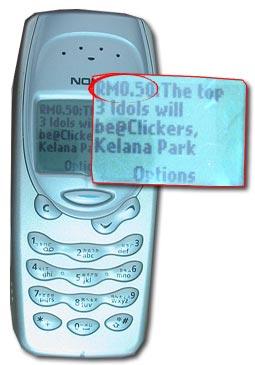 Such was the predicament which a woman, whose 12-year-old granddaughter used her mobile to send Malaysian Idol votes, found herself in. The elderly grandmother does not know how to use the SMS function and thus was oblivious to the messages from Malaysian Idol which popped up with regular frequency.
One SMS on Sept 13, prefixed with a "RM0.50" price tag, informed her that the top three "idols" would make a public appearance in Kelana Jaya the next day. Another on Sept 17 said the trio would sign autographs at the MidValley shopping mall the same day. Other SMS were trivia concerning the show. Each SMS left the hapless recipient 50 sen poorer.
Calling the Malaysian Idol content hotline number was no help as nobody picked up.
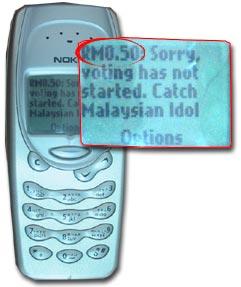
A concerned relative tried typing the word "cancel" to unsubscribe from the service foisted unawares on the 76-year-old woman. That futile attempt elicited an irrelevant "Sorry, voting has not started". To rub salt in the wound, the Malaysian Idol content provider slapped its usual 50 sen charge for the above meaningless computer-generated response.
Like spider casting its web
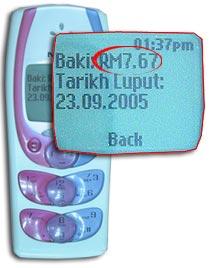
Estimates put the number of mobile phone lines in Malaysia using the pre-paid facility at about 13.5 million. Because pre-paid lacks itemised billing, users have difficulty keeping track of deductions from their credit balance. One irate user is contemplating changing his number after finding his pre-paid credit depleting suspiciously fast.
Many incautious users have downloaded a ringtone or wallpaper from external content providers advertising ubiquitously in the newspapers and online. A costly fact that slips them is that upon downloading a content (ringtone, wallpaper or other material), they trigger a mechanism which automatically enrols them as "members" or subscribers of so-called "ringtone clubs". Exorbitant monthly membership fees are then levied on their phone credit.
 Another
modus operandi
is for the content provider to send SMS in the guise of news updates, e.g. giving information on ringtones available on its playlist, and to charge the phone line an undisclosed sum for the unsolicited SMS. Other SMS offer frivolous services such as astrology readings or dodgy "let's chat" invitations, and draining away more credit.
Another
modus operandi
is for the content provider to send SMS in the guise of news updates, e.g. giving information on ringtones available on its playlist, and to charge the phone line an undisclosed sum for the unsolicited SMS. Other SMS offer frivolous services such as astrology readings or dodgy "let's chat" invitations, and draining away more credit.
While the operators make a fast buck, the victim is landed with a hefty phone bill.
According to the MCA public services and complaint department, a Maxis post-paid customer Liew Wai Keong was hit for RM1,800 in slightly over a month between Dec 17 and Jan 26 this year after his younger brother started receiving hundreds of SMS a day from a Singapore-based service provider.
"I was charged between RM1 and RM3 for each SMS which contained 'bila senang?' (when will you be you free?), 'keluar minumlah' (let's have a drink), 'boleh kawan dengan saya?' (will you be my friend?) and others.
Widespread abuse
Industry players say the abuse started in the third quarter last year and is quite significant ( The Edge , Sept 5, 2005). The newspaper also said countries which have caught on to the unscrupulous practice have banned it because of the widespread abuse.
The Malaysian Communications and Multimedia Commission (MCMC), a body regulating the communications industry, has issued a warning to the public. "MCMC views this very seriously and is working with mobile operators to eliminate such practices," said Adelina Iskandar, its head of corporate communications.
In the press release, MCMC noted that with regard to ringtone and other download, "the related terms and conditions are sometimes not clearly stated. Even if they are stated, they will be in fine print or in an odd or inconspicuous corner of the advertisement material".
Profiteering content providers have managed to come up with the most creative lures for applying their hidden runaway charges. One complainant told The Edge said after he had used an SMS service to check on his brother's national service call-up, he was billed every month subsequently.
 Thanks to the MCMC guidelines effective Aug 15, there's been a brake put on this sorry situation. Among the remedial measures is the opt-out enabler where unsuspecting subscribers can remove their names from any unwanted mailing list by keying the operative word "stop".
Another precaution against automatic registration is the confirmation requirement. Signing up for SMS membership services now has to be done in a separate step. The Malaysian Idol content provider is observing both these guidelines.
Even though the authorities have been alerted to the abuses and the telcos have pledged their cooperation to curb them, mobile users are still not fully protected from content generators. Spam - promotional mail routed through the telcos' platforms - continue to be a nuisance.
In addition to talent and quiz/game shows, viewer-participation TV has taken new forms like the Malay teen drama Trio which doles out seven-minute episodes every Monday to Friday. "Each day's episode ends with a dilemma and viewers are invited to influence the outcome of the story by voting, via SMS, for the choice you feel the characters should make," blurbed the Star on Sept 14.
We can expect more moneymaking schemes to roll off the surreal SMS assembly line.
HELEN ANG is a malaysiakini guest writer