


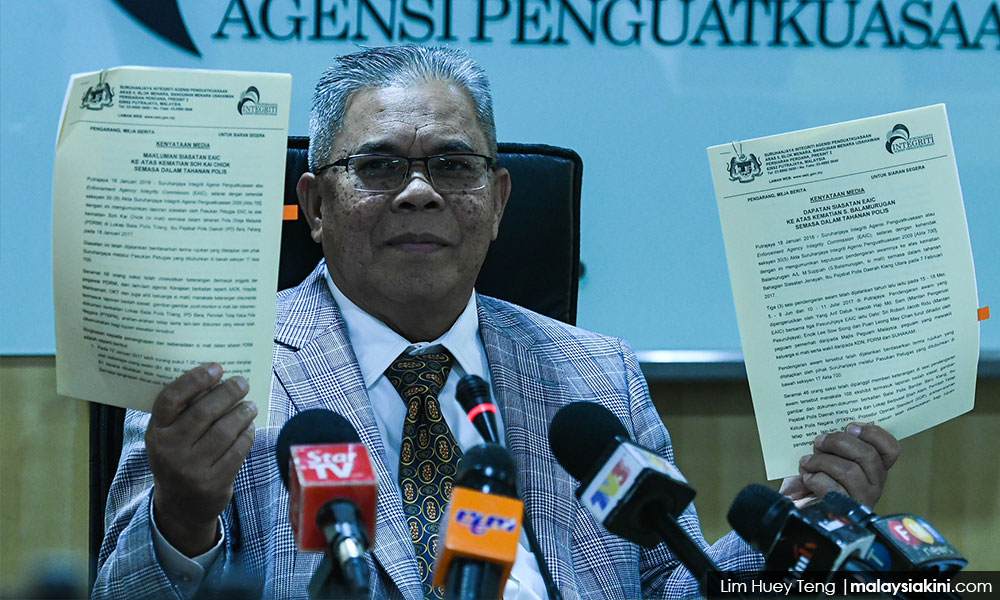

EAIC: Serious police misconduct, abuse of power in detainees' deaths
The police committed several serious breaches of conduct and abuses of power in relation to the death of detainee S Balamurugan last year, the Enforcement Agency Integrity Commission (EAIC) has found.
"The commission finds the police's failure to release the deceased after their remand order was rejected by the magistrate is a serious misconduct of not obeying the court," EAIC chief A Aziz A Rahim said.
Speaking at a press conference in Putrajaya today, Aziz said the police had also failed to comply with the magistrate's order to immediately send Balamurugan to a hospital...
The police committed several serious breaches of conduct and abuses of power in relation to the death of detainee S Balamurugan and Soh Kai Chiok last year, the Enforcement Agency Integrity Commission (EAIC) has found.
"The commission finds the police's failure to release the deceased after their remand order was rejected by the magistrate is a serious misconduct of not obeying the court," EAIC chief A Aziz A Rahim said on Balamurugan’s death.
Speaking at a press conference in Putrajaya today, Aziz said the police had also failed to comply with the magistrate's order to immediately send Balamurugan to a hospital.
The EAIC also found that two police officers, identified only as "SP46" and "SP28", had "abused their power" in ordering Balamurugan to be rearrested "without legitimate justification".
This was done on suspicion that Balamurugan may be involved in other cases, despite no police reports being furnished to justify the order.
Balamurugan was arrested and allegedly beaten at the Bandar Baru Klang police station on Feb 6, 2017, before he was taken to the Shah Alam centralised lock-up facility for a few hours, and then sent for a remand hearing at a Klang magistrate's court in the morning.
The magistrate ordered that Balamurugan be released, but he was instead held at the North Klang police district headquarters, and was found dead in the early hours of Feb 8.
According to Aziz, the EAIC has recommended prosecution against police personnel who had allegedly beaten Balamurugan, adding that one police officer has already been charged.
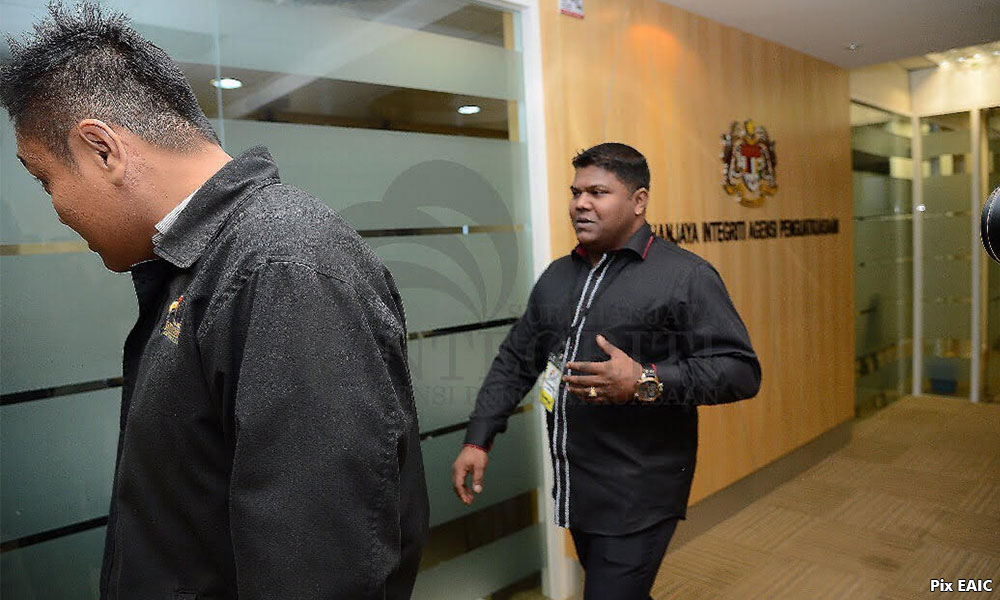
On Oct 30 last year, police inspector Mohaneswaran Thiagarajah (right in photo) claimed trial to charges of voluntarily causing hurt to Balamurugan to extort a confession.
Mohaneswaran faces up to seven years' imprisonment and a fine if convicted.
The EAIC also noted that the area at the Criminal Investigation Department of the North Klang police district headquarters, where Balamurugan was held, was used as a lock-up facility, despite not being gazetted for this purpose.
“This violates the Lock-up Procedures 1953, Prisons Act 1995, and Part A 118 of the Inspector-General of Police Standing Orders. The detention of a detainee in that space can be considered illegal detention by the police,” Aziz said.
'Serious misconduct'
As for case of Soh Kai Chiok, Aziz said the EAIC found that Soh’s death could not be directly linked to the police or any of its members.
This is because his death was caused by a perforated peptic ulcer, which a pathologist determined had developed three to four weeks before his death.
Soh was turned in to the police on Jan 12 last year by four members of the public who claimed they had caught him stealing bananas, and had beaten him with sticks and fists before binding him with a plastic rope. He died a week later, on Jan 18.
“However, over the course of its investigation, the commission has made some observations and found breaches in the existing standard operating procedures and laws,” Aziz said.
This is by failing to provide immediate medical attention when Soh complained of chest pains on the night of Jan 17, despite orders from the Triang police station chief to bring Soh for medical treatment.
He said there were also lapses by the Triang police in providing Soh with his medication, which was prescribed by the Sultan Haji Ahmad Shah Hospital on Jan 13 to treat the injuries he suffered, which included bone fractures to his left leg and arm.
This in effect aggravated his condition, and was a denial of his right to medical treatment, Aziz said.
He said the police had also violated a court order by holding Soh at the Bera police district headquarters on the night of Jan 17.
Earlier that day, Soh had claimed trial to charges of theft and self-administration of dangerous drugs, but could not pay the bond. The magistrate then ordered Soh to be held at the Bentong Prison pending his hearing.
However, as it was already 4pm and the journey to Bentong would take over an hour, the police decided to take Soh to Bera instead, and bring him to prison next morning.
“The commission finds that the police’s failure to send the deceased to Bentong Prison after the deceased failed to pay the bond is a serious misconduct because it is a violation of court orders,” he said.
Aziz said EAIC’s reports on both Balamurugan’s and Soh’s deaths will be uploaded to its website “as soon as possible.”
Recommendations to authorities
In both cases, he said, the EAIC had already forwarded its recommendations to the relevant authorities for further action, and urged them to ensure compliance with procedures.
Asked whether the EAIC’s recommendations were followed through, Aziz said this was usually the case.
“But on how quickly and to what extent, we are not sure, because most of the things that need improvement need money and allocation, whether allocations from this year or the year after. That is their internal affair.
“What we can say is that if, for example, there is a weakness in the standard operating procedure, we will recommend amendments to improve the procedures so that it is more orderly.
“We monitor that. We can ask whether it has been done, and usually it will be done,” Aziz said.
According to the Home Ministry’s statistics, there have been 257 deaths in police custody between 2002 and 2016.
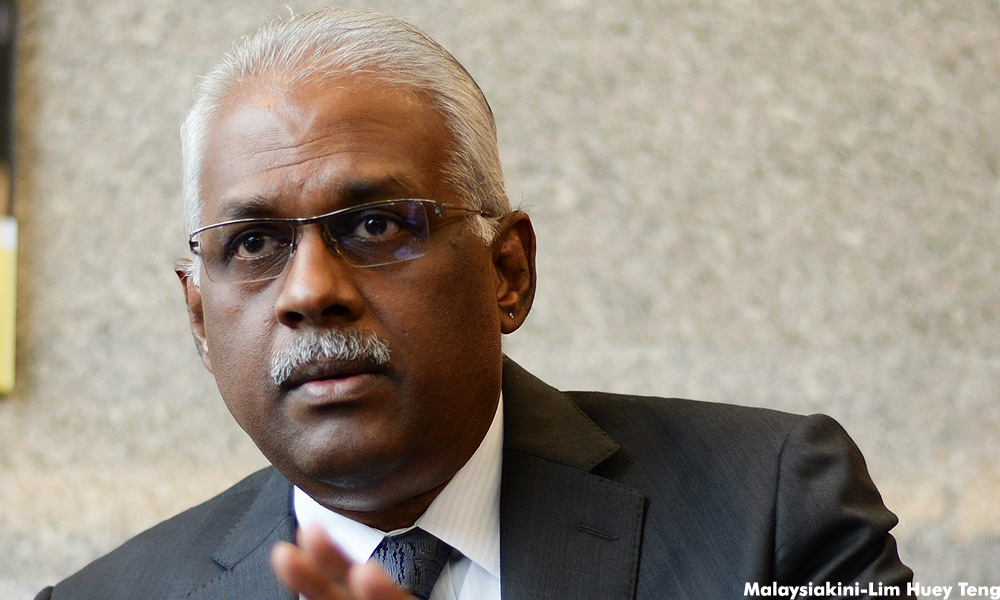
Commenting on the EAIC's findings, Klang MP Charles Santiago called for Balamurugan's death to be classified as murder.
“The findings show abuse of power and police highhandedness.
'The EAIC should be allowed to appoint a special prosecutor to commence legal proceedings against the police officers responsible for Balamurugan’s death.
“This would ensure his family has fair and efficient access to the legal process,” he said.
Santiago reminded that 1,654 people had died in police custody from 2010 till February last year.
“Balamurugan’s death cannot just be another statistic. And police officers cannot continue to be left off the hook,” he said.


Report this comment
Are you sure you want to delete this comment?
This action cannot be undone.